Home Articles Forums Gallery Marketplace Videos

WoodCentral Forums

Knowledge You Can Build On — Est. 1998

Have a question? Ask Woody!

An Easier Celtic Knot *LINK*

Posts

An Easier Celtic Knot *LINK*

#1

An Easier Celtic Knot *LINK*

David Walser

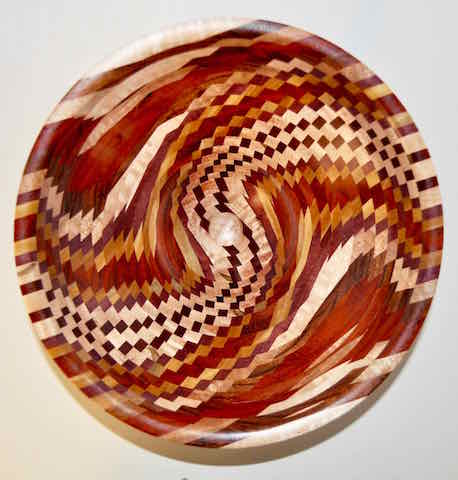
Many turners are intimidated by the thought of making a Celtic knot. It requires getting the blank perfectly square, precisely cutting slots for contrasting wood strips, and mounting the blank exactly on centers on the lathe. Such precision is why we gave up flat work and started turning!

In the linked video, Alan Stratton shows how to make a Celtic knot using a blank that has already been turned into a cylinder! Looks much easier.


Celtic Knot Dresses Up Pizza Cutter Handle

Re: An Easier Celtic Knot *LINK*

#2

Re: An Easier Celtic Knot

John C Lucas

Very interesting. Will ha e to give that a try.

Re: An Easier Celtic Knot *LINK*

#3

That's easier?

Dick Coers

Hot gluing and removing 3 sticks on the outside, and making templates to fasten to the ends sure doesn't look easier to me.

Re: An Easier Celtic Knot *LINK*

#4

Re: That's easier?

David Walser

Dick, whether it's easier or not depends on what skills you're comfortable with. To make a Celtic knot the traditional way, you need to cut a perfectly squared blank 4 times, glue in splines of a contrasting wood, and do all of that while keeping the blank perfectly square and without changing the length of the blank. If you don't start with a square blank, the knot won't be centered in the finished piece. If you don't keep the blank the same length, the parts of the knot won't line up properly in the finished piece. The traditional method requires a precision that many woodworkers find intimidating.

Alan Stratton's method may be less intimidating for some turners. I think it would be much easier for turners who want to try a Celtic knot with something other than 4 loops. (Alan's video shows a knot with three loops, but it would be just as easy to make a knot with 4 or 5 loops using his method.)

Maybe I'm wrong. Maybe the turners who've told me they find making a Celtic knot to be intimidating would find Alan's method intimidating, too. I just think it's worth a look.

Re: An Easier Celtic Knot *LINK*

#5

Re: That's easier?

Dick Coers

I've made my living making square boards for decades, that's sure not an issue. I leave the square blank a little oversized and don't cut all the way through. That eliminates the need for gluing on the extra board that this guy does. And getting all the glue residue off so he can rotate it. Maybe my technique isn't for everyone either, but definitely easier than the video. I sure don't slop on the glue while working on top of my table saw either! A piece of paper would keep those drips off the cast iron.

Re: An Easier Celtic Knot *LINK*

#6

Brad Vietje

Re: That's easier?

Brad Vietje

I don't have any way to make perfectly square stock, so I don't usually make inside-out ornaments, for example. The Stratton method looks pretty reasonable to me.

Safe spinning,

Brad Vietje

Newbury, VT

Re: An Easier Celtic Knot *LINK*

#7

Re: That's easier?

Robert Lalonde

Dick, I do it the same as you - not cutting all the way through the blank, maybe 1/8" to 3/16" shy. I also use a sled, generally 30 degrees. This method works very well and is pretty foolproof. I've not tried to use inserts other than four though but I suppose one could make 3, 5, or 6 sided blanks and go from there.

I do have the equipment and skills set necessary to make square lumber but can understand why a turner would want to use this other method if "flatwork" is not in their repertoire.

Re: An Easier Celtic Knot *LINK*

#8

Jerry Maske

Re: That's easier?

Jerry Maske

Okay, I have to ask; what's so hard about cutting a square blank? IF your saw blade is square to the table and your fence measurements are accurate, where can you go wrong? I do Square Blanks all the time for Segmented work and have no trouble at all. In fact, if I have a sharp blade, I can cut a square segment with a smooth enough edge I don't have to plane it or run it through a drum sander. I don't understand why this is an issue.

And the Celtic Knot? Now, THERE'S a beautiful piece of work. I am a Decorative knotting specialist focusing in what the Whalers did at about 1700. I make everything from key fobs to HUGE picture frames. Celtic Knotting doesn't usually work on frames since it's the way they lay up their knots loosely that makes them so beautiful. I love adding them as inlays, however. So having a skill set that allows for accurate set up and cutting makes that process easy.

And the sled is the perfect way to do it. I built a couple to use in segmented work that are perfect for the Celtic inlay.

Jerry

Re: An Easier Celtic Knot *LINK*

#9

Re: That's easier?

David Walser

Jerry -- The traditional method of squaring a piece of lumber is to joint one surface flat, hold the jointed surface against the jointer's fence to create a second flat surface that's perpendicular from the 1st. Then, run the blank through the surface planer to create a 3rd surface that's parallel to the 1st and, finally, use the table saw to trim the 4th surface flat and square/parallel to the others.

Are all these steps necessary? No. Can you accomplish the same task with just a table saw or some other tools? Sure. But, it's intimidating to a lot of woodworkers -- particularly those who don't own a jointer.

Re: An Easier Celtic Knot *LINK*

#10

Re: That's easier?

Robert Lalonde

Just like Norm taught us all those years ago.

Re: An Easier Celtic Knot *LINK*

#11

That sent a shiver up the back of my neck

Dick Coers

It's my opinion that Norm is a carpenter that happened to get a job making furniture on TV. I consider his use and then mass marketing of air nailers to be his greatest contribution to hobby woodworking. Well that and selling lots of Delta and Porter-Cable machines and tools.

Re: An Easier Celtic Knot *LINK*

#12

Re: That sent a shiver up the back of my neck

Robert Lalonde

I can't disagree with you Dick, but that's TV. That being said, as a rookie woodworker I learned a lot from him and subsequently with a lot of practice and errors got pretty good at it. I'm guessing many others did as well. This really belongs on the other message board.

PS - I don't use air nailers for furniture building. Just a lot of good strong joints, glue and a lot of clamps.