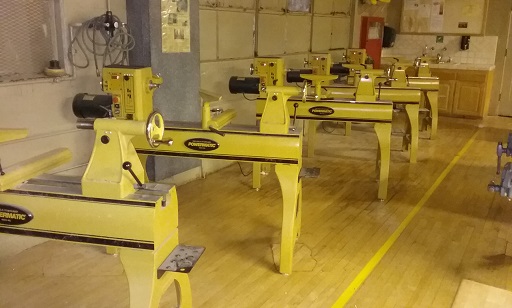
I recently purchased an used Powermatic 3520B lathe and had to fix a couple of things to make it like new.
One repair was simple and quick; the magnetic sensor for the RPM display needed to be repositioned and tightened. The other is the potentiometer (speed control) needs to be replaced because it will not allow the lathe to reach it's maximum rpm. I check the cost of the potentiometer on the Powermatic website; $68. I found a local electronic parts store and the same part is $15. Ebay is another source for various parts at reasonable cost. I just wanted to share this with anyone who might need to replace parts on their lathe or any other machine. You can usually find parts much cheaper online or other places that are local to where you live.
It's stocking and storing parts. When I worked for Xerox we often had complaints from customers about the cost of parts. I remember on foam roller was something like 16 bucks. Probably cost less than a dollar to make. However they have to stock X number of these for long periods until one is needed by the technician, and who knows how many they need to stock for future orders after that machine is discontinued.
And of course there is always the profit margin. We can always argue about that. I found the same thing with other manufacturers. The capacitor for one of my machines cost me $3 at Radio shack. It was $27 from the company.
Glad you are sharp enough to go find the aftermarket part and replace it yourself. Saves a bunch as you found out.
What speed do you get and what speed do you expect?
The potentiometer is a low-voltage/low-current thing that could be replaced without getting one specifically for the lathe. If I remember from looking at the circuit, it simply feeds a ratio to a terminal and the exact resistance value may not even be that critical.
But if possible, take it out of the circuit and test it first with a good ohm meter between the wiper terminal and the end terminals and compare it with the resistance straight across the end terminals. If you get zero resistance at one end and full resistance when the wiper is turned to the other end the pot is probably not the problem (unless it got some sawdust inside, but that can be cleaned out.) It is possible it is a programming parameter in the VFD that could be tweaked.
BTW, the question about how much speed is needed is a good one. My take: it depends on the kind of turning you do. Bowls and large things are one thing. But for those of us who turn spindles and small things the high speed is very much desired. I turn MANY things at the maximum speed, about 3200 rpm on my Jet 1642 lathes. There are several very good reasons for this.
I always like to read where someone works around the parts system to get their machine working. What I wish though, was a way to keep those stock parts in some kind of file where everyone could look them up. I recently spent $16 to get a used switch off Ebay to see if the parts could be used to repair a Minimax switch that they want $379 for. It's looking promising, but will wait for the complete failure of the factory switch before going in for the replacement attempt. I've had to call in a friend though, I just don't have great confidence with electrical work.
When I was looking at new lathes one of the considerations was the Nova DVR since I was using a Nova 3000 and had owned a Nova Comet. Both were excellent lathes. I was scared of the one of kind motor and electronics of the DVR. On the Powermatic there isn't anything that can go wrong that you can't either replace with aftermarket parts or have a good machinist repair. So I figure it will last me a lifetime.
John raises a very good point about one off designs and very unique parts, peculiar to one make / model.
Don't expect to get parts for some machines too long into the future. We had a potentiometer fail on a Nova Mercury or so we thought. Took it to a specialist power tool repairer I trusted, turned out it was the variable speed unit itself had failed. Couldn't source any parts from stockists in Oz or NZ and enquiries to the Chinese technical staff, whilst prompt they were not very encouraging. Basically the reply sorry its an old lathe, discontinued design, no longer carry parts. It was 7 yo at the time.
So generic may be good but they importers rarely carry any parts inventory, at least that is the case here from the few times I have attempted to source parts.
>I want the lathe to work as designed. 3200 rpm is the maximum
>speed on the high speed pulley. Currently my lathe will only go to 1800rpm
Yikes! Something is seriously wrong. I hate to ask the obvious and don't intend to second guess you, but are you SURE the belt is on the right pulley? My Jet runs at about 1800 or so with the belt on the smaller motor pulley/larger spindle pulley. The high speed is with the larger motor pulley/smaller spindle pulley.
What is the maximum speed when it is on the other pulleys?
If the belt is on the correct pulley, does it smoothly speed up to 1800 when you turn the control all the way through the range, or does it turn up to 1800 half way through the range then stay at that 1800 even when the control is turned further?
Another question about the pot: can the knob be turned most of the way around or does it physically stop about 1/2 of one full revolution? (mechanical issue?)
If it is on the correct pulley AND it uses the entire range of the pot, then I would take a look at the parameters in the VFD. Someone may have messed with the frequency parameters to limit the speed for some reason.
Do you have a handheld optical tachometer to test the speed? (You put a bit of reflective tape on the spindle to read the speed.) I can imagine an issue with the electronics where it is reporting a speed in error. But this is unlikely if you are familiar with what 3200 rpm sounds like! Just a thought.
John, the lathe won't reach the maximum RPM on either pulley. On the high side it is only 1800 rpm; on the low side it is about 800rpm. Design parameters should be 3200 & 1200 rpm respectively. The speed control turns all the way but it does not seem to increase the speed in proportion the amount it is rotated. (if that makes sense). I called PM tech support and the guy suggested it is probably the speed control (potentiometer). I also checked to make sure the pulleys were not loose on the shaft and slipping. I don't have a tachometer but it does not look like the RPM reading is wrong.
Then (if you want to figure this out before buying parts in case they will fix it) I would definitely test the potentiometer. Not knowing your level of experience here, I'm assuming nothing. Do you have a multimeter and know how to measure voltage and resistance? If not, do you know someone who does who could look at it?
If you are comfortable with sich things, you can access the pot, switch, etc by removing a front panel. The pot and other controls you see are low voltage signals but there is dangerous AC voltage inside going to the tach module. Look at Doc Green's excellent web site with diagrams, photos, and instructions.
The circuit diagram shows a 5000 ohm pot connected between +10 volts and ground. The wiper provides a voltage between 0 and 10 volts. The VFD proportionally sets the speed based on this voltage.
The first thing I would do is see of ALL connections are tight, the wires going to the pot and all screws connecting all wires to the VFD inside the cover. (check these with the power off) A loose connection here could cause a high resistance and really screw up the speed.
I would temporarily disconnect the wires from the pot either at the terminals or pull them off, if the wires have push on connectors. Measure the resistance across the pot (should be 5k) then between one end terminal and the wiper as you rotate the control. The resistance should change from zero to 5k.
If the resistance is right and the wires connected tightly, I would next check for continuity from the pot terminals and all three terminal screws. (with power off). Then check for voltage at the 10v terminal AND at the pot. (with power on). Then check the voltage at the pot wiper as the control is rotated. It should change between zero and 10 volts.
If any of these thins are not right it should identify the problem. If all the connections and resistances and voltages are right then maybe something is funny in the VFD.
All this should only take maybe 5 minutes to test. If you are not fluent with wires and voltages and such, perhaps a kind friend would take a look. If you lived close by I'd gladly look at it. Where do you live?
Sorry, I had to write this in a bit of a rush. My iPad battery is almost dead and I don't have time to even check what I wrote! Prob has lots of typos...
John; thanks for all the info. Yes, I have a multimeter and know how to check ohms & voltage. I'll test the potentiometer as you described. The link to Doc Greens site is very helpful. I've already ordered a new potentiometer based on a recommendation from Powermatic's tech support. Only $16. FYI; I'm in Southern California.
If the pot turns out to be OK, you might look at the VFD parameters to see if one got changed. Most (all?) VFDs have a maximum frequency parameter to prevent the motor from going too fast and if this got altered by some unknown mechanism, it would limit the motor speed. It may be 60 or set to another parameter relating to power-line frequency which typically is the fast running speed for a motor.
Did you get any settings info with the machine that you can run through?
I've read a couple of posts from a couple of forums, talking about random VFD change possibilities. Is it really a possibility that can happen? Don't you have to go in and make a deliberate effort to change it? And don't you have to hit some button to enter the change? Except for maybe two resets, I haven't touched the VFD on my Oneway in 18 years. And, it never has randomly changed itself. I'm not an electrical guy, just wondering.
>...random VFD change possibilities. Is it really a possibility that can happen?
Many years ago it wasn't all that unusual for even non-volatile memory to glitch occasionally, although not as likely as dynamic memory. It was reported that even a stray cosmic ray could change memory contents.
I have not kept up with the technology but I have the impression that the electrically alterable memory used today in everything from flash drives to ipads to VFDs is much more robust. A brief check with Sir Google indicates some technologies are less robust than others although, for example in gamma ray tolerance.
Memory corruption, however, is almost always due to software issues. I can imagine something like a power spike might change a parameter in a memory location, perhaps one weak from a manufacturing defect. Further research and a survey of reported cases (if the previous and changed values were recorded) might shed some light on things if such cases were common. But that sounds like a lot of work...
Even a romote possibility of a problem like that is what made the computer analyst in me write down all the factory settings on my VFD! Call me Mr Paranoid.
No, it shouldn't happen and it hasn't happen to my General's VFD in about 18 years either but it is an electronic box and things happen.
Since that parameter can affect the maximum speed it should be looked at and if wrong, putting it back to the correct value may fix it. If it doesn't remain at the correct value then the VFD needs servicing/replacing.