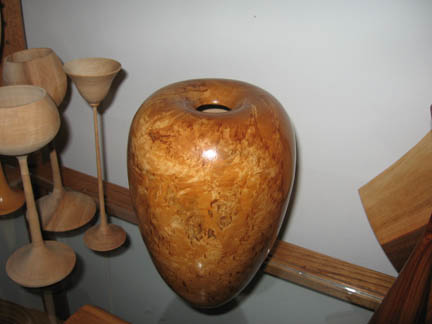
I see all manner of discussion on facebook of what to do to "save" a rough turned object or block of wood with multiple checks or cracks from wood movement during drying. I'm not referring to filling voids or bark inclusions -- perfectly fine -- but highlighting the evidence that someone doesn't know how to handle green wood.
My typical response is to burn it or cut it into small spindle/pen blanks between the cracks, followed by a quote from John Jordan about life being too short to turn crappy wood. Usually there are 100 knuckleheads advocating CA or epoxy for every voice of reason (and experience). I try to be gentle & supportive, even suggesting alternate sources of perfectly sound wood, but not everyone plays nice on-line, and there's always a risk of friction or hurt feelings when the clueless start passing out bad advice or trying for a Darwin Award.
Quite aside from all the dangers of exploding wood spinning at 1800 RPM (I typically refer them to Lynn Yamaguchi's blog about that), I gotta say, I find absolutely nothing attractive about multiple cracks filled with turquoise, brass filings, etc..., again, because it just points out that the "artist": doesn't know squat about seasoning wood. I'd take one filled with gold, but only if I could burn it to then cash in on the precious little blobs harvested from the ashes
Thoughts? Opinions? Anybody like these end-checked masterpieces? I'd love to see an example that I would want on my mantelpiece.
I agree. Many people refuse to take a blank that has cracks and turn away the cracks. You end up with a smaller bowl but a much more attractive one. When I have wood that is cracked in my wood pile I cut it through the crack and turn those blanks into smaller box or spindle blanks.
I have done my fair share of crack repair over the years but now I try my best to avoid them. The main reason is a crack still looks like a crack. You can't hide them and it's always possible they will open up over the years. Glue won't hold them forever.
I do understand that new tuners have trouble finding wood, and there is definitely a learning curve to saving bowl blanks and then turning the wood to avoid checks. However it's worth spending the time to do it.
Brad, I'm with you and John. When I first started turning I used a tremendous amount of CA "fixing" bad wood. Now it makes me cringe to see some of the "fixes" done by other woodtuurners That being said, last year I had a large piece of Monkey Puzzle that was cracked all to hell. After a class with Kelly Dunn, where he told me about a bowl he made with 39 "piwas", the challenge was on. I finish turned the outside, then installed the piwas to make it structurally sound enough to turn the inside. It ended up with 29 piwas, 12" diameter, 6.5" high, 1/8" walls, 1/4" bottom, and I love it. Probably won't try another one.
That's why I only turn green wood. I choose to not have any cracks in my final product. There are three rules. Make a uniform wall thickness, make sure there are no cracks in the wood before I start, and never have the pith in it. These three rules will prevent any cracking.
Adrien, go to www.bigislandengraving.com and go to the repair/inlay section, and they will tell you everything you ever want to know. I have no connection with them except to use their services and products, and have never had anything but the best service and advice. Highly recommended by me. If you have other questions, feel free to email me.
.."heal" a crack and keep it from moving as humidity levels change. Same with filling cracks with Inlace or minerals, the future wood movement will cause irregular edges as the wood moves, but the filler is static.
Hey Brad, Agreed. So many times I have had turners bring wood to a class that was so badly cracked that I refused to let them turn it. Needless to say they were not happy. The combination of crappy wood and new or inexperienced turner can lead to disaster. I did recently use a butterfly in an otherwise sound bowl that had a honeycombed section, but there was no risk of it coming apart.
I take exception to your holier than thou attitude about the artist not knowing anything about seasoning wood. In the dry climate I am from, the wood we get tends to split before it hits the ground. Unless you can get it cut and sealed within about 3 days of when it is felled, it is going to split. Turning green is not always an option when you lave limited species to start with, then add the dry climate on top of it.
There are times when split wood is just that, split wood and needs to go. However, there are times I personally think a crack becomes interesting. I have had a lot of success with a mesquite/turquoise combination. I personally don't like the butterfly patch look that some people use, but that is just that, my opinion. If they like it and it works for them, fantastic.
You don't have to like filled cracks. There are a lot of things I haven't liked that others do, and vice versa...different strokes and that is great. That being said, don't presume that because I turn something cracked or work a certain way that I don't know what I am doing.
I tend to agree with you. Most of the time it isn't worth the time or risk involved. I have seen some folks turn cracks in their piece into epoxy filled trees that look quite stunning if done well. I guess I tend to like the pieces where I either don't realize there was a crack or the crack is left alone.
However, I don't have any bias against using epoxy, etc as a design element. I do enjoy pieces where the colored non-wood material is a main element (along with the wood/pods/rice/coffee/acorns/foil/sticks/pencils/etc) rather than just a crack fix.
Looks like you hit a nerve. Lots of "heavy hitters"responding. Mostly I agree with other posts but have been known to fill a crack or two which I thought warranted the effort.
I would like to have an additional conversation on what we tell the newbie who just hast to use such wood. I know on the few occasions I have turned cracked wood I have either wrapped the outside with filament tape or stretch film before turning the interior to contain the piece, if it does come apart. I am sure there are those who will have something to say about that.
The question for me is, is it enough to say"just don't do it" or should the more experienced among us offer constructive ideas on safer ways to do it, if they insist.
Interesting thread. I turn lots of dry wood, hell, we all do one way or another. If you twice turn a bowl, or platter you are turning dry wood. If you turn kiln dried or air dried wood, you are turning dry wood. Cracks? Sure they happen. Personally, I don't like super glue or CA or whatever you call it ... except when used like Ted Sokolowski does.
Also, I am in the process of turning another couple hundred spheres. SOme of these are in exotic woods (marble wood, black and white ebony, African Blackwood, zebra wood, etc.) and the blanks are roughed out and set aside for up to a year to further dry. Even at that, when turned to final dimensions, some of them develop hairline surface cracks after being finished. Usually within a month or so. So, I fill them with copper powder ala Sokoloski. Customers snap them up, even after I tell them that the fix may not last.
And yes, I have let some spheres set up to 18 months and they still develop hairline cracks.
Down here in Central and South Florida, our weather is a little different from yours. I got into bowl turning very heavily in 2004 when we had not one but two hurricanes hit us in three weeks and de-roofed 25,000 homes and knocked down 100 times more trees, and I spent 15 to 18 months salvaging as much wood as possible. Because our humidity can change as much as 20 points overnight and does it very often in the "winter", I quickly learned that the only way to preserve rough-turned bowl blanks was to rough turn to one inch, and put them in 20# paper grocery bags and fill the bag with wood chips. A dependable form to allow the moisture in the wood to migrate out of the bag. Each bag was marked with the type of wood, date it was rough-turned, weight in pounds and ounces and was weighed at the end of each week. It was amazing how quickly some of these blanks dried. Not meaning to brag, but even as a rookie, I only lost two bowls in two years and one of those was a walnut blank from up north somewhere. I know your weather is very different up there, but wrapping rough-turned in their own wood chips is a very dependable method to avoid those nasty cracks!
Jamie. there are a lot of bowls turned from tropical woods that will flex with the humidity without separating from good glue repairs or fillers. That is something that has always amazed me.Your very dense hardwoods up there are totally different from our tropical woods that must be flexible to survive our constant storms, I guess.
I am in the camp that simply does does not like the look of cracks filled with contrasting colors regardless of why they are in there. I have no problem with anyone else liking them.
I do like natural voids, bark inclusions, and natural edges as well as carvings, piercing, texturing, grooves, and other enhancements, perhaps filled, perhaps not.
It's good that not everyone likes the same thing. Life would not be nearly as interesting.
The question is how do you educate the uninformed? There is no hard and fast rule/guideline that we can quote chapter and verse.
What we do have is our personal experiences that have given us a sense of judgement as to when a blank is unfit for turning. Period.
My thoughts: You have used your best judgment in getting to the place you are now at as a turner. And you have survived. How did you get there. On the backs of others who have shared their experiences with you and your attempts to harness their experiences to your type of turning. This is called education. Sometimes formal and most of the time informal. Other than Jordan who else takes that position? How did he come to this position? My answer would be he was told by someone or he tried a couple or hundres cracked pieces and thought better of those experiences.
My thoughts are that the beginner needs to hear that there is a discussion and the RISKS involved. If we do not involve both side of the issue then they discover it by accident and someone gets hurt.
EVEN IF YOU FILL OR GLUE OR ENHANCE THE CHECK OR CRACK IT IS NOT A 100% FIX. The check or crack is a flaw and can have hidden itself throughout the piece. If there is one there is likely to be others that will bite you later. There could be a demo in this: "When is the blank just a piece of firewood?" OR "Can you tell the masterpiece from the firewood?" The what, where, when and how a blank checks or cracks. With examples. Why you turn it into firewood. Safety first. What happens when it explodes.
OK I know on the internet is very easy to read something and get your hackles up. That's not intended in most cases. What we are trying to do is educate. John Jordan came up with that saying after realizing that if you simply start with a good piece of wood turning is so much more fun. You have so many more options on shape, orientation of the figure and color in the wood and it's just a lot easier and safer to turn.
How do you do that. Well first of all try your best to find get fresh cut wood. Seal the ends immediately and get the wood out of the wind and sun. I've had Cherry start to crack while I load it in the truck which is why I started trying to seal the ends first. Anchorseal works great but is messy. I just wrap a plastic bag around the end until I get back home and use the Anchorseal. Most woods don't crack that fast and you can get them home.
Leave them as long as you can. Much harder as we get older and certainly if the log is large. Much more important is to get them out of the sun and wind. Put a tarp over them or put them under a building. That slows the drying tremedously which really helps the checking.
OK now your ready to cut a blank. Usually the end of the log has checks. Cut them off. When you think you have cut another 3/4" slice and try to break it. If it still has checks that are hard to see it will break. When you get one that doesn't cut your bowl or hollow vessel blank.
OK lets say all your wood was cut into fireplace size lengths and left out in a pile. This wood will start to check at both ends and if left for any time will start to split end for end. Most of the time you simply have to make much smaller bowls or maybe boxes to use this wood without the checks. If you cut off a section and then split it at the crack you may get at least half of it usable. I will often take a log like that and bandsaw it through the crack to see what I get. If it won't do bowl blanks then I cut it down into spindle blanks as large as I can. 4x4, 3x3, 2x2 etc. seal the ends with wax or anchorseal and put these up to dry.
Most of this discussion seems to concern wet wood.
Turning wet wood is a lot of fun but most of what I turn is dry wood. I don't like dealing with cracks and like round things to stay round. Much of the wood I'm using now I cut from the logs long ago, some air drying for over 10 years now, mostly spindle blanks, lots for end-grain boxes, small bowls, etc.
In case anyone who mostly turns wet wood is interested, this is how I process logs specifically to get dry turning blanks with very little loss. (Processing into smaller pieces while green relieves much of the stress that can destroy wood, especially species with high T/R ratios.)
- protect the wood as Sir Lucas recommends and process as soon as possible
- remove obvious defects, cut a few shorter segments from a long log
- seal the log ends of what I can't process in the next hour or so
- rip log down through the pith, along a defect if present (I rip under 12" with bandsaw, otherwise chainsaw)
- cut into a variety of turning squares on the bandsaw (1x1 to 4x4 or bigger)
- mark any obvious remaining defects with a red marker
- seal the end grain and any wild grain
- seal around heartwood in problem species (like dogwood or persimmon)
- write the species and date on each batch
- stack with airflow to dry, usually on wire shelves
I let these dry for a few years or more. Then I take each blank back to the bandsaw and usually slice off a little bit from each side and end. This does three things: one, it reveals any cracks that have developed so I can remove them, two, it squares up the blank and cuts away major warping (e.g. in persimmon and dogwood), and three, it lets me better see the color and figure in the blank.
If the dried blank has split cracked significantly, I rip on or close to the crack and re-evaluate. Sometimes I can get smaller squares and sometimes it goes into the scrap barrel. (BTW, neighbors love these barrels full of kindling!)
At this stage, I always slice off a little of the end grain and flex the offcut to check for cracks and checks, often hidden. I take off just enough to square the end, maybe only 1/8" or so. If the offcut breaks I cut another thin slice until I get down to good wood. The slices from the sides are also checked for cracks.
Sometimes there is enough good wood to keep the blank although minor cracks remain, typically down the sides or edges, sometimes where it will probably be turned off. In this case I mark the crack with a bright red Sharpie. This way I won't be surprised when I turn that block later.
If the wood is not completely dry (I check with a meter) I reseal the end grain. I always re-write the species and date on each piece since I hate to try to guess later.
This can make things SO much more predictable when turning years later. A big advantage is I usually end up with far more dry turning squares than I can use so I always have wood to share - come visit!
When I saw logs I also cut some thick boards and slabs and let them air dry for years before resawing into bowl and spindle blanks. When we did the children's woodturning class a few weeks ago it was so easy to cut and bring a big tub full of dry cherry and walnut spindle blanks. Life is good!
>I've had Cherry start to crack while I load it in the truck
>which is why I started trying to seal the ends first.
What surprised me at first is how different trees from the same species can be! I've experienced the instant-crack fruitwood, but one particularly large cherry tree was amazing - it simply refused to crack! I left some big chunks sitting out in partial sun without sealer and still no cracks, although I did see some minor checking on the end grain after about 6 years.
BTW, Anchorseal is expensive when bought by the gallon at Woodcraft. It is so much cheaper in quantity. I bought a 55 gal drum years ago, shared and sold most of it, and still have a bunch left. When I run out of that I might check into a 5 gallon bucket.
Brad and others mentioned pretty much nailed it talking the folly of trying to save ugly cracked bowls. Besides safety issues inherent with that task comes down to are you working smarter or harder.
Unfortunately had to learn the hard way, and ended up throwing those attempts away. Other than boring people explaining my efforts really have nothing to put on a mantle, brag about or ready to sell! Now days when it the point of demenision returns with a piece of wood I stop!
Re: What's the best way to deal with these cracks?
robo hippy
I liked a response a year or two from Steve about cracked pieces of wood, and I use it when ever I am talking about safety. There was an accident where the turner got hit by a big chunk that came off, and his wife found him on the floor in a pool of blood. He survived. At one of the clubs next meetings, there was a 'high risk' piece of wood in the raffle, and several turners were standing around discussing various methods to fill and turn the piece of wood. Steve's comments were some thing like 'Are you guys crazy? That piece is almost exactly like the one that almost killed 'Charlie' (or what ever the turner's name was). More discussion was had, and the conclusion was that maybe 20% of the turners in the club were capable of turning a piece like that SAFELY. Fire place works for me...
OOPS! I certainly didn't mean to insult anyone, so thanks to Dale for pointing out a different angle.
On facebook there are a stunning number of absolute beginners that are very quick to dole out advice as if they actually know something about turning, while their advice and some of their turning photos convince me that they really ought to learn more before feeling qualified to give advice -- especially when they are egging on another novice to do something truly dangerous. THAT's what I'm really referring to here -- the inexperienced trying to lead the blind.
I didn't mean to come off high & mighty at all, but I did want to express my personal preference for well-turned work without what I consider to be unsightly cracks. I certainly acknowledge that I am SO lucky to be surrounded by miles and miles and even more miles of trees of a pretty wide variety, so turning stock is real easy to find around here. What I hear from turners I have met at regional/national meetings is that with some diligence, they have found good sources of wood, too.
Good wood may not be easy to find for everyone here, but here's a universal truth someone else here (Keith?) already pointed out: mixing badly cracked wood with novice turning skills is a recipe for serious injury.
I'm not trying to come down on someone else's sense of accomplishment or pride in their work, but when they are doing something that looks dangerous to me, I don't -- and won't -- mind saying so.
John, I agree completely, but I also try to be careful about one little detail.
You wrote: Leave them as long as you can. I'm sure most people here understand your meaning, but a few novice turners (or beginners with green wood) mistake that good advice, and think they need to try to dry the wood as long as possible in log form -- pretty much guaranteeing cracks/failures. Thus, I'm careful about using that phrase.
I usually say rough turn ASAP, but if you can't get to it for a few weeks (or even months) keep the wood in log section or the biggest chunks you can manage, so you minimize losses at the exposed ends.
I'm always seeing novices who just scored their first good-sized hunk of fresh wood from a tree cut in the neighborhood, and they want to know how long they need to dry it before they can try turning it. i say turn it as soon as you can find a way to mount it on your lathe! (and get ahold of a copy of Turning Green Wood, by Michael O'Donnell).
Anyway, we're all pulling on the same rope here...