I don't use very much figured woods because I simply don't have them. In that case what do you do. For example on boxes highly figured or very colorful woods will stand on their own if they have a good shape. However when the wood is very plain something else usually needs to be done. Texturing, fluting, carving, burning, or some other form of embellishment is usually required to make it stand out from the crowd.
there are purely functional pieces like a spoon, bowl or rolling pin in which plain woods are acceptable and maybe desirable.
I got into segmented work early on because all I had access to were plain woods and usually not over 3/4" thick. Adding contrasting colored woods sort of gave me the look of exotic woods or burls.
I use plain wood to make prototypes so that when I get to the Pink Ivory or Snakewood or etc. I know that the shape is good and (more importantly) the process will work. Centering, gluing the next layer, etc. is critical.
I once did a series of bowls using first scrap and pine, then scrap and hard, then hard. Only by the fifth try was I ready to attempt what I wanted. I had to find a way to get the center of the layered ring close enough to center (perfectly) so that there was no discernable difference in the ring (in the finished bowl) no matter which side was looked at. It turned out that it had to be centered within 1/64". Here's a pic of the final result.
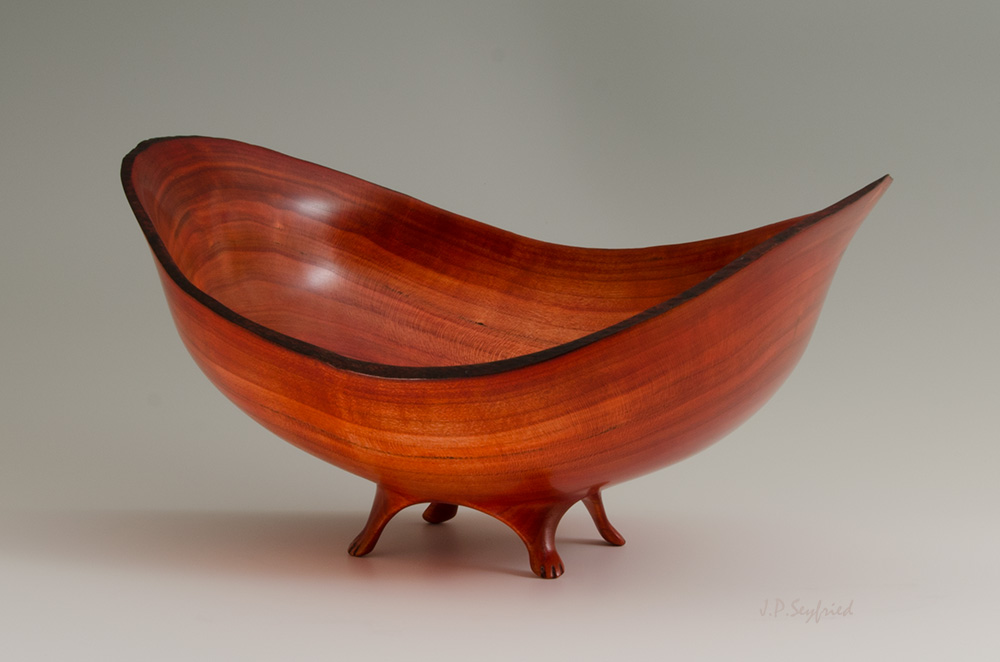
I turn mostly fallen trees, sometimes I procrastinate long enough it spalts and I also embellish by torching, dying and a little carving like I did with this cherry bowl.
The first bowl might be considered boring cherry but changing the shape and leaving some bark on, works for me.
This second bowl is far from be non-figured but the concept of turning a N/E end grain bowl could work with non-figured wood, at least in my way of thinking
I've done it 2 ways. I put a 2" sanding disc in my drill chuck and put that in the headstock and simply sanded flats. It goes faster on my 12" disc sander but I have a courser grit on that and it leaves little sanding lines.
Here are some photos of other boxes I did. On one I used an ink brayer to roll ink on the high spots. The other was burned with a propane torch.
Being an old retired phart, I can't do this kind of stuff any more, but I can assure each and every one of you that your ideas will inspire many, many new turners who can't seem to come up with new ideas. You are all to be praised for allowing us all to see your ideas, whether simple or complex, as we know they come from the heart, which is what makes Wood Central so remarkable!!!








 Well, you asked!


 You are all to be praised for allowing us all to see your ideas, whether simple or complex, as we know they come from the heart, which is what makes Wood Central so remarkable!!!


