My cousin is in the landscaping business and she has acquired a persimmon log about ten inches in diameter. She wants me to turn a bowl form it as a gift for the land owner from whence came the tree. Apparently there was some history involved with the tree and taking it down and she wants him to have a reminder, forever.
She says the wood is white, all the way through. The only persimmon I have ever seen was in the heads of golf clubs. Did not know it was white.
I expect it is as hard as woodpecker's lips, but other than that have nothing to go on. Any advice?
Turns like a dream. It will hold incredible detail. The stock I turned didn't seem much harder to work than hard maple. It likes to check really quickly in log form. I think it's really bland unless you get some black streaks that sometimes occur.
I have turned a bunch of persimmon: boxes, bowls, tops, wands, goblets, decorative handles. All my persimmon comes from downed trees on my property an occasional one that has to be removed.
Persimmon is part of the ebony family, sometimes called White Ebony. It is in fact hard and heavy, giving objects a nice feel. I once made a pencil holder from persimmon for a friend with limited mobility - the weight and wide base kept it upright when bumped. Persimmon trees used to be quite valuable for the golf club industry - one guy told me buyers would come and make offers on trees.
Although the grain may look coarse in places the wood cuts smooth as glass with sharp tools. (Of course, who here doesn't use sharp tools.)
The persimmon I have varies widely. Some is very white, some has great darker streaks and variation in color and figure. (I left some persimmon firewood on the ground once and the wood with bug hole is to die for! Figuratively speaking.)
Persimmon seems pretty stable once dried - the lids on some turned boxes always fit nicely. Most of the boards I have on hand are between 2-3" thick and have been air drying for 5 to 9 years and while warped, are very stable now. I also keep a supply of dry turning blocks, 4" and smaller.
Persimmon can warp and split horribly, especially near the pith. The pith is usually a thin line of jet black, sometimes with interesting variation. (I remember the King of WoodCentral mentioning once that he once had some with larger pith and would like to find more, but I have never seen that here.) I have not been able to prevent splitting near the pith even with lots of anchor seal. I don't see checking or splits when away from the pith.
Some of the first persimmon boards and slabs I cut on my sawmill twisted and bowed more than anything else I've seen. It is much better away from the pith but even then I see major cupping on even thick 6" boards.
If turning a bowl intended to stay round, I would rough turn thick and let it get good and dry before finishing. I haven't done a natural-edged green bowl but it might be fun.
It is very easy wood to turn, but in addition to checking easily it will warp like a fruit wood. Be sure to leave it thick enough if you are double turning. I usually have about a 95% success rate at preventing checking in rough turned blanks, but persimmon seems to be more in the 60%. Turn a few extra and hopefully you will get at least one.
My favorite story to tell about this wood involves my daughter. I had gotten a small tree, maybe 10 inch diameter, and was turning some bowls. It had a really bitter, kind of rubber tire smell to it. My daughter wanted to gross me out and licked my arm. Well, she got a tongue loaded with persimmon tree juice, and from the horrible faces she made, it must have been really bitter.... I haven't seen any with the colors John showed, most of what I have seen is white, with a tiny black pith. Aged, it has grey streaks in it.
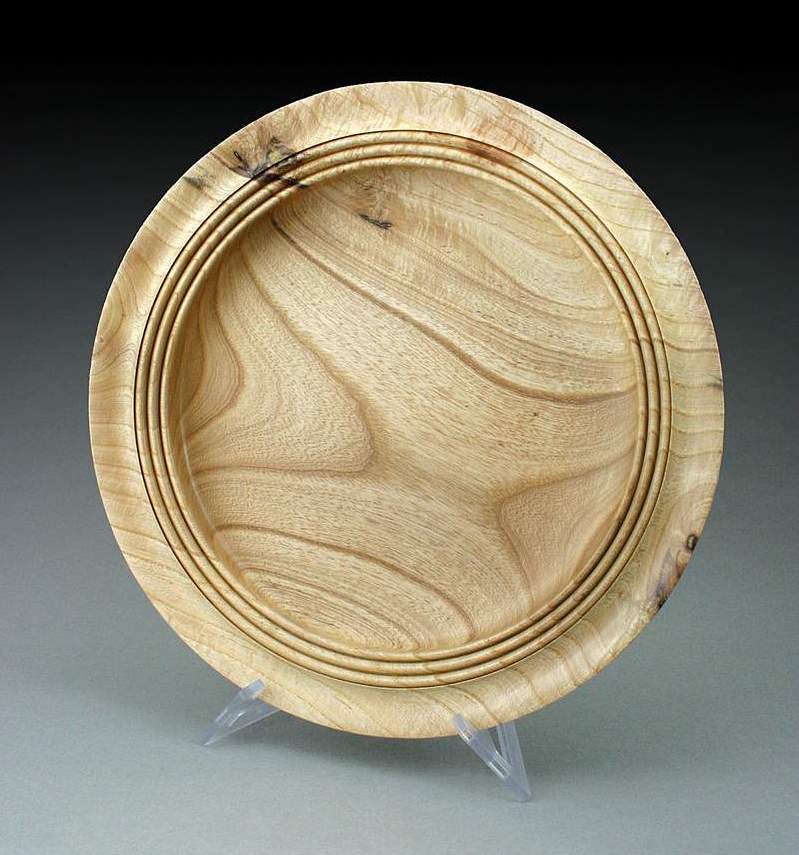
My experience has been different. The Persimmon I turned started out as a blank that had a strong orange color, but when the bowl was completed it was a more traditional brown. I had no issues with cracks or wood movement. This may be because the blank was thoroughly dry when I obtained it. The attached pic shows a completed bowl that has only sanding sealer as a finish.
>Persimmon is a fruit and it is usually sour, bitter, or whatever!
The unripe persimmons of the type that grow here (East TN, Diospyros virginiana) are quite astringent, can actually shrink/dry tissues, will cause your mouth to "pucker" with a feeling of a horrible hairy coating to your tongue and mouth. Kids used to trick other kids into eating an unripe one. I read it was once used to help close wounds.
The fruit is quite tasty when ripe. They make a plump orangish fruit maybe 1-2" in diameter, actually a large berry. My goats and dogs love them. (I counted about 30 good-sized persimmon trees here.) My wife made some very good pudding once but she said the seeds are a pain to remove.
I read that the younger persimmon wood is mostly white. Some say the the older heartwood is dark with the streaks and character but the Wood Database says the heartwood is the thin black streak I've been calling the pith. I have a friend who has one about 30" in diameter who said we could cut it down. Hmmm, do I have enough wood yet?...
Since it is not a commercially available wood, I read of high prices, especially for quality quarter-sawn boards, $30-$300 per board foot. Yikes. Maybe I don't have enough wood yet.