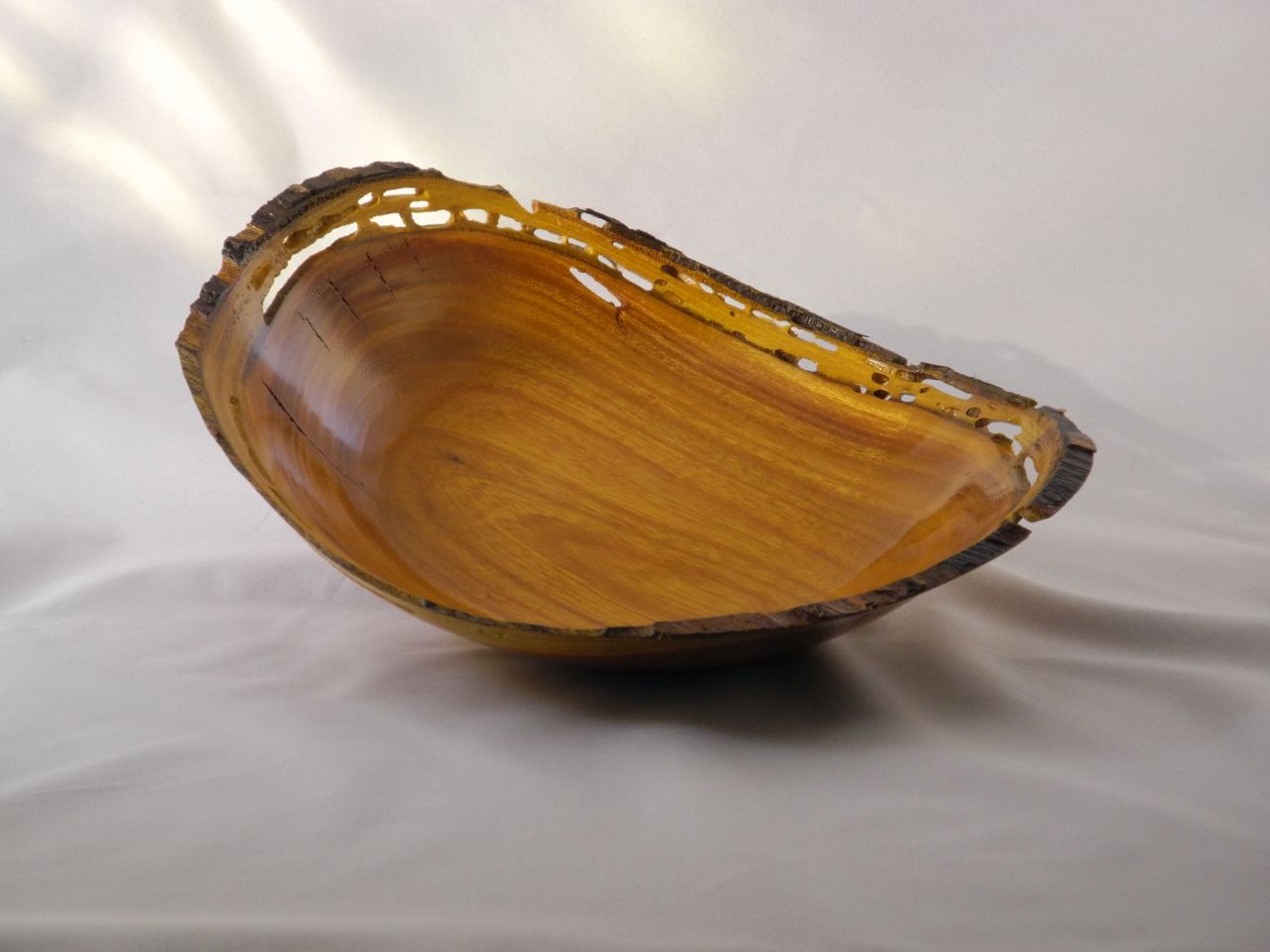
The 1st picture is about an 8 inch bowl that I turned out of dry Box Elder. I had major tear out with the bowl gouge but got it down to this level with a scraper. Is there anyway to make this better, or would you just leave it and make it part of the design? The inside does not have the tear out I knew this might be a problem because I had similar problems even when the wood was damp. The 2nd picture is of the whole bowl. Thanks for any help.
"would you just leave it and make it part of the design?"
No, that should not be left on, it's no design feature.
Do you still have a way to rechuck it? You can use a shear scraper, easily done on the outside. Some will dampen with sanding sealer, let it dry, then shear scrape. Just part of the learning process. Surprised that a scraper made it better. Sharpen and very light cuts with a gouge will almost always make a better surface. You might try working on you techniques. Final fix, power sanding with 80 grit.
I will also try a "wet cut" with shellac or anything that will stiffen the fibers. The cut can be made the gouge (sheer scrape, or push cut with the handle low in your stance) or scraper or sheer scrape. Box Elder is generally a light wood, tear out with darken when any finish is added; address as best as you can before you proceed to sanding and finish.
...looks like you also have some spalting going on there, too. Boxelder is pretty soft to begin with, so in the spalted state you'll have even softer areas to deal with. I'd second the shellac method (which I prefer 100:1 over a highly toxic approach like a commercial wood hardener), and a very fine cut with either a sharpened and honed bowl gouge, or even better, a long-bevel detail gouge with a significant sheer angle. You could try a sheer scrape with a bowl gouge (what Bill Grumbine mistakenly calls a "vertical sheer scrape -- it wouldn't be a shear scrape if it weren't vertical), but don't use a scraper without a high sheer angle.
I had a piece of old dry box elder I turned as part of demo the other day. It needed more tools and chemicals than I had with me. What I do is first I try a tool that has a sharper angle to the cutting edge. I have a bowl gouge with a 40 degree grind and then a detail gouge that has a 35 degree grind. If those don't work I have a Hunter Osprey that has an edge that is around 27 degrees. ON most woods that does the trick.
Also try not to force the tool to cut. Relax your grip and let the tool go forward at the speed it wants to. Even a sharp tool will get tearout if you force it.
Also make sure your cutting downhill with the grain if at all possible.
On really tearout prone woods I put several coats of thinned lacquer on and let it dry. I think it 50/50 with lacquer thinner. Shellac works well also. If it's just a small spot I'll use thin CA.
If all of that fails try Shear scraping with a freshly raised burr on the scraper. I have also use a cabinet scraper with the lathe turned off to scrape away tearout and then feather the surrounding areas so it doesn't look too lumpy.
If the tenon is still in the bowl I would fill the tear out with wax and slowly shear scrap away about 1/8 of an inch deep reapplying the wax as needed.
Another option is the 80 grit gouge 2 inch disk sand away the 1/8 deep tear out fearther it into the good wood work each grit up to 320.
To my eye you may not have enough wood left to fix both the outside and the inside so pick one.
Are you sure it is box elder? The photo on my monitor is to dark for box elder. I do not see a hint of typical red in most box elder.
To my eye the zig zag in the side grain screams elm. (slippery elm)
Depending on the extent of the tearout and type of wood, when faced with tearout I try:
- hair-splitting razor sharp tools (1st defense)
- moisten with water or oil (for minor tearout)
- small hand-held cabinet scrapers (great with ERC)
- shear scrape with wings of very sharp bowl or spindle gouge
- flood with shellac-based sanding sealer diluted with alcohol, let dry
- if really bad (soft), flood with thin CA glue
The CA works best but may darken the wood. Sometimes this is good. Be aware the reaction can get smoking hot and the fumes extremely irritating to the eyes. Takes a lot of glue - I usually buy larger quantities. Don't turn on the lathe until glue is completly cured! CA over sanding sealer is also sometimes effective.
I made a tricorner bowl from beautiful spalted but very punky yellow poplar. I used thin CA glue to stabilize the horrible tearout. I began the stabilizing before I got too close to the desired thickness since removing deep tearout will remove a lot of wood. I flooded the entire surface to even the finish. Made a clean cutting pass with the gouge, shear scraped, then soaked again. Scraped then sanded with 400 & 600+. Final surface was smooth as glass.
The best thing is to start with a new piece. There's nothing to be gained by trying to remount it, you will never get it true and it will just lead to more poking at it, without improving it. Sand it if you want and be done with it. The tearout is from gouge sharpness/technique issues. Shear scraping won't repair that much damage. Get some fresh green wood and keep at it.
From the colors in the wood, it looks like you have some rot going on. That adds to tear out issues. I am surprised that you didn't get it on the inside as well. As deep as it appears to be, it may be wasted effort to cut it out. I use water, get it wet and let it sit for a minute or three, then take very light cuts to remove just the wet stuff. You may have to do it a couple of times to get it all out. Very sharp tools, and the higher the shear angle, the better. I prefer scrapers for shear cutting, and ones that are ground way back on the left side. Bunch of bowl turning clips up on You Tube if you type in robo hippy
Sand with paste wax on the sand paper until it looks good then go one grit higher. Phil Brennion taught me that trick years ago and it's never failed me.
This is the final result. Thanks for all of the suggestions. I used 80 grit sand paper to take out most of the tear out on the outside. I then tried shellac on the inside and re cut it with the bowl gouge. This help reduce the tear out but did not eliminate it, so I used the 80 grit sand paper to eliminate most of the larger tears. I only had a light colored wood filler handy, so I filled in the problem areas and then sanded it using 220, 320 and 600 grit. Had I had a darker filler, I don't think it would have been as noticeable. This was a great learning experience.
I turn for a hobby and am learning as I go. The next time I get some box elder, I will know to turn it while it is wet.
Another thing you might check into - lots of turners are willing to spend shop time with others.
For example, I often have people come to my shop to visit and play on the lathe. One collage-age guy is coming this afternoon, another one day next week, an older guy was here last week, and two guys almost as old as me came a few weeks ago. Some have never touched a lathe and some have experience but want to learn sharpening techniques or skew chisel or something. A couple of days ago a friend brought his quadcopter to take pictures of our farm, saw my woodturning, and wants to come back for lessons. And I visited another gentleman's shop just yesterday (he has been turning in isolation for many years and didn't even know about the local club.)
You might contact the club president - he (she) may know just the person who is willing to share some time.