Home Articles Forums Gallery Marketplace Videos

WoodCentral Forums

Knowledge You Can Build On — Est. 1998

REAL MILK PAINT

Finishing: buffing Qsn.

Posts

Finishing: buffing Qsn.

#1

Finishing: buffing Qsn.

phillip Medghalchi

I have read that most of turners finish their bowls or turnings by using the beall buffing system in most cases, which includes three stages of Trippoli, white diamond and Carnuba wax. Bellow you will see the pic.s of a Bradford Pear bowl I did last year and I noticed that the white diamond made whitish, cloudy stain around the bead and the coves. My qsn. is that when you use the white diamond on your turnings that have intricate bead and cove design w/o further staining your piece. And, do all type wood (light grained or dark grained) get all the three treatments in the buffing system or do you skip one method or any others? I put arrows in the pic. to highlight the problem areas for clarity of the discussion.

any help will be appreciated.


Re: Finishing: buffing Qsn.

#2

Re: Finishing: buffing Qsn.

Barry L Elder

I use (or used) the Beall system for years and it took a true artist (Jack Shelton) to get through my thick head that the results from using any buffing system is only as good as the finished surface of the bowl or whatever. Think about it for a while and play with the idea before making a decision.

Re: Finishing: buffing Qsn.

#3

Re: Finishing: buffing Qsn.

David Walser

I don't know that it's true that "most" turners finish their turnings using the Beal buffing system (or something similar). I know a lot of turners do, but I doubt its a majority of all work done. I generally use my buffing system on plastics or turnings finished with a film finish (shellac, lacquer, etc.). When I'm going for softer finish, such as oil/wax, I just buff the finish with a paper towel on the lathe.

To address your question re: white diamond leaving deposits in the wood's pores, cracks, and details. Yep, it does that. (Tripoli does the same on light colored woods, but it's not as apparent.) There are three possible approaches:

1. Don't use white diamond on dark colored woods. Buff with Tripoli, skip white diamond, and go on to your final wax buffing. Tripoli produces a fairly fine finish. White diamond produces a slight, but noticeable improvement. If a particular turning doesn't "need" slight benefit from white diamond, skip it.

2. Do a better job of filling all the pores and surface defects before buffing. If you're going for a gloss finish (if you're not after a gloss finish, you shouldn't be using white diamond anyway), the surface should be level -- which means the pores and cracks should be filled. Then, other than surface decorations you've added, there won't be anything for the white diamond to stick to.

3. Get good at removing the white diamond from the surface of the turning. For the bottoms of v-groove, you can use a card wrapped in a paper towel or tissue to remove the white diamond. Some use blunted dental picks for removing it from pores and cracks. Compressed air sometimes works. The stuff is soft and will come off if you can find a tool that will reach it.

HTH

Re: Finishing: buffing Qsn.

#4

Re: Finishing: buffing Qsn.

Dale Bonertz

I agree with both responses. I don't use white if it is a wood that I think it will show. I also no longer use carnuba wax because it seems to show finger prints. I prefer renaissance wax which doesn't show prints at all, from my experience with it.

Re: Finishing: buffing Qsn.

#5

Re: Finishing: buffing Qsn.

John Lucas

Use a very soft tooth brush with mineral spirits on it to remove the white diamond or dark tripoli. It will remove all wax however so you might have to do the final wax buff

I don't like using the Neal system for work with crisp details like v cuts 90 degree corners or beads that fit close together.

For serious finishes I don't use the beal. I prefer to build the finish ad then sand it flat and hand rub the finish. Either that or I spray lacquer if its working fine. Since I spray outdoors it constantly changes and I fight orange peel

Re: Finishing: buffing Qsn.

#6

Re: Finishing: buffing Qsn.

phillip Medghalchi

Barry, sorry I am getting this part of your reply "Think about it for a while and play with the idea before making a decision".

Which idea is that and making decision about what? can you explain, plz?

Re: Finishing: buffing Qsn.

#7

Re: Finishing: buffing Qsn.

phillip Medghalchi

David, thank you very much very good points to adhere to. I do have many dental picks which I got them form my dentist. I never thought of it to use it in this manner. I thought it will further scratch the surface. Hopefully, I will manage to put up lots of pic.s of my work pretty soon. However, I am getting good at adding decorative elements to my work and just have to find the answer as how to make them crisp and without any things added to them to lose their design effect. I am still in process of learning how to add those elements and still come out clean after the final finish.

I certainly appreciate your tips.

Re: Finishing: buffing Qsn.

#8

Re: Finishing: buffing Qsn.

phillip Medghalchi

Thank you Dale, I recently acquired Renaissance wax, and going to try it on them. although it was meant for pen turning, however, one of my friends let me use it on one of my works and I was happy with the way it turned out. I have quite a lots of bowls that are waiting for finial finishing and I have to get in there and get them out of the way before they get ruined further from rubbing on each others form being stacked on top of each others. My wife keep telling me that I have to get in there and finish them all. they are getting to be too many unfinished articles laying around.

I will post the results soon as I finish them.

Thank you for your reply.

Re: Finishing: buffing Qsn.

#9

Re: Finishing: buffing Qsn.

phillip Medghalchi

John, I agree with you. Ont the crisp details is very hard to do that. I am trying to learn that how you clean cut the bead and coves when you transition from the larger curve on the design into the bead or V groove. I am striving to find a way to cleanly cut them so I don't have to come back and clean them with sanding which in most cases it results in rounding over the detail to a less crisp design,rather than the original intention of it in the first place. I wonder if the tool got something to do with it.

On my last bowl ( another Bradford Pear bowl) I had trouble with the cove and the bead and no matter which one of my tools I used I had tear out with the grain, I finally used my 1/4" round carbide cutter tool to clean it, however, I had to spend lots of time hand sanding it to get rid of the grain tear out and was not too happy with the profile of the cove after I was finished due to sanding effort. When I first designed it- it was looking crispier than when I finished it.

Re: Finishing: buffing Qsn.

#10

Re: Finishing: buffing Qsn.

Juergen

I buff almost all my gallery work because shiny seems to sell better. As noted by others, some paint thinner and a stiff brush will usually clean out the rouge and diamond compounds.

The process below works best for me:

1. Apply Watco until saturated, then wipe off excess and let dry for 24-48 hours.

2.Use a rake http://www.grizzly.com/search/search?q=rake to remove any encrusted buffing compound. If you don't have a rake handy, use a short piece of salvaged bandsaw blade and vise grips to gently rake the buffing wheel at a safe speed.

3. Buff with rouge. If the Watco comes to the surface (sweats) you're either buffing too fast, too hard, or the Watco has not set up. Should the rouge streaks, you've over charged the buffing wheel. Rub a piece of wood scrap against the buff to remove any excess. A paper towel and paint thinner will remove excess rouge from the piece.

4. Apply your finish of choice, I prefer Wipe on Poly. Allow 24 hours to insure the finish is fully polymerized. I usually lightly buff with rouge to remove any dust or runs.

5. Finally, finish with White Diamond, which is not as greasy as the rouge and needs only a couple of light taps to charge the buff properly. Normally you don't have to rake the buff before applying the compound. If you see white on your piece you've overcharged the wheel, get the wood scrap out. If the buff is running too fast the diamond will get into the inclusions. Insure the buff is turning slow enough to expose the inside of the buff and not only the edge.

6. Apply Renaissance Wax and buff at a speed which is fast enough to bring out the shine and expose the piece to the inside surfaces of the buffing wheel.

Re: Finishing: buffing Qsn.

#11

Re: Finishing: buffing Qsn.

John Lucas

I assume the round car IDE tool is scraping. It's very hard to get non tearout scraping. It can be difficult on some woods even with a be el rubbing cut. I approach problem areas like that with a freshly sharpened tool. The. I try to figure out how to make the cut with a shearing angle in the be el rub ing cut. For example I usually start cutting a bead with the gouge on top of the bead with the flute up. Lift the handle to start the cut and then roll it over. This way the wood is crossing the tip of the gouge 90 degrees or perpindicular to the edge. This is a course cut. If I rotate the flute slightly so the start of the cut is odd center on the flute it presents a more angled edge to the wood and cuts cleaner.

If you look at each tool

As you cut and ask your self can I change the orientation of the tool to get a more shear angle by rotating the tool very slightly. It's amazing how much cleaner it will cut sometimes

Re: Finishing: buffing Qsn.

#12

Keith Tompkins

Re: Finishing: buffing Qsn.

Keith Tompkins

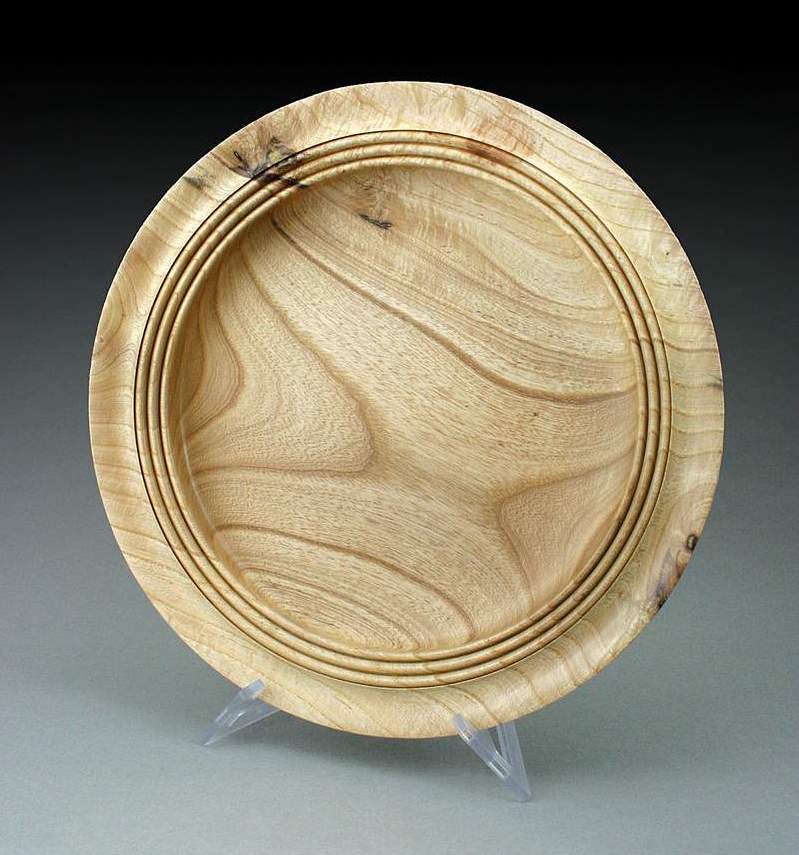
Hi Phillip, Here is a bowl with a bead embellishment. It has a finish of pure tung oil mixed with a touch of polyurethane. The finish was wiped on with a rag, allowed to soak in, then wiped dry. This method takes many coats to complete, but well worth the effort. No buffing at all is needed. The secret, if there is one, is the surface quality produced by the sharpness of the tool, and its presentation. Sanding is important, but all the sanding in the world won't make up for torn grain. I've buffed lots of lacquer finishes, and use automotive polishing compounds, but the surface being buffed must be as perfect as possible. I don't recommend many of the "easy" finishes on the market, as they are not durable. Hope this helps.

Re: Finishing: buffing Qsn.

#13

Mike Stafford

Re: Finishing: buffing Qsn.

Mike Stafford

Phillip, Barry is trying to say in a nice way that the surfaces of the pictured bowl in question are no where near the quality they should be to consider using the Beall system.

The Beall system is supposed to be used on objects which are finely sanded, free of tear out, cracks and other imperfections. Using the various compounds and waxes will only accentuate a poorly prepared surface. That is what is happening in this instance. This bowl is not ready for polishing and buffing using that system. It needs more work.

Re: Finishing: buffing Qsn.

#14

Ric Taylor

Re: Finishing: buffing Qsn.

Ric Taylor

I agree with Juergen about the need for keeping the buffing wheel clean. In the photo it looks like you have way too much white diamond on your buffing wheel, which is a mistake made by many people who are new to buffing. Just a tiny amount of white diamond on the wheel is all you need, as Jeurgen says just touch the white diamond quickly (about one second) to the wheel a couple of times.

You need to clean out the excess white diamond from your wheel. You don't have to buy a rake, just hold a piece of 60-grit sandpaper against the wheel and it will grab most of the white diamond (that's the only thing I use 60-grit for ;) ).

I never use white diamond on dark wood.

Ric

Re: Finishing: buffing Qsn.

#15

Re: Finishing: buffing Qsn.

phillip Medghalchi

Keith, I remembered this piece form while ago and I admired it how clean it came out. I do agree nothing is better than a clean cut on the piece and I think I yet to master that skills. I am trying hard to get to there, however, on your own is not that easy unless you have someone to coach you visually to see where you stand on this scale. Sometimes the description of a process is not as clear as the visual aspect of the process. In this case i think if I was there watching you how you did it I may have learned the exact intent better. However, I am very thankful for you sharing this tip. I try my best to follow to what I understood and hopefully master it soon. To me if a piece is not finished that clean like yours it doesn't represent the true intent of the artist.

Re: Finishing: buffing Qsn.

#16

Re: Finishing: buffing Qsn.

don stephan

Phillip:

Like the design of your bowl, even if it shows some tearout. Perhaps changing the lathe speed might help, as well as fresh sharp edge and light cuts to get to the final depth.

You might try inspecting bowls as they are being turned, to try to find tearout while it could be re-cut. But my eye still is not well trained, even with a raking light source.

Re: Finishing: buffing Qsn.

#17

Keith Tompkins

Re: Finishing: buffing Qsn.

Keith Tompkins

Well, Phillip, sometimes we texture pieces on purpose! :D but seriously, one piece of advise I can give you. Focus on quality, not quantity. For example, if you want to get really good at cutting beads, mount a piece and cut beads on it until there's nothing left. See what cuts cleanly, and learn from it. No need for a finished piece, it's the experience of turning clean beads that matters. When you turn a bowl, do it to perfection, or as close as you can get. Focus on only that one bowl, and nothing else. In my opinion, one good, clean, well turned bowl is worth a hundred hastily turned pieces with torn grain, poor form, etc...Practice, practice, and more practice. Join a club to really accelerate the learning process, or schedule some lessons with a good turner if no local club exist.

Re: Finishing: buffing Qsn.

#18

Re: Finishing: buffing Qsn.

Don Evans

Phillip:

I don't know where you got the idea that microcrystalline wax was meant for pen turners but u need to forget that as it isn't correct.

I finish all turnings with microcrystalline wax as the last step, also I never put it at that point against a buffing wheel or any other point.

Just put on a small amount with a Tshirt cloth and use another clean one to hand buff it. It is very quick and doesn't require any power equipment

Someone already mentioned the NO finger prints and that is also correct. It is the best final step you can take for a finish. Also I store the cloth that is used to apply the wax in the wax container and use it over and over again and again.

Only times I would use white diamond or any wax abrasive is on metal never wood. Unless you learn how to use clear filler during final sanding and fill in all those pores so they are even with the wood fibers you'll never get good finish with your method.

Don

Re: Finishing: buffing Qsn.

#19

Brad Vietje

Re: Finishing: buffing Qsn.

Brad Vietje

Hey Phillip,

I think Mike and Keith about covered it -- you need a smoother surface to start with, and most finishes accentuate the figure and all the surface imperfections.

You need to find some better wood, Phillip! Your skills have improved to the point where you have created a very nice profile, and a nice design, but you are limited by wood that is starting to decay (spalting in some species is just spots and light-colored areas) and wood with cracks. Cracks can be glued or epoxied, but they will always detract from the beauty of the wood, and sometimes they can be dangerous if the wood flies apart.

I'd say you are ready for some nicer blanks. Are you able to go to a club meeting or a local symposium and come home with some better wood? Let's face it, you're worth it!

Good luck and safe spinning,

Brad Vietje

Newbury, VT

Re: Finishing: buffing Qsn.

#20

Re: Finishing: buffing Qsn.

phillip Medghalchi

Thank you so very much for words of encouragements, although that I may have gotten here by these woods, along the way I learned a lot and I appreciate the tips I get form all of you guys here. I am going to SWAT in two weeks and I see what I can find. Some of those dealers ask for a lot of money for decent blanks, which I think they are worth it. I am a member of two clubs here in S.TX, which are Alamo Wood turners Association, and Hill country turners which I have learned quite a bit form them. Very gracious turners and pros, too. the only thing is that we do not have that much communications through any common web site during the month and you have to wait until the meetings. Even at that you can not ask all your qsn.s at the meeting because of the time constraint. Here, I have been able to tackle some of my obstacles and fortunately, some of you been nice enough to answer fast and I can learn much faster to over come my turning experience.

I have been told about my forms and designs and I think some of that is inherited from my family and culture. I come from a very visual and artistic family, have two sisters that do Persian rug repairs and restorations in Santa Fe, and that takes lots of talents in order to know how to restore the old design on a rug w/O having the original prints, both of the oldest were clothing designers and very good at sewing, I was always good with my hands an always were into making stuff, my youngest sister now does oil and water color paintings W/O lots of training form pro painters, we have singer and the professional ball room dancer/instructor in the family. Rest will get boring. Anyways, I think I have the right blood running in my veins if I can improve on it. My ultimate goal is to try to recreate old and ancient Persian empire pottery and artifact designs in wood, since they were originally made in clay and stone wares, and try to bring a different element to our trade. Hopefully, i am getting there little by little, have to be just patient and perfect each steps towards it. I have been experimenting with different design ideas in the shop and hopefully i can share some. Pic.s of my works soon as soon as I can get passed all the illnesses we have around the house.

meanwhile I truly appreciate everyone's input on my inquiries.
