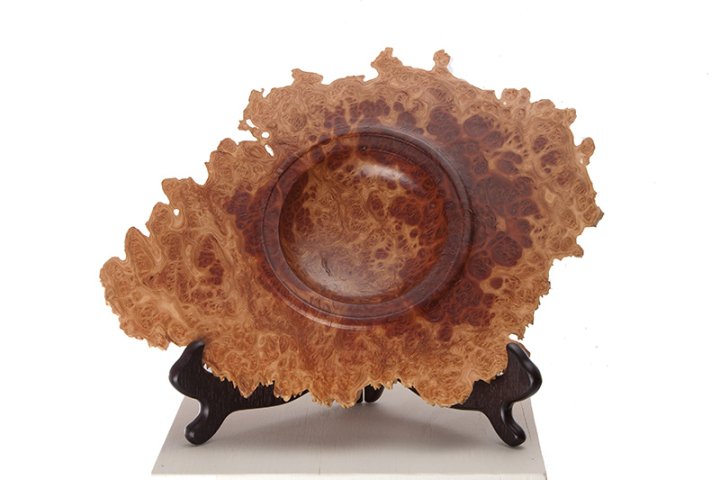
For those of you that core bowls, do you core the largest bowl first and then remount the core and remove a smaller core, etc.?
Why don't we mount the big blank, take the smallest core, then the medium one and then the large one? That way we could leave the blank mounted and core it three or four times rather than remounting the blanks over and over. Are we trying to preserve the largest bowl?
Same here, smallest one's first on functional salad bowls. It only makes sense to do the largest first if doing nested sets out of burl as Mike Mahoney does in his video.
I take the big one first. If I did artistic pieces like Mike does, then I would maybe take the smaller one first. I also turn green to final thickness, and the money is in the big bowl. The smaller cores that come at the end of a big bowl set are almost not worth the effort of sanding and finishing. I do mount with a drilled recess in the top of the bowl, so no centering problem when the core is removed, big bowl final turned, then remount core, finish turn the bottom, reverse, core, etc.
I don't core often but I take Mike Mahoney's advice. The big bowl is the money bowl. Core it first and then go on down. If you core the small one first you may end up losing the biggest one. Now of course if we were all perfect and coring machines were perfect we could map out the bowls and get all of them but in real life that doesn't always happen.
In his video "On the McNaughton Center Saver" he does it both ways and the third way he does it is from the back of the blank while still mounted on the faceplate which gives the largest bowl first.
I am not trying to get every bowl that I can out of every blank...just more than one. My cores are usually -1's (meaning I could get another medium bowl if I tried) or -2's (meaning 2 more if I was Mike Mahoney). In the end, 3 bowls is better than 1 bowl, and I am OK with missing a couple of middle sized bowls anyhow...
S
P.S. Same reason you mentioned- one chucking. Core inner, and reversed in the hole it just came out of to put a new tenon on it.
Agree with John and Mike M. I will expound with this. Not only should you do the big one first, the money bowl, but when you are making a nested set, you want the nest to have a natural size progression. You might be able to go small to big and get the big one, but the big one will likely not fit the progression. Joe
I have to disagree with Joe. The size progression for a set is done when finish turning and not at coring time. Yes you want to pay attention to the sizes you are coring but there is a lot more flexibility in the coring than suggested. I core small to large but my main purpose is quantity of blanks. When I finish turn a set I start with the smallest bowl so that I can then go to the next sizes on up and calculate the percentages as they grow (wall thickness, height, width, foot size and etc.). The smallest bowl generally has the least amount of flexibility since it generally has the thinnest walls when roughed/cored. A well laid out blank, for coring, along with sound practices will yield very nice sets if that is what you are after (not talking about thin nested sets like Mike's - I am referring to utility sets). If your not after sets it is much quicker to core small to large so that is why I suggest learning and getting comfortable with that method.
Good article you have on coring Joe, I enjoyed it very much and one of the best out there that I read.
Seems that most people with McNaughton systems have the knives that bend to the right -- that is, they cut toward the headstock. Many people don't realize that they also sell knives that bend the other way, curved to the left.
I have the -- shall we call them the "traditional" knives? -- that curve to the right. A buddy of mine has a full set that curve the other way. He attaches a billet or blank to the lathe with a faceplate where the opening of the bowl will be, brings the tailstock up for support, and cores toward the tailstock with knives that curve to the left. He first shapes a tenon on the outside of the largest bowl and removes the largest bowl first. Then he shapes a tenon on the next bowl, cores & removes it, then the tenon on the next, and so on. No re-mounting or reversing the bowl to create a tenon by friction chucking or any other steps. Just tenon, core, remove, repeat. Very efficient use of time and equipment.
He makes a lot of large natural edge and burl pieces, and only flattens a 3" spot for a small faceplate to drive the wood, since he has the tailstock there for support. Only issue he has had is clearance of the headstock. He bends the handle ends of the knives out at 90 degrees so they don't hit the headstock, and often uses the knives w/out the handles on them, anyway.
When I save up enough, I want to get a new set with the reverse curve so I can do this, which seems to make so much more sense than having to re-mount and reverse each core to put a foot on it.