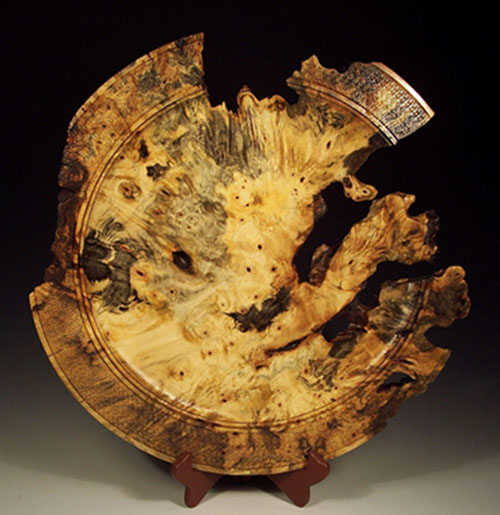
...digging through my wood stash today, and decided it was time to exercise the Monster and see if I could remember how to hollow. The front side in the first image was easy, but the voids in the 2nd image show what made this project interesting. Had to leave some wood at the top to keep the flap on the L side from flying away! Turned to 3/16" and top has no finish, to contrast with the nice smooooooth sides.
I looked for the "Like" button, Jamie, but Woodcentral doesn't have them.... too much Facebook for me I think!
Nicely executed, and I like the contrast between the top and sides. Hollowing this in dry osage must have been a 'concentration fest', with the main theme of 'slow and easy'.
Dry Osage Orange; The closest North America has to granite without actually being there. Congrats on the recent 'cleaning up' of your stash. I can't recall ever seeing a OO burl before.
....supported on the L side by solid wood, the area that continues around to the L of your green shaded area and above the hole. It is supported also from the top, which I was careful to not turn too thin when hollowing. I've been turning similar works for most of my 25 yrs. of turning, and one of my early teachers was Rude Osolnik, who is considered to be the pioneer in this process of using found irregular wood. This is a low risk project for me, and I don't take uncalculated risks with any of my turning. Experience in selection and design of similar projects eliminates most all unforseen hazards.
...and, when hollowing, we are standing well away from the danger zone. If a H.F. does explode, the pieces fly out radially, while I'm standing down at the tailstock, and I'll bet Jamie is, too!
For those who don't do hollow forms -- or are new to it -- I'd also add that a super-strong wood like Osage Orange can handle this well, but a weak wood species like Boxelder or Cedar would not support a thin section as well, so the strength of the wood does come into a discussion of safe practices.
Experience is usually gained 10 seconds after you need it...
That said, knowing this wood (Osage) has interlocking grain would have certainly changed the risk profile (if you knew that). Having the experience to "hear" how thick something is also helps. Having the hole in the side makes it easier to validate what you hear... and usually the spray of wood being flung out of the hole will keep you out of the LOF.
If you've ever cut through a vessel (dozens for me), you'll know that sickening moment when the sound changes, a large spray of wood happens and the opening starts spinning around your tool at a different speed than the lathe is set at. Hollow vessels usually don't fail dramatically unless the turned uses the tool wrong. Once you put it in the wrong spot, the vessel can move the tool quickly, which acts like an enormous lever on the opening. That's when you will see piece fly.
OK, since we're on to H.F. turning, I'll add another tidbit...
When you have a catch inside a spinning vessel, things can go haywire real fast, as Steve relates. This can happen if: A) a hollowing tool is used well below center; B) the internal curve mates up with the bevel, causing a dig-in; or C) when the cutting edge is pushed down at the same time that the shaft or curved section is pushed upward, usually near the opening or when the interior gets clogged with shavings. DAMHIKT -- but experience is a good teacher -- just not always a safe one.
Oddly enough, if you cut through a vessel from the inside, it's really no big deal at all. I do it all the time as part of a hollow form turning demo, so attendees can hear how the sound changes as the wood gets critically thin (it's saying "Warning -- stop now to save the piece!"). As the side wall gives away, there's a spray of shavings and dust as they fly out the newly-created opening, and the top of the vessel separates from the chucked base, and spins quietly to a stop with the opening on the shaft of the hollowing tool. I recommend all newbie H.F turners do this a few times -- on purpose, no less -- to hear the sound changes that tell you to stop, and to get over the fear of cutting through a piece.