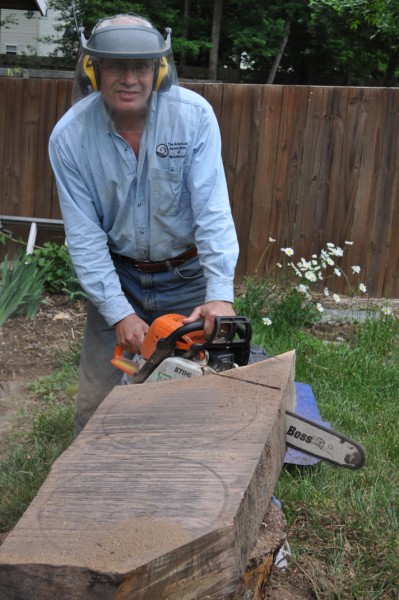
I want to twice-turn some natural edge bowls, both ash and walnut (maybe some cherry as well). For those of you who do this, do you CA the bark before anchorsealing and drying? My thinking is that it will help retain the bark. Is it required or am I wasting my time?
Personally Steve, I'd ignore it. If possibly, and I've gone to great lengths, to remove the bark from NE bowls while still keeping the "naturalness" of the bowl. Shipping anything with even a trace of bark is harder and harder and in some areas "bark" can't pass borders (even if it's finished, it won't matter some times.) At the AAW St. Paul WOW swap there were turners that couldn't take their new pieces home and had to leave them behind due to natural edges or bark inclusions. I like to cut NE edge bowl blanks in the spring and summer so the bark is easy to take off and leaves a nice natural edge behind.
If you want to hold the bark the only viable way is to harvest the tree in the months when the sap is out of the tree. I think it is called the cambium layer which just under the bark. That means the winter months in the northern climes. You will not be able to hold it otherwise. This is not withstanding the issues of transporting wood with bark on it.
Thanks Greg. I've only had a few where I managed to keep all the bark...which promptly lost pieces when I bumped them. Walnut just looks so cool with the bark intact.
Steve I turn them to finished thickness wet before I do the last cut and sanding I Ca glue the bark,cut Glue sand glue .Then oil sand and let mother nature do her job
Carving on three feet means they can warp and buckle as much as they want
Steve, some questions come to mind. Why double turn with natural edge?? The natural edge will hide the fact it will warp out of round, so why bother. Question two, why leave the bark on?? I usually take the bark off while I'm green turning. What does the bark communicate to the viewer?? Rustic?? Sturdy?? Strong?? Functional?? Is that the message you want to send with a natural edge bowl?? I prefer to keep a consistent message. My natural edge bowls are usually thin walled, nice grain, nice color, small footed, non-functional looking. When I finish them I usually take one more step and soften the edge by sanding the corners off and rounding the rims. This makes them huggable, caressable. The bark is not sending the message I want.
Very interesting insight Lyle (as always). "rustic" is certainly part of it. Going beyond the look and feel of the wood to create more of a connection with nature is a big part.
And you're right about the warpage of turned-green as it relates to natural edge pieces. I had never thought of that.
Steve I hate to jump in here with real professionals and their ideas but. . When I turn a natural edge I do it with the idea the bark will remain. When I lose the bark it seems the people who buy my stuff will pass that bowl by every time and go for the NE with bark. For that reason I do whatever I can to keep the bark intact. If the bark seems to be a bit loose I will resort to CA during the turning stage. I generally soak in alcohol prior to drying. I generally will turn the bottom half of the bowl and the bottom so it sits level prior to finishing and fair the new round into the out of round tops. I finish with semigloss lacquer which I think will also tend to stabilize the bark over time.
I love the look of a walnut bowl "fully dressed" with the dark bark and white layers the contrast puts the finishing touches that I like. I have best luck with green wood but have pretty good results with semi dry stuff. So once again your get answers all over the map.
I to find bark edge sells better. Might try: after blank is turned round,
if bark is loose, go ahead and pry it off, clean, let it set a couple days to dry and glue in all back on, weight with sand bags, then turn inside.
Also if some of the bark comes off, bark is usually rough enough, you can "piece it back together" with any handy piece from that wood and no one can tell.
Crossing into the States last weekend for Totally Turning the Boarder Guard searched the back of the the car and wanted to see all wood products I had with me. After he looked everything over he stated that he had to make sure nothing had any bark on it or insect holes.
Guard was super friendly and seeing I had nothing to hide ( there was no bark or worm holes ) it was all good!
I'm kind of iffy on how long a natural bark edge will last. Not permanent I'll bet but based on previous bowls a long time. I have 5 Walnut roughed out bowls from a friends wife to redo. He passed away 10 years ago and the bowls I think are a lot older than that. These were more or less finish turned to 1/2" thickness and are huge. I'm going to finish them for her. They are Walnut natural edge and bark is still on them. I'm sure Joe didn't use any CA glue back then.
On the other hand I've been experimenting with adding my own sponge painted natural edge. I've also added thickened epoxy to the edge, carved and painted it. I like them.
At my local pre-Christmas shows the bark-rimmed bowls outsell any other category. Some types of wood really lend themselves to bark-rim, such as black locust. The bark is so deep and crinkly that it becomes a feature in and of itself. And because of the bark issue, you won't ever have to compete with cheap products from Indonesia.
As for rough-turning a NE vessel, I agree with Lyle--there is no reason why you should want to do it, unless you dislike the oval shape that drying will accentuate. But to get a really round NE bowl, you'll have to cut your blank from a fairly flat area of bark surface.

 Walnut just looks so cool with the bark intact.