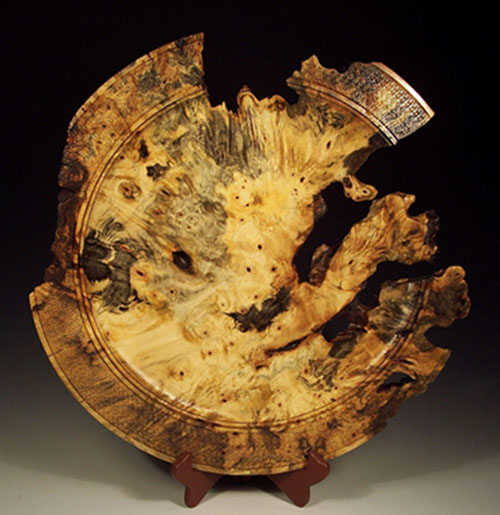
Is it common to rough out / twice turn hollowforms to reduce warpage? Do the same rules of 1" of thickness for every 10" in diameter still apply? End/Spindle grain or facegrain work?
Any tricks to drying them?
In the past I've roughed out cylinders and let them set for 3-6 years. (like the 8" unfinished ash shown) but, hollowing is a rough ride and it still moves a fair amount.
Devon, I just finished a class last week at John Campbell taught by Charlse Farrar on hollow forms and he told us that he turned his hollow forms green to 3/16" and they did not move that much. He said they would always move some because the wood absorbs and loses moisture all the time. Once we got to 3/16" we didn't have problems with movement. He also said that putting a collar in the hole (3/4" - 1") would help reduce the movement. He also did not finish the inside of the hollow form.
Green end grain vessels are about all I turn. Pushing toward a couple hundred of them now & they have all been rough turned, air dried & return.
Movement varies between species some move very little, some move a lot. Knots also effect movement a lot.
As to roughing thickness I will rough out any where from about 3/8" to 1/2" thick depending on the piece itself.
Seems that many people turn green to finish.
Personally I feel the wood needs to dry before you can expect it to sand - take a surface finish - and be expected to be stable once it's been displayed.
I know it's not the only way to do this but it works for me so I stick with it.
I do that mostly with side grain hollow forms. For end grain I seldom do. What I do is rough them out to about 3/4". I don't leave any sharp edges. Then I seal all the endgrain portions and sharper thinner edges where a crack might start and usually seal the base with tenon since I've left it thicker so I feel I need to even out the drying time. I can't say I'm 100% successful but have saved most of them.
I do turn them twice, first rough to 3/4" - 1" depending on size and put them aside in a quiet corner, I don't do anything to them except saturate the pith area with thin CA, and write on it the date and weight.
What I like doing is to choose chunks where the growth is more or less even around the pith, that would minimize the movement. If the growth is uneven it will move a lot more, I steer clear of those.
If it is a piece that does not include the pith, ie: a quarter of the round, I let those dry completely and turn them once. Sometimes I make a cylinder and let it dry.
I like the grain better when is evenly distributed around the pith.
I have made dozens and only lost one, made of a chunk of very old sugar maple, those have lots of tensions built in, on this piece it was compounded by the fact that it was cut in a bias to the grain.
If I put and insert with small opening, no sanding inside, if it is open like a flower pot, then I make the opening big enough to sand with shop made contraptions and they get finish as well. At least sanding sealer.
I have done it both ways, and it usually depends on my mood, and the wood.
* For end-grain vessels (no pith) I usually turn them to completion when green.
* For end-grain turned on the pith, I always finish them green and get them to less than 1/4", so not quite the same as Jorge.
* For side grain, I usually turn them twice if I want the end result to be round, or finish them green if I'm feeling like accentuating the warpage. I want to turn some on the bias as I have seen a very good turner from Massachusetts do (Mike Green?)
* For green burl wood I almost always finish turn green and wet sand with water, and then sometimes with oil to allow the wood to crinkle and develop texture. If I want a shiny smooth surface I have twice-turned these, too, but I'm more interested in the tooled leather look these days.
When I finish them green, I usually wet sand with a bowl of warm water (no dust!), then towel dry after about 320 or 400, and sand with 400 using Danish Oil or, previously, urethane oil. Sometimes I just apply an oil finish or Tried & True Original after toweling off (still pretty wet), which acts like Anchorseal to slow down the drying. Any fuzzy grain that is raised as the wood dries can be removed with very fine Scotch Brite abrasive pads w/out destroying the texture. I rarely use collars, but like the looks of them if well designed.
Sanding the inside? My feeling is if you can touch it, I gotta sand it. Hmmm.... I seem to remember that I hate sanding.... maybe that's a good reason to use collars...
If you are turning fruit wood, apple, you had better get it finished in one session. On all wet wood I will hollow the piece to about 3/16" and place in a brown paper bag for a few days. Then put it back on the lathe and sand.