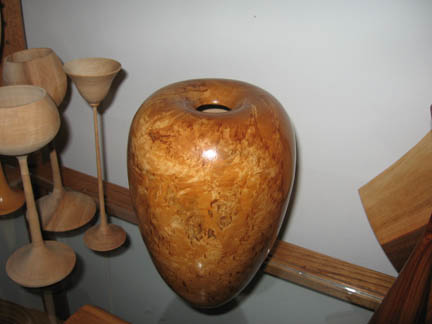
The recent post concerning what species of wood a bowl was turned from raises a question I've had for years....Why do we write what kind of wood our work is made from on the base of our work? If one feels it's important to label the species, then the identity must be correct, not guessed at. That requires study, field guides, and wood ID manuals. I've seen many,many, turnings with obviously mislabled wood ID's. Birch when obviously Beech, Ash labelled as Oak, etc.... Why does it even matter; after all when we look at the work by other craft venues, do we read "thrown from stoneware" or "porcelain" ? "Cast from C863 Bronze"? No. Personally, I don't think it matters, and may actually somehow "cheapen" the product. If a customer wants to know the type of wood I made something from, I simply tell them. What do you think?
I stopped putting the wood on the bottom of pieces a few years ago. Buyers sometimes asked. Most didn't consider the type of wood relevant to admiring a piece to the point of purchase. Admirers of my personal collection rarely ask the type of wood...they are more interested in where I obtained the piece or what I did to it or how I did it. FYI...I have never ever had someone ask me how thin the walls are either...!
To me, the reason to put the species on the piece is because often the customer forgets, especially if it's an oddball species or difficult to spell (black acacia, norway maple, machiche, jatoba, mallee ... you know). Somehow, I think that the name of the species can add a touch of panache to the piece, especially if it sounds exotic, and it helps confer bragging rights to the owner. It is also there when the owner isn't, so that a casual onlooker can find out the species.
I'm with you. To me the project is what's important. Not what it's made of. I may choose the wood to compliment the project but it's the piece that's important. I mean if you make it out of steel do you write SAE1020 or SAE2340. No you usually just say steel.
People often ask what wood it is since my memory sucks and I'm not very good at identifying wood anyway I do write it on a lot of pieces. However that's production work mostly. I'm with you in that I think it cheapens the piece. I mean Van Gogh didn't write what kind of paint he used.
It always bothered me in Photography when they would write "silver Gelatin print" on the label. It's all about the image, not what process you used or what camera you used. It's the image that is all important.
On the other hand it is very hard to identify unknown wood especially when you don't have the bark or leaves handy. I have Bruce Hoadley's book and it does narrow it down when you look at a magnified piece of end grain but it still only narrows it down and doesn't begin to cover all the odd pieces of foriegn wood I buy from Big Monk Lumber.
For the sake of argument Ill take sides with Ellis. I think it can add to the value when you can boast about it being burl, or spalted, or curly etc. It is always more valuable when its made from wood that is not in your own back yeard.
...he often uses woods that they, or even we, have never heard of before! I always place the name of the wood on the bottom, and don't believe it diminishes the value in any way. Of course if I were a segmenter using many combinations of wood, the rules change.
The reason I posed the question is what about the pieces that are well made, but obviously NOT the species noted. It makes someone look like they really don't know their stuff. Some of the exotic stuff goes by several names, depending where you bought it, so that adds to the confusion.
I like to know because it helps me identify characteristics I may hope to incorporate. Yes, things are sometimes mislabeled, but I suspect the majority of the time they are correct and if I see a piece labeled as something that doesn't look right, I'll try to get more information.
I know that I've spoken to a large number of turners that insist that American Sycamore (Plantanus Occidentalis) is a Maple, which I know it is not. Possibly this is because the brits call one of the Maples by the name, Sycamore (Acer Pseudoplantanus).
I usually put it on the piece, but it's certainly not necessary.
Keith, I've sold more than a thousand pieces and people always ask or they state it themselves and ask if they are right, so it did not take long before i started writing the species on each piece...
I possess a different attitude. To me, my role as a woodturner is to reveal the beauty within wood; therefore, it is important that the wood be labeled and labeled correctly.
Perhaps a reason woodturners put the name of the wood on the piece is that WE CAN. Most of the other media mentioned you really can't name the media or no one would know about it anyway. Trees are something that most people know a little about and may have some in their yard. I think people have a "connection" to trees- unlike paint, plastic or clay.
I would like to nominate Ellis & Rob Wallace to feature a "wood or the month" ???
There may be one good thing about writing down the species....we can educate the consumer that WE are using a renewable resource, and we are concerned about not depleting the source of our livelihood, and there will be a good supply for future generations...we as woodworkers or turners, are good stewards of the land.
I have several pieces that I gathered from a commercial tree recyclers and I did ask around in our club and no one knew anything about it. All we can tell that the darn thing stinks like caw manure, and so I would write down stinky wood at the bottom? Well, if you know it you can write it, and if you don't then you say is just a great find. I am with the majority that the art that involved in the creation of the piece should be discussed at the point of sale. Unless, you are trying to sell the wood spices.
They don't often know what else to say. It's kind of an opening statement to get conversation started. It's at that point that you have to start the sale. If you just say "Oak" then you've ended the conversation. You need to keep them interested. You could say it's an Oak tree that came down during such and such storm or it lived in my friends family for 100 years.
OK so you found the wood on the side of the road. Then you need to shift the conversation. Well I found this wood and had trouble identifying it. do you know what it is? What do you think of the shape? What would you use it for? These would all shift the conversation away from the species but would also engage the customer which is the key to making a sale.