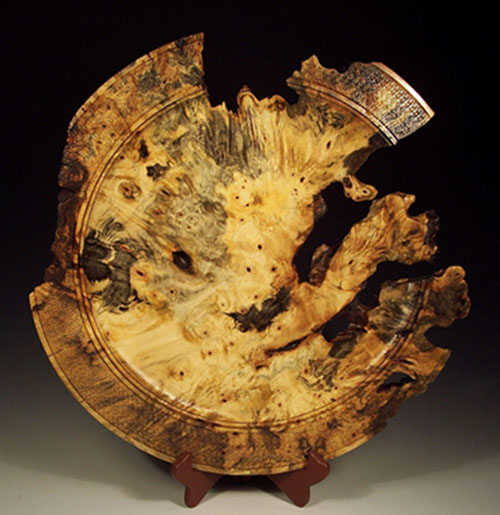
This is a small bowl I recently turned (5-1/2" dia., 2-1/4" H). As yet it is unfinished. I'm pretty satisfied with the proportions. I couldn't get myself to add any surface embellishments. I liked the spalting too much.
C&C welcome.
The question is: What kind of wood is it? I cut the tree down from the woods in front of house, but the tree had no leaves or bark left. I had labeled the piece Sweet Gum, but, after turning and sanding it, I am doubtful. It doesn't look at all like any sweet gum I have turned in the past. Any ideas?
It would be best if we could see a close up of the end grain. Given the views shown, I can't decide if it is elm, hackberry, or maple. It has some attributes of all of them.
Nice bowl. I agree with your decision - not every bowl needs surface embellishment or other "gussying-up" if the form and wood figure are attractive on their own.
It looks like maple to me. You did a really nice job of turning this piece. I love the shape. I agree with you. That piece does not need any texturing. The wood is to pretty on it's own. Texturing would be a distraction.
Thanks for the suggestions. I am in eastern North Carolina (Chapel Hill). Here is an end grain picture.
The mention of elm makes sense. Although there is a lot of sweet gum near where the tree was cut, there is a fair amount of elm in the general area, too.
Regarding embellishments, my pendulum has swung from doing a lot of surface embellishments to doing almost none. Currently, I am more focused on trying to create purer forms and elegant shapes now. There is a happy medium I'm sure.
It looks like elm to me also. With spalting like that I would recommend an oil finish, such as Mike Mahoney's walnut oil finish. After it dries it will buff very well and the oil will really bring out the grain and spalting.
John, Sycamore has flecks that are highly visible when quartersawn..see link. Elm, and related species has a zig-zag pattern in the grain that is unmistakable. Another clue was the tree was leafless and barkless...a victim of Dutch elm disease.
It can't be sycamore - the numerous parenchymal rays on the end grain are absent.
Without question it is an elm (Ulmus) - which species would need some additional sleuthing which can't easily be done over the Internet! We can't automatically assume it is a victim of Dutch Elm Disease without further information.
Only the bottom few feet or so was spalted (a pleasant surprise), yielding about 6 useful small bowl blanks. The rest was too split/rotten/punky, etc. But the price sure was right.
Thanks to you and the others for the nice compliments. The encouragement and affirmation is appreciated.
Keith: Elm is murder to spit, but is even worse to use as lumber.. I remember the time about a hundred years or so ago when I bought some elm to make a chicken coop, because it was cheap. I was up at night working with a Colman lantern pulling out bent nails to replace them because the baby chicks were coming in the morning.