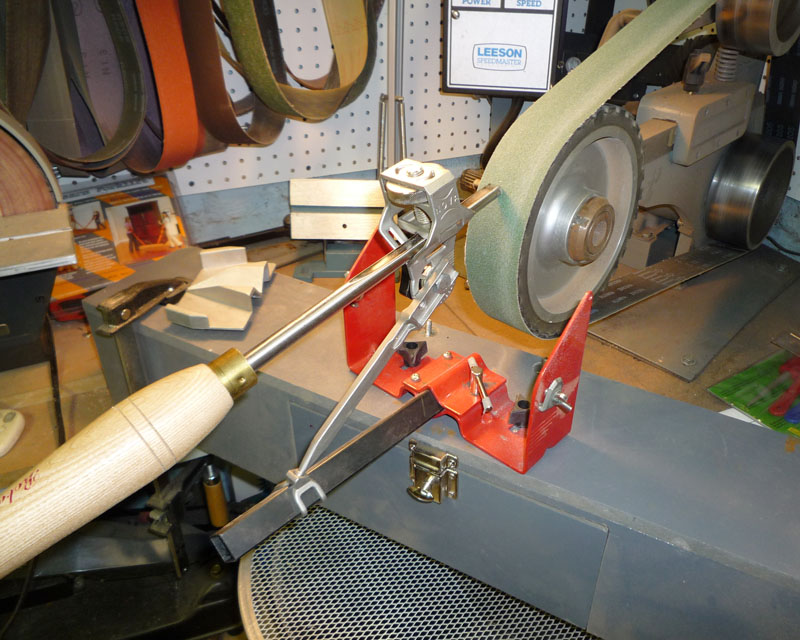
I started out using a sanding disc and then went to a belt sander upside down. Eventually I ended up with a grinder with gray wheels and then white wheels. I like the disc sander because you can move toward the middle and get slower surface speeds. Changing grits would be a pain with a disc sander however. With belt sanders it's very easy.
I took a class with Frank Sudol and he used a 1" strip sander with a worn out 400 grit belt. We were sharpening without a jig and I had one hell of a time getting my tool sharp. I kept rounding the edge further until I had to remove quite a bit of metal when I got home to get it back to normal.
My skills in turning and hand sharpening have improved a lot since then. I'm thinking about trying sanding sharpening again because I want to experiment with higher grit grinding to see how it affects my turnings. This is easily done with belt sander since it's so quick to change belts.
I'd like to know what you like or don't like about it, those who use this method or have tried it. Belt wear seems to be the most obvious although I haven't tried the new blue ceramic belts which I'm sure hold an edge better.
I found an interesting article in Modern home machinist on building jig using a cheap woodworking miter guage. That's for adjusting the angle on a platform or with an extension to use it like you would use a V arm.
Then there was the article in last months AAW mag on converting a cheap HF disc/belt sander for use with lathe tools.
Is it important for the belt to run backwards? My friend who makes knives sharpens his knives with the belt running down. My carving friends who use belt sander have the belt running up.
I did sharpen tools with a belt sander before I got a grinder, I did like the belt running up because that way I never got a shower of hot sparks in my hand.
I use my belt sander to grind steel when making knives and other such things. I don't want the belt running into the edge, because if I get off the bevel, I could essentially stab the platten and destroy the belt. In addition, the force is back into the tool, which would tend to want to push that sharp bit of metal back into my body in the event of a bad thing happening. I'd rathe have the belt carry it away.
Make sure you remove the bag, or you'll burn down your shop. I take a screwdriver with a small magnet to pull out the metal shavings that get pulled into the body. Cuts down on the smell of burning plastic...
You can get a crazy sharp edge, even with a worn belt. Biggest challenges are keeping it from overheating and drawing temper. Never have to flatten a wheel, but you have to make everything since there is very little commercially available to address the market.
If I was going to make something like this, I would use a motor with a rheostat and build it from scratch. You could get rid of a lot of the issues with a beltsander (noise, fire concerns...) and probably build something for under $100 if you have parts laying around and a little mechanical aptitude.
I use the 1" x 42" Viel sander/grinder offered through Lee Valley. I run the motor CCW so the belt travels away from the edge. To avoid inhaling too much metal dust I typically wear my air helmet when using the unit. When I first wired the motor it was CW and I learned real quick that a belt running into the edge can become sliced easily.
Specific to lathe tools, I use it consistently for parting tools and scrapers. In terms of gouges, I'm not comfortable using it free hand for fingernail type grinds. That said, last week I re-ground a spindle gouge by doing the shaping free hand on the sander/grinder and the final refinement on the Tormek.
The other primary use for me is kitchen knives. The area just above the platen is the sweet spot.
I have never tried a belt sander. Knife makers use them extensively. If I was going to get one, I would go with Stuart Batty's Omni grinder. He has been teasing us with it for 2 years now, but after looking at it very closely, it is a very well thought out machine.
I have not used Stuarts. I tried to sharpen my bowl gouge on a manufactured model (I dont remember the name) at a symposium a few years ago. I could not do my grind on it. The tool rest table got in its own way and the jig would not roll over far enough to do the grind. Be careful if you build one that the bench, holding brackets, or the tools rest table is not in the way of the grinding jig you are going to use. There are some out there that only work for scrapers.
There's still no information available on the price of one of the SB belt sharpening stations - at least not on his web site at present. When I asked about cost at the St. Paul AAW Symposium, no price had been determined at that time, and it really wasn't "for sale" at the San Jose Symposium either, as far as I could determine. I suspect the cost will ultimately be measured in hundreds of dollars, and likely far above what most average turners can or want to afford. I intend to stick with 8" low-speed grinders, and will invest in my 'high-end' sharpening station improvements with CBN wheels.
Another difference between sharpening on a belt and a wheel is that the belt will give you a flat grind while the wheel will give you a hollow grind. A flat grind can be either an advantage or a disadvantage, but it might make bigger difference than the difference in grit. This is particularly true if you are comparing a belt using a 400 grit (or higher) against one of the newer 180 grit CBN wheels (or a Tormek's claimed 1,000 grit equivalent wheel). Of course, if you grind away the heel of the bevel, you might make the hollow grind almost equivalent to a flat grind.
My point is that you'll be introducing another variable in your test. Not only will the grit you're using be finer (and, thus, the edge should be sharper), you'll also have a slightly different shape to your bevel. When I first started turning, I doubt I could have detected the difference between a flat grind and a hollow grind. Now, after several years turning and developing a better "feel" for the cut, I can tell the difference between the hollow grind the comes off my 8" grinder and my 10" Tormek. So, I'm pretty sure I could feel the difference between a hollow grind and a flat grind. I'm sure you can, too. So, the question will be, is it the shape of the grind or the fineness of the grit that's making the difference?
David I agree about the flat vs concave however I grind most of my tools now with a very short main bevel so I doubt there is more than a few thousands difference. Now maybe if I was using a 6" grinder and the wheel was worn down to 5" it might be more noticeable.
..from several different manufacturers, and definitely don't care for grinding toward the cutting edge. This tends to round over the edge, whereas grinding away from the edge works OK in most applications. I agree with Rob, that the standard ol' wheel grinders are quite suitable for the task at hand, and refinements such as the CBN wheels really accomplish the job just fine.
Stuart is/was saying that he needed orders for about 1,000 units so he could buy the necessary machinery to make the grinder in house. It has a flat platten, vertical, horizontal at both flat and 90 degrees by being able to tilt the whole mechanise, and about a 10 inch diameter wheel. It has a 2 hp motor, which I think is DC, so that would mean speed options. When I asked him about price, he was saying in the $800 to $900 range, which is what the Baldor slow speed 8 inch grinder runs. Compared to other similar 'knife belt grinders' this is 1/3 to 1/2 the price of the best ones out there I could find, and a way better design. Not sure if I need one, but what does need have to do with it.
Jon Siegel is a pro woodturner in NH that does mostly architectural spindles. He designed a belt sharpening system that used a modified belt sharpener and an indexing system. The motor direction was reversed so the belt runs upwards. The indexing system works like a charm for spindle gouges, roughing gouges, parting tools and bedans. I also use the belt system for sharpenig bowl gouges, but I use the Hannes grind, and do this freehand. He does have a holder that allows you to use the Woverine holding arm if you like that grind, but I an using the Hannes grind pretty exclusively now. See the link to my site to see my modification of the system to get the index out of the way. Takes 2 seconds to flip it up or down. Jon did try to sell these for a while, and was at at least one AAW symposium. He is in the process of trying to figure out a better way to produce them
I found a link to a PDF regarding Jon's system put together by Ward Donahue. It goes through some of the pros and cons. Jon will actually be presenting this exact topic to our club in VT this Sat. I know he has his own write up of his system, and why he thinks it is so much better. I'll see if I can get a link or a PDF on the subject then.
The things I like about this system are
It eliminates the hollow in the hollow grind (I know, some think this is actually desirable)
It is fast, accurate, reproducible for each tool so you remove very little steel
There is a built in buffer that removes the wire edge
I can change the belt in seconds to change grit (I usually use 180)
It is safer, and less worry regarding abrasive dust from a wheel
I do still have an 8" ginder that I use mostly for rogh shaping a tool to a new grind or removing a lot of metal, and I also have a 6" slow speed grinder dedicated to sharpening scrapers that has a platform set to the angle I use.
not sure if the above will link to the pdf, but a google search of Jon Siegel sharpening will pull it up. The link to my modification is below, scroll down the page a little and you'll see it
I would hope it would be that price but Knife grinders run that much or more and they don't look nearly as complicated as his grinder. It looks really cool and probably works fantastic.
Jeff Farris of Tormek fame is selling a kit that converts a grinder into a 2" x 36" belt grinder/polisher. A set of three belts, 220 grit to 1200 grit costs $19.95. Interesting.
Because I originally set up my shop for knifemaking, I own a 2"x72" Bader III variable speed belt grinder.
The variable speed is NIIIIIICE, it lets me be as delicate or agressive with the metal removal as I am in the mood for.
Think about having a single speed lathe, vs a multi speed, or better yet variable speed lathe. You can get used to just about anything!
I have belts from 32 grit to a couple of microns... you can come visit and we can play together!
I typically sharpen my chisels on the grinder with a 240 grit belt over a hard 8" rubber wheel.
It's nice to go easily between my belt grinder and our slow speed 8" bench grinder, so for the moment, it's set up with the wheel. Every so often I configure it with my flat knifemaker's platen... I actually prefer a flat or convex grind to the concave grind produced by a wheel.
Lauren prefers using a JoolTool, so she can actually see what she's grinding. It produces a flat grind.
It all works, and it's nice to have options.
Oh, and virtually all the knifemakers I've known have the belt running towards the edge (the same as a bench grinder). When buffing the edge on a fabric wheel, the knife edge is positioned downwards so that buff runs away from the edge.
If I remember right, you will be in Orlando, and demonstrating as well. I am planning on getting down there. I hope Stuart is there and will have the grinder. Do check it out. I REALLY looked this one up and down, and while it is way more gussied up than I would make it, it seems to be a really simple and efficient design.
I didn't mean to mislead anyone regarding the cost of the belt grinder sold by Jeff Farris. Yes, it's $220. A set of three belts is $20. I had intended to provide BOTH prices. Somehow, I did not.
About a dozen years ago when I really got sucked into this turning vortex and before I had a decent grinder, I sharpened using my portable belt sander propped at about a 45 degree angle in my B&D Workmate. It made a nice intermediate grind on a bowl gouge resting the handle on the workmate jaws and I could freehand grind spindle gouges and skews. I still use it when I want to freshen up my skews which I grind convex as Ali Avisera promotes and hone for months before resharpening. The 120 grit belt runs towards the tool. John Williams published in Woodturning Design #25 his jig to vertically mount a belt sander.
I have used these systems quite a bit since learning about them from Jon Siegel in his own shop about 10 years ago. I built a similar system, and have also used a disc sander instead of the belt.
Mike gave very good info, and I'll be sure to take photos at the club meeting of Jon's demonstration.
My thoughts and experience:
1. Belt must go up (or at least away from the cutting edge, depending on how you hold the tool), for the best result. Belts tend to ride on a cushion of air and if you then push a spinning belt against a platen, the belt has to curve around the pinch point, so the upstream edge gets rounded over. If this is the heel, so much the better! If it's the cutting edge, you'll get a pretty dull tool.
2. Coarse belts can be used for shaping; edge maintenance can be done with 150 - 220 belts and almost no pressure.
3. Belts last a long time if you're just barely touching the tool to the belt. Coarser belts wear out more quickly than finer grits. I have used densely-woven cloth backed 180-grit belts in my past, and they could be used daily for 2-4 years.
4. 1" is not wide enough to be easy to use. 2" might be OK, but Jon's system uses 4 x 36" belts. I have used a 1" strip sander -- going down -- to shape a convex bevel on a spindle gouge, but I couldn't really see what was happening as I held the tool with the edge facing down and the handle up high. This might even work better with the platen removed to get a rounded bevel...(?)
5. Flat bevel: some prefer these, some don't. Logically, the best bevel shape for a spindle would be concave, while the best bevel geometry for inside a bowl would be convex. Flat bevel may be the best overall compromise, unless you have lots of tools to sharpen both ways. I find them easy and non-aggressive in use.
6. Honing: Honing is a must if you're using a 60-grit wheel -- otherwise you're grinding a saw-tooth edge on that tool (both the edge and the bevel itself). When you're using a well-used 180- or 220-grit belt, honing is not so important, and takes the form of a Tripoli-charged linen wheel to buff & polish the bevel, and remove the bur edge inside the flute. Honing with diamond dust hones like Eze-Lap or similar are easier to use with hollow grinds; after honing a few times, a flat bevel can be rounded over in my hands. I currently hone hollow ground tools, but not those with a flat bevel, except I sometimes hone the inside of the flute (I don't have the honing wheel on my current setup).
7. Jon's "jig tower", or side grind adapter, for lack of a better term, allows the use of side grind jigs like the Ellsworth without interference.
8. Gotta say, folks, I have never used ANY system that even came close to this for ease of use, speed, reproducible grinds that are always the same, etc... With this system mounted right next to (or ON) the lathe, powered by a foot switch, you can sharpen and hone a tool in about 6-8 seconds -- no foolin! I'll even try to shoot a short video of the process!
9. These can be built from inexpensive belt sanders with a few modifications, for about $200.
Jon Siegel will be demonstrating his system and discussing its merits at one of my local clubs this month, while the other club that meets even closer to me will be building a few of these from off-the-shelf components a week later. I'll take photos at both events (if I can attend them both), and report back to the group.
I'd say for anyone struggling with accurate, easy, fast, absolutely stress-free sharpening, you should look carefully into these "sand & buff" sharpening systems.
Here's a more expensive way to go with the belt. I could not find the price of the grinder with the belt but it has to be at least as much as the one with 2 diamond wheels. Still if you have the money these look like fantastic machines. They had an ad in the last AAW magazine so I drooled on it for a while.