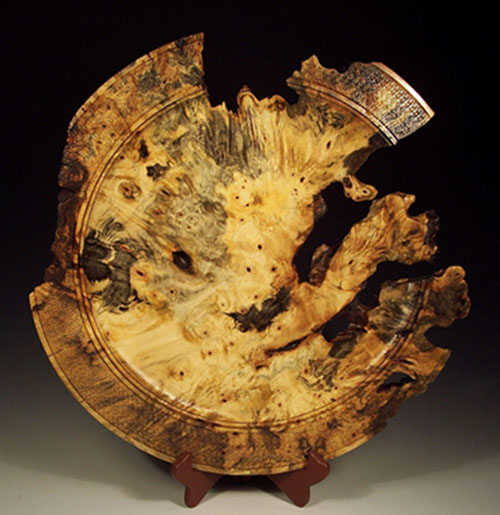
Here's the 3rd attempt, made from the same log as #2...
I've learned that a more open, or shallower shape is much easier to work with -- I really couldn't maneuver very well inside the taller form!
I need to get some fatter logs. These shades are roughly 12" in diameter at the base, while the log was about 14 x 17 with an odd shape. I'll be looking for 20" - 24" logs to make the shape and size I'm after.
These have a turned recess inside the top, where I've cut a disk of 1/4" plywood with 1-1/8" holes to allow the warm air up and out. The curve of the outside comes a little too close to this recess for comfort -- you can see a bright ring where there "ain't much wood left"! Need to figure out how to do this better.
These are all great. You've been hanging out with Peter too much I guess. If you are in need of some aspen, I have a few on our property that are totally sacrificial. One is a leaner and I would love to pull it out of the woods (still alive). I think Peter came up with a method to get some spalting in the logs for more interesting lamp shades. I have yet to try one but you have definitely figured it out. Great work.
I've been following these posts and remember Peter had a youtube video that showed him turning a large lampshade but now can't find it. Any ideas for a link?
I have not seen that link work for a while -- maybe he's concerned too many of us will try to imitate his work. Peter makes nearly all his full-time living off those lamp shades, so I don't think I'd blame him at all.
I've seen Peter start a lampshade in person, but I've never seen how he finishes one, and parts it off. I've seen the short video he used to have on his web site, but I have never seen the 90-minute video of the entire process. He lives about 75 miles SE of me, in central NH, so I may have to request a visit.
These are quite a bit of fun; slightly nerve-wracking until you get used to working with such thin pieces. I think the trick is o work fairly quickly and purposefully, so the thing stays round and wet while you're working on it. That's a lot like working natural edge bowls -- if you work too slowly, you have a lot of additional challenges.
Peter Bloch starts these with about a dozen tear-drop scraper tips all sharpened up and ready, so he can swap them and keep working... I only have one larger one for the Stewart Hooker tool in the Armbrace handle, and a smaller hand-held one for finish work. I could benefit from a few extras, and a good sharpening/honing strategy to maintain sharp edges for very light cuts reaching final translucent thickness (or thinness).
I hope to make a few more whenever we get some weather up in the 30's or 40's again.... I can work in the 20's, but it's just too brutally cold when its only about 12 degrees (F!) in an unheated barn stall! New shop needed -- hey, Santa... you hear that?!?!
Maybe after New Years we could sacrifice one, and practice making a shade or two. I won't turn down a chance to work in a heated shop!
Peter stores them in the shade, and lays them on 4 x 4's, and leaves them for 9 - 12 months. I believe they get rolled about 1/4 turn every 3 months or so, in order to spalt and season more evenly. Logs left too long in one position will have a wetter/heavier side down, and a dryer/lighter side up. I left one that had started to spalt for about 12 months without any tending, and it was too far gone by the time I tried to turn it, but soggier and softer on the side facing the dirt.