Home Articles Forums Gallery Marketplace Videos

WoodCentral Forums

Knowledge You Can Build On — Est. 1998

Exotic Hardwood, Personally Sourced Worldwide. Inspected at Origin. Shop Rare Stock.

basic dust collector questions

Posts

basic dust collector questions

#1

basic dust collector questions

darrin hill

k so my shop has been 'in progress' for more than a year.. and i've finally gotten cleared space to work on my dust collector....

I got mine mostly new.. bought it off craigslist but it still looked new.. guy said he wanted a bigger one...

so can i use an air compressor to blow dust out of the big filter or ?

i think i designed my shop badly... the input to the collector faces my lathe.. now that i think about it it should have faced the wall and the air output should have faced the lathe, since the pipes are going to be on the wall.. The shop, being small, now has a lot of shelves.. and since the motor is lower to the ground than the filter, i built shelves right above the motor... (ie the collector has an 'area' assigned) and if i turn it around then the shelves will be in the way...

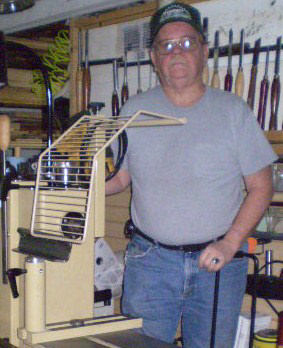
maybe i should take some photos..

any help or advice on general dust collecting theory and lathes would be appreciated.. as far as i know, i will use 4 inch pvc and then drop a tube around each of my machines......

each end will have a blast gate and then i have to figure out how to adapt an input tube for each machine...

does it ever end? I would much rather turn than build the shop...
Re: basic dust collector questions

#2

Re: basic dust collector questions

John Lucas

My problem is I do turn instead of working on the shop. It's reaching the point where I really need to take 4 to 6 weeks off and completely redo the shop. Especially the dust collection.

Right now I have flex tubing running through parts of the shop. Not too bad but I'm sure it eats up some power. I built a sort of manifold that runs behind the table saw and connects the table saw, jointer, planer, router, and then has a hose running to the bandsaw and thickness sander.

I don't think it matters where the input side is but would make it as clean as clean a run as possible to your other pipes. You want the fewest bends you can. It's one of those things that is do as I say not what I do. Where mine sits I have no choice but to make a 90 degree bend on all but one input.

I'm still mulling over buying a building to attach to the back of the garage. I would put my dust collector and air compressor out there along with all the yard tools, motorcycle, lawn mower and much of my wood. That would allow me to run the dust collector hoses much better and with straight pipes. I might even be able to move around in the shop, wow how great would that be.

Re: basic dust collector questions

#3

Re: basic dust collector questions

Bill McWhirter

Two points:

1. Darin- make your primary runs out of 6" pipe (I used sewer and drain pipe) because theoretically the resistance to flow is about one-fifth. The cost is not that much more and what you want is maximal air flow.

2. John-if you put your collector outside it will quickly take your heat or cool along with the dust. Even a small 500 cfm collector will completely turn over the air in a 20 X 20 X 10 garage in eight minutes. I did put mine outside (because of noise and space) but have the exhaust coming back inside.

Re: basic dust collector questions

#4

Re: basic dust collector questions

Dale Bonertz

John is on the mark. Dust collectors work better when they can grab a volume of air. Therefore if your collector can handle a five or six inch main line then it will work better at grabbing dust. As John mentioned the fewer corners the better air/dust grab as well. I did what John said by building a small attached tool shed to the side of my house where it holds the dust collector and a future 60 gallon compressor. The line comes through the wall and I have no choice but to elbow it to the ceiling and then again towards the machines. Still works fine and I have more room and it is quieter.

If you google "Bill Pence dust collecting". He has written an article that is a wealth of dust collecting information - great read. He developed the clear view dust collectors (don't know if their still in business) but I am pretty sure the article can still be found.

Good Luck,

Dale

Re: basic dust collector questions

#5

Re: basic dust collector questions

Barry Irby

I agree with all of the above.

You can blow out your filter bag, but its not necessary and maybe not even good. They depend on being caked with the fine dust to help with the filtering. So, to start with you might just take it off, take it outdoors, turn it inside out nd give it a good shake. After that you might just shake it in place after you empty the bag below and let the dust fall into the trash bag.

Collecting stuff off the lathe is difficult. The action of turning tends to spray the shavings all over the place and setting up collector boxes that will get all of them and not get in your way is problematic. I ran 6" sewer and drain "mains" and then 4" branches to all my tools, but did not even bother with the lathe. The shavings from the lathe may tend to clog up the fan in smaller units. I walk on them a while and then use the 4" flex hose to vac them up with the DC. I also made a separator out of a Rubbermaid trash can I use sometimes, and it works great, but it takes up room in my small shop.

I bring the flex hose to the lathe and hook it in the tool rest when I am sanding. Very effective at collecting sanding dust. Its the fines you really want to collect. They are the harmful part. The big shavings are messy but fairly harmless.

I put a small shed on the back of my shop and put the DC and Air Compressor in there. I highly recommend it. Less noise, more space. My experience is that it does not take the heat out of the shop. At least not badly. I run the DC only when a tool is running not in long bursts. Also, I have a dog door in my shop and I see the DC pull the flap open, so I think the air comes in the dog door, into the DC and out. The shop warms up almost instantly when you shut off the DC. (Most of the heat is in the solid stuff, not the air, anyway)

I try to discipline myself to spend some time working on the shop and some working in the shop.

Re: basic dust collector questions

#6

Exhaust inside

John Lucas

Bill I don't really know how to bring what I'll call the exhaust back inside. The intake of course is a 6" pipe, that's easy enough to run through the wall. However the exhaust is the huge bag filter. It would seem like the only way to capture this (and the heat) would be to build a room for the dust collector to keep all the heat in one small area. Then I would have make another hole in the wall with probably another filter to channel that exhaust and heat back into the main building. Does that sound correct. In other word it's not just a simply matter of running another pipe. At least I don't think so.

Re: basic dust collector questions

#7

Re: Exhaust inside

Barry Irby

One serious advantage to running the DC outside the shop is that ANYTHING it collects is GONE. IF you don't return the air to the shop. No need to worry about the filter or what the micron number of the bag is. And I always spill some when changing the bag. That's outside too. If I could, I would blow it outside into the woods, but I think the neighbors would object. I want a dust remover, not a dust collector.

Re: basic dust collector questions

#8

Well said Barry NM


Re: basic dust collector questions

#9

Re: basic dust collector questions

robo hippy

If possible, get one of the pleated paper filters for your collector rather than the bags. Main reason is you have several times the surface area for the collected air to vent out of, so they work way better. 1 micron is pretty standard now days for both bags and filters, so there should not be a problem with venting back into the shop. If I lived in a stable climate where the temperatures stayed around 60 to 70 degrees, I would not worry about venting back into the shop, but that does not happen here. If you have an outdoor shed, if it has a door into the shop, problem solved. Probably best to have a door to the outside as well for changing and cleaning the barrel, and the filter/bags. Avoid any flex pipe except for hooking up to the machines. You lose huge amounts of air flow with them. You can use one drop down for several tools, especially if you have a smaller shop and have to wheel out one tool, then put it back to use the next one. A remote start is great as well. There are two types, an infared, where you have to point it at the collector, and a FM variety that will work from any where in, or even just outside the shop, which is a lot better. I have a Lone Ranger, which I think I got from Penn State. You may need an electrician to hook it up. Do keep a spare remote handy, and the one in your turning area should be on a hook, not on the bench or in your pocket where it might go into the shavings pile never to be seen again.

robo hippy

Re: basic dust collector questions

#10

Harry Robinette

Re: basic dust collector questions

Harry Robinette

I built a quite room for my 1200cfm DC you hear the air going into the hose more then the unit it self. I used 4" commercial steel down spout with a hose to each machine. My lathe has 2 flex ducts one in front and one in back, I can see a steady stream of dust going in when I sand. I can now sand walnut without even smelling it.

If your just stating your system BUY a book and read it I found out 1/2 to 3/4 of what I was told and what I thought was wrong.

Put a "Y" in any place you have 4' of open duct you'll end up getting a piece of equipment and trying to put a "Y" into an already placed duct is nasty hard work.

Put all blast gates in pointing down or sideways never up,they will clog with dust an not shut all the way.

Just my $.03

PS: quite room was the best thing I ever did for my sanity and my hearing.

Re: basic dust collector questions

#11

Re: Exhaust inside

Josh Bowman

I second Barry’s comment. 2 years ago I got rid of my filters, mounted my 2 HP grizzly dc fan/motor in the attic of my shop and cut a hole in the gable where I ran the 4" DC pipe into a 12" havc pipe that drops into my garden wagon. My DC's air flow and static pressure rose dramatically. I now have a "100%" efficient DC, since I don't recycle the dusty air. I have not seen any real difference in the temperature of the space while running in the summer or winter and I don't see dust on my machines surface after working. I even got a big vacuum nozzle with wheels to suck up my lathe shavings off the floor. I am yet to get a blockage with this set up, where before it happened often.

Re: basic dust collector questions

#12

The inlet diameter of a dust collector ....

JamieDonaldson

..impeller housing is what determines the size of ductwork that should be used. Anything larger creates a big drop in airflow that can cause blockages in the ducts, resulting in a maintenance headache. Bigger is not always better when considering flow dynamics.