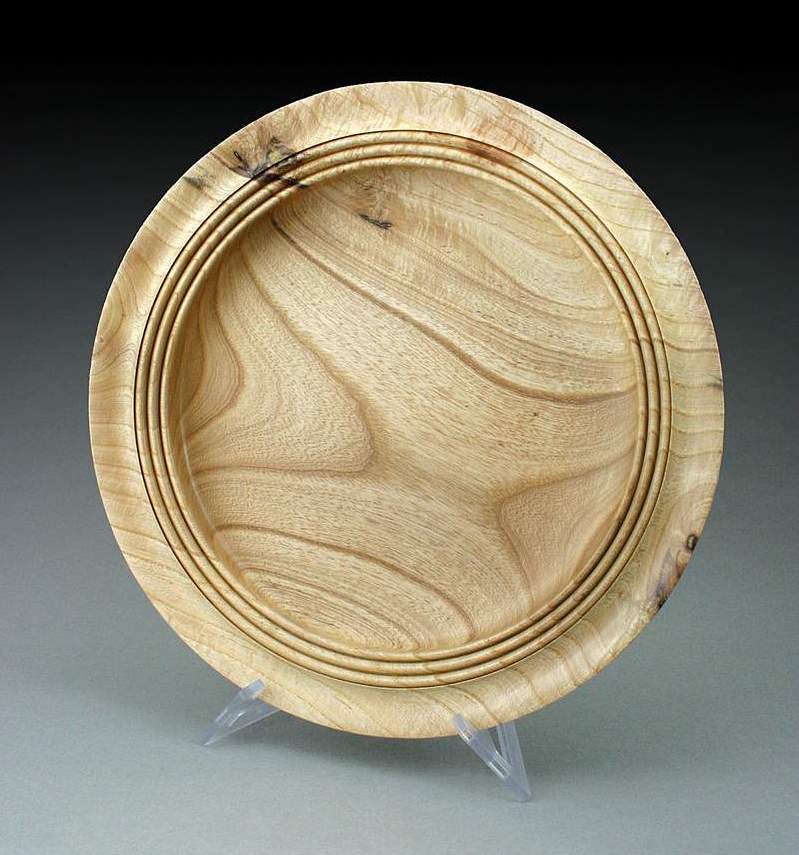
Ok, so I have this giant piece of green (WET!) box elder w/bark inclusion that someone gave me. I cut it in half and discovered the bark goes right down to the center. I began to turn one half, and dunked the other half into DA as recommended. Since I've never done this before, the question is: Should the object be totally covered, and for what time period? And, is it advisable to do a rough turning, then do the alcohol dipping?
I decided to use the Alcohol Drying of Wet Wood technique that Dave Smith developed and highly recommends. In the past I’ve had excellent results with it.
Because of its size, I turned an end grain vase out of a piece of the root. The rough turned wall thickness was about 5/8". I soaked it in alcohol that we’ve used several times before for 24 hours. I removed it from the alcohol and let it dry off for a short while and then wrapped it in brown grocery sack on the outside and top rim, leaving the inside open and upright. I weighed it as soon as it was wrapped, here are the results:
Date Weight (grams)
5-4-06 450
5-5-06 400
5-6-06 365
5-7-06 320
5-8-06 310
5-9-06 265
5-11-06 240
5-13-06 200
5-14-06 190
5-15-06 190
After weighing on the 15th, I final turned it. The foot was still round so that I could use the chuck tenon originally used to turn the piece. There were no cracks or checks. The piece has lost 58 percent of its original weight in ten days
setting in my shop. It was out of round by less that 1/16 inch. The wood was very dry when turned.
I tried the alcohol dipping on a couple green ruff turned cherry bowls and a couple of cherry bowl blanks ( just a round hunk of wood). I soak them for 4 hour's then dried then on a rack over night. Did that over and over for a couple of days. The ruff turned bowls did lose weight and the blanks did not. But they where small enough to finish drying in a microwave.
Thanks to all. I did ruff turn both pieces I was able to get out of that hunk of timber, them dunked them both. I'll look at Dave's article to see if I missed anything. Thanks again.
Ok. I've read Dave's article - sounds good to me, especially since that was exactly as I done did it. Guess my ESP thingee works after all. My wife has always said I'm from a different planet.
Alcohol does not 'rise to the top' of the water - they are fully miscible and form a complete, uniform solution. Alcohol DOES have significantly different evaporation properties when compared to water, even in solution - this is the thing that might be interpreted as "rising to the top".
In your school demonstration, your 50-50 rubbing alcohol-water solution (which actually was likely more water than alcohol, since "rubbing alcohol" is typically sold as a solution of 70% isopropanol and 30% water; I doubt you used 100% isopropanol to make your 50% mix), the differential evaporation of the alcohol during the "burn" allowed it to continue its combustion with the blue flame you observed. Once the amount of alcohol burned-off to the point where there was an insufficient amount of vaporized fuel to continue, the fire went out, and the water left in the towel provided sufficient heat and burning protection to leave it unscathed. It's the different evaporation properties of the components of the solution that account for this. This is indirectly related to the alcohol soaking method for turned items, since it uses the same properties of alcohol having a higher evaporation rate (due to differences in vapor pressure).
The alcohol soaking method (I'll leave "dipping" to the smokeless tobacco users) simply infiltrates the wood with alcohol (ethanol, in this case), that has been adulterated (or "denatured") with another organic solvent, such as methanol (to allow it to be sold without taxation under consumable alcohol laws). By allowing the water in the wood to be diluted with another fully miscible component of the solution (alcohol), the water concentration in the wood drops. The alcohol being used for soaking therefore needs to be fairly "fresh" - that is, of sufficiently high concentration to allow the water in the wood to be diluted by the alcohol. This is why Dave Smith advocates using denatured alcohol which is at least 60 to 70% alcohol (and no lower) in concentration - the alcohol won't dilute the water enough to make it effective if the alcohol being used for soaking has too much water in it.
When the water in the wood is diluted with alcohol after it has been soaked, the more rapid evaporation properties of alcohol allows the wood to "dry faster", at least in theory. True experiments have not been done (or have not been publicized) to compare whether bound water loss in the wood is improved by soaking in alcohol. The goal with this method is to dilute away as much water as possible to replace the water in the wood with alcohol - this can only happen because alcohol and water are fully miscible. When the water has been diluted or "replaced" with alcohol, the alcohol evaporates comparatively quickly, and the time to moisture equilibrium is shortened.
I hope this answered a few questions about using alcohol to assist in drying woodturned items.
Rob Wallace
[One request: Can we PLEASE stop using "DNA" as an abbreviation for denatured alcohol? To the rest of the civilized world, this combination of letters already has a long-time established meaning, and it does not stand for adulterated ethanol!]
Rob thanks for the explanation, I didn't know a couple of things you pointed out and obviously was looking at it like water and oil. I realized a couple of other things also now that didn't before. Well written by the way.
There are not many people on here I'll bet that can hit 80 words per minute typing like I can so I understand their wanting to abbreviate. My problem is I type words, not letters and you have to do that in order to hit high speed, so I have problem with typing wrong word for somethings like "want" instead of "what" and there are others.
How about DNA is for that thing they do on CSI programs on TV and dna is denatured alcohol? Would that be good for this and make all happy?
UNfortunately I have bigger things to worry about like chronic pain, that will take your mind off DNA.
I am a biology/botany professor at Iowa State University, teaching courses in biological evolution, classification and evolution of plants, economic botany, and biogeography. My research has been to study plant evolution and classification using molecular (DNA-based) techniques. I also spend a fair amount of time chairing some college and university committees, mostly relating to curriculum and academic standards.
BTW - At some point in the future, I hope to set up some real experiments to test the efficacy of alcohol drying, as well as doing some studies on the possibilities of vacuum drying - I was able to to acquire a lab grade vacuum pump last week for use in my home "laboratory" (my garage!) - after this semester is over, I'll be setting up a vacuum chamber to see how that might be applied to small-scale drying of wet-turned wooden items.
Glad my comments were helpful!
Rob
PS: Since 'denatured' is one word, some have suggested that we adopt "DA" as the acronym for denatured alcohol, but I think we would get some push back from the district attorney lobby (!). This would be an improvement over use of 'DNA'. The 'generic' abbreviation for ethyl alcohol (ethanol) is ' EtOH ' and in my shop I label my denatured alcohol containers "d-EtOH", and I know exactly what it is.
I was able to hold vacuum (on my gauge) at .02 Torr (mm Hg).
The system is usually used to de-gass urethanes and epoxies prior to mold pouring.
After 30 minutes of constant vacuum I measured no noticeable change in sample weights.
I used a Ohaus Scout 200gram digital scale. The scale measured to 100/ths (.01)of grams.
I measured the sample pieces before and after with no measurable weight change.
All testing was done at standard room temp (72F) with Controlled 50%RH.
Granted it was not a controlled scientific method.
Hope your findings work out better than mine.
I concluded it was not worth the hassle of bringing in rough turned blanks to work and trying to explain to the boss why the Vacuum pump was running all day :-)
"[One request: Can we PLEASE stop using "DNA" as an abbreviation for denatured alcohol? To the rest of the civilized world, this combination of letters already has a long-time established meaning, and it does not stand for adulterated ethanol!]"
Thank You Rob! I am so glad I am not the only one who feels this way.
Mine did not let me either. Someone gave me a small one ( I gave him a bowl) and it has worked very well. It's cheeper to use than alcohol. Now someone else has given me a larger microwave ( up to 15 inch's). Yes I will give him a bowl.
Thank you for this, Rob. I suggested the same thing in another thread on the topic of alcohol soaking.
In Canada, we don't have "DNA", at least as it pertains to alcohol. We have DA and SDA. The only difference between them is that, to manufacture SDA, one needs a special permit, because the end product can still be made potable. There are about 20 grades of DA in Canada, each starting with pure alcohol. Different denaturants are added in specific quantities to form the grades of DA. They are generally then used in the manufacture of some other product. The manufacturers use DA so that they don't need the licences and pay the high taxes imposed on those using beverage alcohol.
I assumed that, with all the topics discussing DNA in the US that things were different in the US than in Canada. Your post would seem to indicate that they are not.
Just to add an extreme example, in Canada the much maligned "gasohol", that is 90% gasoline and 10% alcohol, is a grade of DA. I don't think soaking my bowl blanks in it would give the desired results.