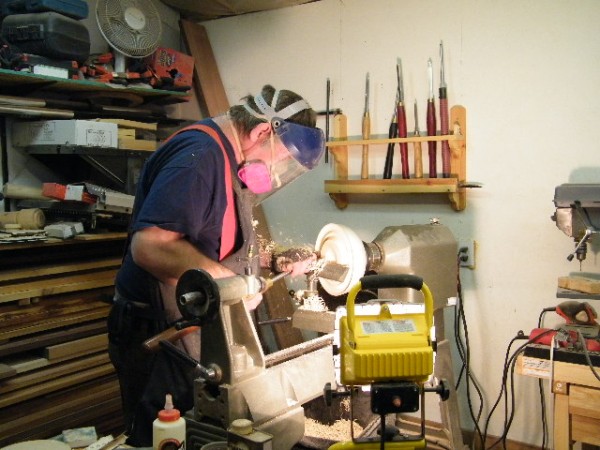
I'm a relatively new turner and just found the joy of turning green wood for bowls. The bowls have a 20% to 33% moisture content. I've turned the bowls to about 3/4" to 1" thick. I understand the the microwave can speedup the drying process. Does anyone have a proven method to achieve a high measure of success for this method of drying?
I just turned a tulip poplar bowl yesterday to about 3/8" andchave been nuking it on and off 30 seconds to one minute and let it rest 2 - 3 minutes. Still fairly damp and will keep it up until I can sand it. Slow process but I'm afraid to to nuke it for 3 - 6 minutes at a time.
It's very helpful to weigh it before starting. When it stops loosing weight, stop the process. It's very easy to just keep putting it back in the microwave for another cycle. Then before you know it, you have smoke coming out of it. Get it outside quickly if that is the deal because of the way the microwave works, it will be burning from the inside out. My only experience is with pen blanks.
Either turn it to three quarters to one and one quarter inch, depending on the diameter, and put it in a double paper grocery bag for a couple of months, or turn it to finish thickness and let it do what ever it wants to.
If you use the first method and just continue to turn green bowls pretty soon you will forget what the first ones looked like and will have a wonderful surprise when you open the bags in May or June.
I am also new to turning green wood and have been given a old microwave to try drying green ruff turned bowls. So far I have not cracked any useing the 1 to 2 min. on and 1/2 hour off to let the bowl cool. Then check it with a moisture meter in several places till it gets to 8%.
By the way this is a great place to get good information.
I'm not new to turning, and have used the microwave with pretty good success. The key is multiple short bursts at partial power -- all depends on how powerful the microwave oven is. If you have a goblet with a thin stem, be real careful -- a thin spot is where you can over-do it, and scorch the wood.
Unless you burn the wood, there should be no objectionable odors (may depend on the species of wood), but if you go too far, you'll regret it!
For all the details, including a detailed explanation of how it all works, get Turning Green Wood, by Michael O'Donnell.
It's a very good book that's well worth having, and you can always donate it to your local club's lending library when you feel you no longer need it on your shelf. I refer to this book a lot, so I bought 2 copies -- one I keep, and one I loan out.
i had a pine tree fall about a month ago.. i decided not to waste it and cut logs.. i decided to take a bunch of scraps and make staved bird houses. Decided to use the pines for turned tops and bottoms.. turnings were around a foot long (yeah.. bird houses are bout 3 feet or more long... multiple stories)..
but i nuked the turnings.. out of one 6 inches diameter, i got 3, 8 oz drinking glasses full of water..
and one almost caught on fire.. it has carbon and made lots of stinky smoke..
i kept a log of the weight.. and it had not bottomed out yet.. i was still loosing weight, but it burned.. i dunno... probably best to let the wife do the tree cooking ...
Wow -- that's a lot of sap in that wood, Darrin; thanks for the report.
The key to drying wood in the microwave is to do it in multiple, very small steps. Within reason (and time available) more steps are better. You do not want to do it in one go, as that defeats the purpose of driving out the water without creating a large difference in MC between the surface and the interior of the wood.
The key is to think of the MC of the interior and the surface, and keep these pretty close together. Michael O'Donnell's book goes into all the details, and shows an excellent plot of these MC values, showing the value of multiple, short, gentle "nukings".
Oven drying would just explode the blank. The end grain would give up the water too quickly and cracks develop really quickly. I think microwave works only on the water molecules, so it from the inside out. You can still set up stress, just not as easily.