What do you use to make the ferule for a lathe tool handle? I recently used those inexpensive copper fittings that I got at the hardware store. But I couldn't cut through them with lathe tools. Resorted to a metal saw and then used a file. Not very elegant! Is brass easier? I think I'm doing something wrong.
Everyone has a different answer. I use copper pipe. Comes in various diameters. Easily cut to length and polished with steel wool on the lathe (watch your fingers with steel wool).
If you only want a functional ferule, and "purty" is not important, wrap it with a strong string and then coat the string with epoxy. I learned this trick from reading David Ellsworth's book.
To make wrapping easier, I tack the end of the string in place with CA, do the wrapping, and then tack the other end. Then, I apply 5-minute epoxy.
The string I use is strong, but its diameter is less than the thickness of a dime. Seems to work. I've never had one to fail.
I use a tubing cutter to make something to the right length, and then insert it over the handle end. It is usually a pretty tight fit, so no glue is needed. I may have to drive it on by hitting the rear of the handle before turning it, and after the hole has been drilled. After putting on the ferrule, I dimple the sides with a nail set 3-4 time to lock the ferrules in place.
I use the connectors for copper pipe, usually the one inch ones. They have a mid point marked on them so I cut them in half and that seems to be just about the right size. Usually put a bit of CA glue one the wood before I fit the copper. I usually try to taper the end of the wood portion just slightly so the copper has to be nudged a little to go on. It a cheap and easy answer. If you want pretty you can polish with steel wool and spray with lacquer.
My favorite ferrules are brass flare nuts, although they have to be sized to the tool diameter. They are strong, and give the handle a professional appearance. They can be threaded onto your tenon, and if the tenon is turned to match the flare inside the nut, they will actually grip the tool.
I always epoxy mine on and file them round on the lathe.
Typically I will drill my hole, turn my tenon, thread the ferule onto the tenon, epoxy ferule to tenon remount with ferule in cone live center, file the ferule round,turn the handle to shape, sand, finish, epoxy tool into handle. Before fitting tool I will clean the hole with a hand held drill bit of appropriate size. The brass will sand to a brilliant shine.
Thanks for the tip of the CA to hold the end of the string. Dad used to have a sporting goods store, and would re-eye fishing poles with the wound string method. On those, a short U-shaped length was placed under the winding on the end where the winding would finish, and the loose end pulled back under the winding with the U. The entire winding was then coated with clear lacquer.
The CA sounds quite a bit easier, especially when considering trying to pull a larger string back under against wood instead of fiberglass.
A bunch of good answers. Brass, copper and aluminum all make good ferrules and can be turned on the lathe with standard HSS lathe tools. If you have a piece of copper or brass that won't cut it has been hardened or possibly work hardened. You have to anneal it and it's exactly the opposite of annealing steel. Heat it red hot and quench it and it will take the hardness out.
Standard smooth ferrules will eventually fall of no matter what glue you use. The wood constantly moves over the seasons and eventually breaks the glue joint. Sometimes it takes years for this to happen. If you look at most store bought tools there will be a dimple in the ferrule that been punched in. This holds it on to the wood after the glue gives way. there are some exceptions I know, probably an industrial glue that I don't know about but generally what I stated above is true.
For that reason I like the threaded brass plumbing fittings. I can thread them on the wood by leaving the wood just a hair larger than the inside diameter of the brass threads. Then I turn down the hex and add some personal touches to the shape. They look great and stay put forever. I do add a drop or two of epoxy before threading it on.
Doc's string method works fantastic. I had to make a quick handle one day about 8 years ago and used dental floss and coated it with thin CA. It lasted about 7 years before it came off. Epoxy and string lasts longer.
Thanks! So there must be one more step, it would seem: after threading the flare nut onto the tenon, you would have to un-thread it to apply the epoxy. If I am following you properly, these flare nuts start out hexagonal so that you can use a wrench for threading and un-threading so as not to mar anything up. Then you file it round. And, again, if I'm following you, you don't use lathe tools on the brass. Do I have it right?
Yes Eliot you are correct in your assumptions, and no I do use turning tools on the ferrule, just a file and sandpaper. I do insert the tool when threading on the ferrule to help keep the ferule true to the tenon.
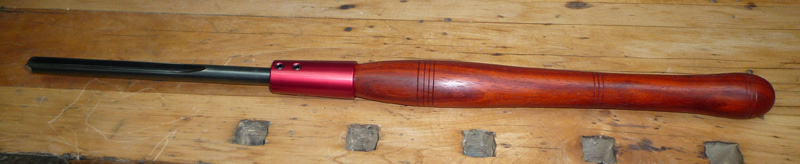
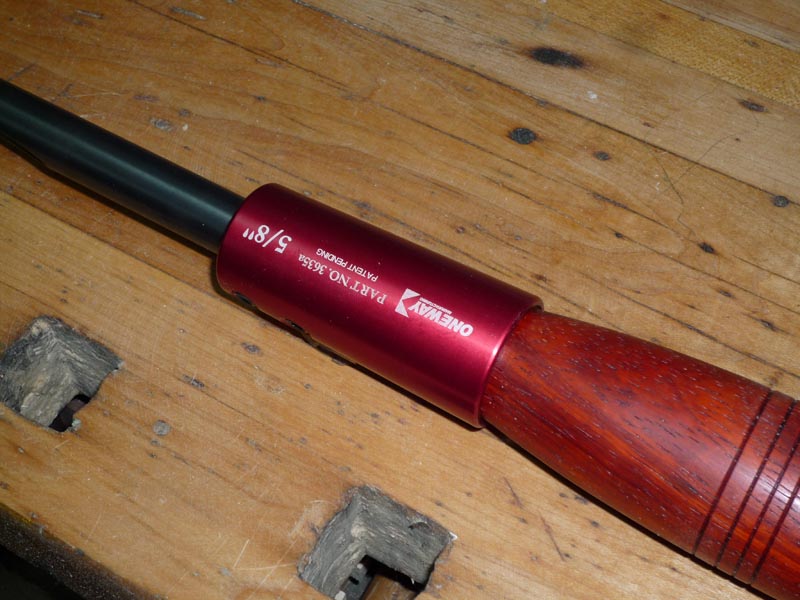
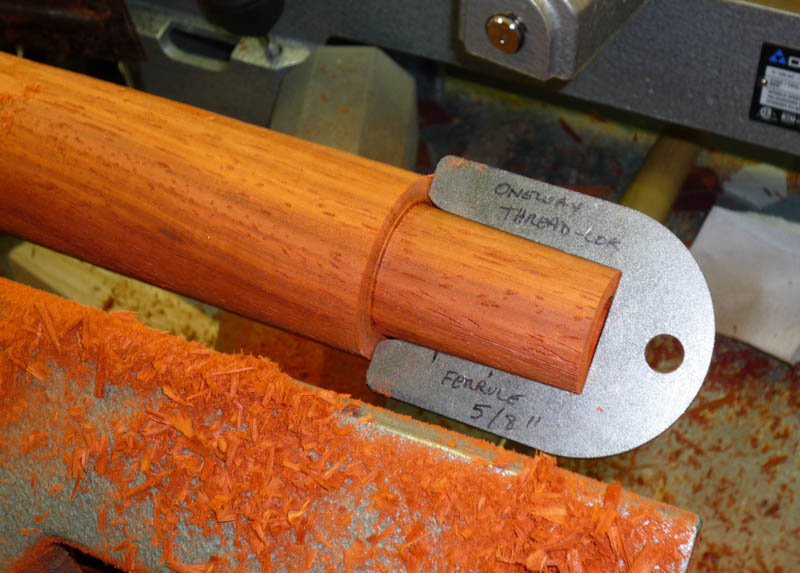
I've made a few wood handles. I've taken a different approach, I used OneWay Thread-Lok adapters.
These have fine tapered thread that locks onto a tapered tenon cut into the end of the handle. This adapter lets you easily remove the gouge from the handle.
Shown here with a 5/8" Thompson gouge on a padauk handle.
How cool is that! Nice job! So now I can think about a range all the way from some twine, to a DIY metal thingy, to something sophisticated like this. What a world!