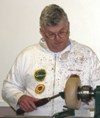
In a session in my shop this last weekend with a couple of old-time turners, I was surprised to learn that I was alone among them that focuses my attention to the opposite side, away from my cutting tool, to control my cut and to check the profile in progress. I do this with the inside cut of a bowl or box as well. Don't we all do this? Where do you look?
That's how you accurately control the shape. You watch the shape and then your hands and body will move accordingly to get that shape. It's much more accurate than looking at the tool.
There are of course times when you look back at the tool. when I'm turning up to a shoulder for example. I glance back at the edge because I may change the orientation of the tool to keep the edge from catching on the shoulder.
Same thing is true when cutting up to a foot on a bowl. I'll watch the shape of the bowl but as I get really close to the foot I'll move my eye back to the tool edge and orient the gouge to get a clean cut without a catch right up to the foot.
As John says, it's a good idea to take a peak at the tool from time to time near critical "events", but, otherwise, you see the shape (on the outside) and the shoulder (on the inside) better away from the tool.
A good note here is the importance of having a strong light source shining along the axis of the lathe. This highlights the smallest ripples that are hidden by overhead lights (particularly linear fluorescent tubes). Since I turn outside on my back patio, this is a constant aggravation for me. It's pretty hard to find a light stronger than the sun, but I try -- with a 250 Watt reflectorized flood-light bulb held on a photographic tripod on the back side of the lathe. ...Gary
I glance back and forth. On the outside, I have the shape the way I want it, and then make a finish cut. Most of the time I am watching the cut, not the profile. Watching the profile has me standing in the line of fire. Since the shape is already right, just watching the size of the shaving tells me if I am cutting right. I do use my hands a lot to feel for bumps and flats. On the inside, pretty much the same thing. You can't see a profile, so you watch the cut. On roughing, it doesn't matter, but if my tool hand is covered with shavings, then I look to the opposite side. I again, watch the shaving thickness.
On the outside I tend to go back and forth, between profile on top and the cutting tip.
On the inside, I noticed that the other day, when cutting with a Kelton, I was looking at the lower part of the inside, following the cutting line that appears. This was of course a closed form, with a large opening.
rear view mirror to see why the idiot in the red Ford is honking
cell phone
then road.
I try watching the top profile after initial roughing but find it hard to do when making a finishing cut. On the inside I watch the tool tip otherwise I seem to regularly loose the bevel.
I spend probably 80% of my time looking at the top when on the outside and opposite on the inside. Like others, I do check my cutting edge and tool position though.
Same here Ronny. I watch the cut line progress on the lower right of the inside. Often, if I have felt a lump somewhere on the inside of a bowl (Terry is right about always giving it a good feel!), I will mark it with a pencil or chalk line and then watch the line disappear as I shave away the hump.
I try to watch both areas as much as I can. If I'm struggling with getting the shape I want I watch the "horizon". I also, as John L. says, watch the cutting edge to make sure I'm using the edge correctly and not approaching a catch situation. When I'm roughing I watch the horizon to see when the piece becomes round as well as the cutting edge. My focus goes back and forth a lot. I do tend to concentrate on the cutting egde during finishing cuts.
Hi Mike, I think there is another part to the equation: I look at the top of the form when I'm turning, whether it's a hollow form, bowl , or spindle turning. It takes skill and confidence to not think about how the tool is cutting; someone who struggles with catches always needs to look at the tool to try to avoid more catches. The form is always secondary. But the second part: Do you have a preconceived idea of the final shape, or design on the fly? And, is the final result what you expected? Often I hear that we should cut from beginning to end in a single, uninterupted cut..I think that is a big distraction to many. So much attention is paid to how the tool is cutting, and again, form suffers. As an example, sometimes I may feel a "bump' on the inside of a bowl, even if I can't see it. I will highlight the bump with a pencil line with the lathe running, then carefully sneak up on the bump, watching the pencil line vanish. So, instead of making a new one-continuous-cut, I remove only the high spot. I always have a preconcieved idea of the final product...I think that helps.