Home Articles Forums Gallery Marketplace Videos

WoodCentral Forums

Knowledge You Can Build On — Est. 1998

Compare cordless drills on the numbers that matter

Dill's Exploration, Discoveries & Demystification

Posts

Dill's Exploration, Discoveries & Demystification

#1

Dill's Exploration, Discoveries & Demystification

charlie belden

Exploration, Discoveries and Demystification - Barbara Dill�s Journey

Escoulen�s eccentric/mullti-axes turnings brought almost Hieronymous Bosch conceived forms into the wood turning communities� consciousness. Stoney Lamar and Michael Hosaluk took multi-axis turning into the abstract. Mark Sfirri took it into the surreal. Keith Holt and Derek Weidman use it as a new means of sculpting pieces that initially don�t look turned at all, but rather carved - with mallet and chisel - applied to stone. Each exploits the freedom from, and the possibilities offered by escaping, the single axis symetry that characterizes most wood turnings we see.

Until Barbara Dill�s methodical exploration of multi-axis turning, and her papers on her discoveries that she�s been sharing with the turning community, the use and exploitation of multi-axess turning has been limited to a few imaginative and creative turners.

Though other�s have tried to explain how a piece of theirs was done using multiple axes, it is Barbara Dill who has begun to develop a systematic structure and vocabulary of the principle of mutli-axis turning upon which mental models can be constructed that enable outcomes to be predicted. Using these mental models that link Effect and Cause, she provides the turning community with mental tools that can be used by almost anyone - to DESIGN multi-axes pieces - and get the intended result. Whether the intended piece is asthetically pleasing or not - is determined by the design, not the means by which the design becomes a reality.

Barbara Dill is demystifying multi-axes turning, literally lifting the myst surrounding the underlying concepts of multi-axes turning. While there�s still a long ways to go before multi-axes turning becomes part of most turners� repertoire, she�s laying the foundation for the understanding and exploitation of multi-axes turning.

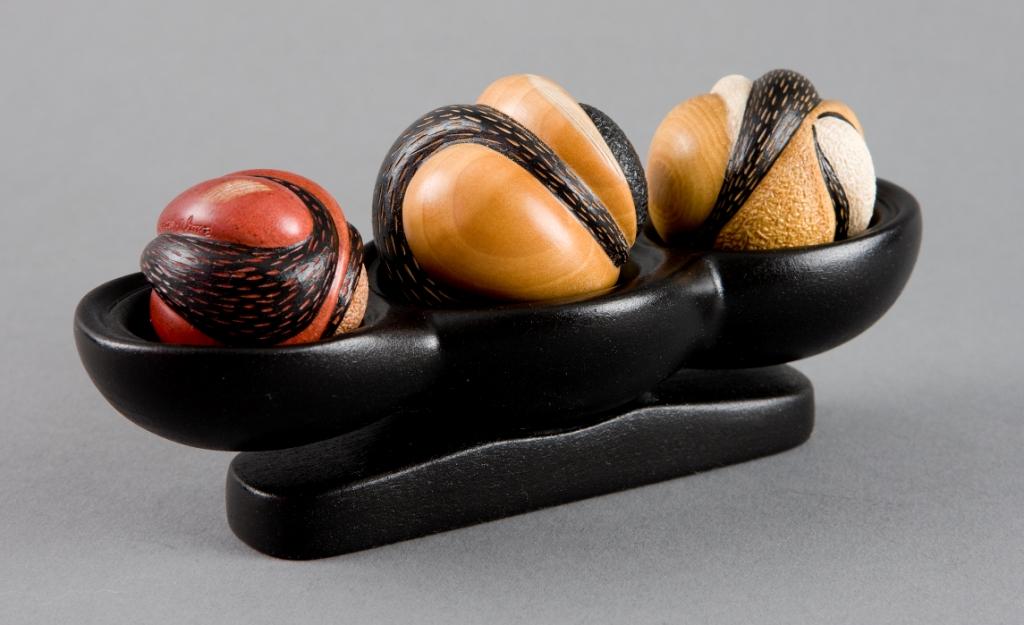
As her understanding of multi-axes turning is developing, she�s also developing her own minimalist aesthetics for it, creating pieces that are immediately familiar - yet somehow unfamiliar - pieces that most turners have never seen before, or even imagined. I have no doubt that these early works will become part of major collections.

Being on the cover of the December 2011 issue of American Woodturners magazine, with a featured article and a two page gallery of her recent works to accompany it, is a well deserved acknowledgement of her contribution to the turning community.

Some explorers kick open doors which close behind them as they pass through them on they journey into new areas of turning. Barbara Dill finds the keys, unlocks the doors and leave them open for others to pass through.

Trappers and traders made it to previously unexplored areas well before Lewis and Clark. But it was Lewis and Clark who drew the maps and took notes of what they encountered - so others could begin to grasp what was Out There - and perhaps venture into those areas - to create settlements that became great cities. Barbara�s approach to her exploration of multi axes turning is in keeping with the Lewis and Clark tradition,

Once again, thank you Barbara Dill, for opening the doors to multi-axes turning - and creating maps for the Rest of Us to use.

Re: Dill's Exploration, Discoveries & Demystification

#2

Re: Dill's Exploration, Discoveries & Demystificat

Frank Van Atta

A hearty second to a well-deserved accolade. Barbara has probably done more than any single person to further the use and understanding of multi-axis woodturning, and she is certainly to be lauded for her unselfish sharing of information as she discovers it.

Re: Dill's Exploration, Discoveries & Demystification

#3

I took a class with Jean-Francois......

JamieDonaldson

...Escoulen at Arrowmont several years ago, and although I've been turning for 25 yrs. I felt like a beginner, watching him use the French bedan to create magical objects. His skills and imagination were so far over my head that the experience was humbling for me. There is so much mystery about multi-axis turning that it would take years of intense study and experimentation to "master" the options available. :O

Re: Dill's Exploration, Discoveries & Demystification

#4

Betty Scarpino

Re: Dill's Exploration, Discoveries & Demystificat

Betty Scarpino

Charlie, I appreciated reading your tribute to Barbara Dill ... eloquently expressed, thank you! I was very pleased that she was willing to share her knowledge with AW readers. I probably won't do multiaxis turning myself, but after editing Barbara's article, at least now I understand the theories involved so that when I look at multiaxis work in the future, I'll know more about what the maker went through to create a particular piece.

Re: Dill's Exploration, Discoveries & Demystification

#5

Keith Tompkins

Re: Dill's Exploration, Discoveries & Demystificat

Keith Tompkins

Hi Charlie, You certainly have a way of painting with words! Perhaps you should write a novel :D I think what Barbara is doing is simply drawing out what she sees in her head...I've come to realize not all people can do that. Kinda' like drawing something on autocad, then watching the image in 3D as it rotates to view it from all angles. It's easy to visualize for some, impossible for others. It will be interesting to see where she takes it.

Re: Dill's Exploration, Discoveries & Demystification

#6

Well said, and congrats to Barbara!

GaryG in MD

I was very pleased, when I got my Journal in the mail today, to see what was so obviously Barbara's work on the cover.

She has worked very hard and with great passion, vision, and integrity to get where she is, and, happily, where she now is is being recognized as a pioneer.

Brava, Barbara! ...Gary

Re: Dill's Exploration, Discoveries & Demystification

#7

Re: Well said, and congrats to Barbara!

Barbara Dill

Thank you for these comments. Charlie has been such a cheerleader to me for many years..he even made drawings in 3D. Many clubs in my region invited me to share these ideas. These opportunities helped me clarify my thoughts. And Betty Scarpino worked her editorial magic on this artlcle and I thank her for that. I loved multi axis work from the minute I saw it (the early 90's). I just got tired of not knowing what else I could do after making a few candle holders. So I became obsessed. I am glad that this information is valuable to others. I am still enjoying this path. So thank you.

Re: Dill's Exploration, Discoveries & Demystification

#8

Re: Dill's Exploration, Discoveries & Demystificat

R Henrickson

A very clear and comprehensive discussion of the factors involved, with clear and well-chosen photos and drawings. A great basic reference.

Re: Dill's Exploration, Discoveries & Demystification

#9

Re: Dill's Exploration, Discoveries & Demystificat

charlie belden

Keith:

I don't think this is a "Michaelangelo merely freeing The David from the larger marble block " thing - at least not initially. That approach starts with envisioning the desired piece (the design or WHAT), then figuring out the methods to execute the design (the HOW). Keith Holt and Derek Weidman pieces use this WHAT Then HOW approach.

Barbara's approach appears to start with the "primitives" and developing designs that exploit them. Start with HOW and work backwards to WHAT.

As her understanding of the primitives of multi-axes turning has developed, initially with between center spindle turnings and then pieces that apply what she'd learned ( stems of candle stick holders and goblets ), and now intersecting concave and convex arcs, she is developing her own sense of aethetics for her multi-axes pieces.

With her knowledge of HOW , with the accompanying mental models that allow her to visualize them, she is now working out the aesthetics of her multi-axes pieces - combinations that work together, proportions, negative and positive space, light and shadows, surface intersections, . . . For things like plates, bowls, vases and hollow forms, much of their aesthetics have been worked out - golden ratios, the rule of thirds, the rule of fifths, as well as the methods to create them. Not so for multi-axes pieces. And THAT will probably be where she goes next.

What's really valuable to the rest of us is that she's sharing her insights and discoveries - in a way that the rest of us can begin to grasp - and utilize - to apply in OUR own way to our own pieces.

Re: Dill's Exploration, Discoveries & Demystification

#10

Re: Dill's Exploration, Discoveries & Demystificat

Bill Neddow

Wow,, Charlie -- you said this so beautifully. I agree with every word.

Re: Dill's Exploration, Discoveries & Demystification

#11

Re: Dill's Exploration, Discoveries & Demystificat

John Lucas

Well I've been playing with off center turning almost since I started turning. I think I saw an article on making a hammer handle and had to give it a try. I've done a lot of inside out turning. I think I saw an article in a very early Wood magazine book. I also own several books and lots of magazines with various articles.

Barbara has done about the best job of explaining it that I've read. Her articles are wonderful and should help anyone understand it better. Great job Barbara. I believe you answered some questions I still have. There will probably be some off center mirror handles in the very near future.
