Home Articles Forums Gallery Marketplace Videos

WoodCentral Forums

Knowledge You Can Build On — Est. 1998

Price drop on over 1300 Rockler items

New work

Posts

New work

#1

Ellis Walentine

New work

Ellis Walentine

Hi folks,

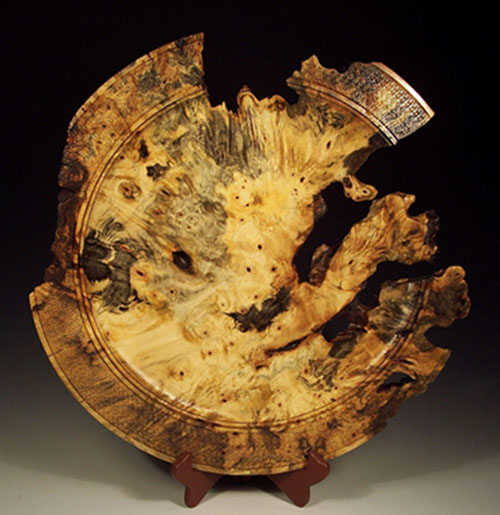
I just thought I'd post a shot of a plate I turned recently from a piece of "anthracnose" walnut that my friend Mark Mandell gave me a while back. The plate measures 12 1/2" in diameter and is about 5/16" thick for the most part. There were several voids in the dark areas of the wood that needed to be filled with epoxy before I could proceed with the turning.

I had to look up anthracnose to find out what it means. Here's a link, if anyone else is interested: http://www.na.fs.fed.us/spfo/pubs/fidls/anthracnose_east/fidl-ae.htm

Ellis


Re: New work

#2

Re: New work

Mark Mandell - Gone Round In Jersey

Exceptional job, Boss!

You done that plank proud!

Re: New work

#3

Steven Antonucci

Fine bit of turning...

steven antonucci

Looked at the link... it doesn't appear the inclusions are related to your $10 word?

The hardest thing on that piece is getting that continuous flat surface. Impressive.

Steve

Re: New work

#4

Betty Scarpino

Re: New work

Betty Scarpino

Ellis, excellent use of a lovely piece of wood!

Re: New work

#5

Re: New work

Hal Taylor

Looks so good I want to touch it.

Re: New work

#6

Ellis Walentine

Thanks, Steve

Ellis Walentine

Yes, I've always found it difficult to get a flat surface on a plate, and this was no exception. As for the $10 word, I was just repeating Mark's terminology and pointing you to the first link I found. Maybe he can add some further explanation. Otherwise, what do you think causes this kind of inclusion and grain deformity in walnut?

Ellis

Re: New work

#7

Steven Antonucci

Per the link, only leaves and twigs affected

steven antonucci

in walnut.

I assumed that this section was in a crotch, and that the figure would have been as a result of normal stresses. As for the inclusions, I can't imagine.

I do have a lot of white oak that exhibits this kind of bark inclusion, along with the burl and curl as pictured. I know that the log that these planks were cut from was massive (48") and perhaps your tree was similar?

Mark- do you know the tree?

Steve

Re: New work

#8

Don Leydens

Re: New work

Don Leydens

Very nice piece, Ellis. I'd love to know what might have caused those little voids also. Well done.

Re: New work

#9

Gorgeous!    (and some questions?)

Barry Irby

The is a really great piece of work and you done the wood proud.

I use my card scraper as a straight edge with the lathe off from the center to edge and across the center to check for flatness. Mark the high rings with chalk.

The questions are about the Anthracnose. Is it possible that its not a good idea to move this wood around for fear of transmitting the disease? Is it impossible to move the disease with the wood? (I ask because I live in Chesterfield County VA and the walnut trees here are quarantined because of Thousand Cankers disease. I understand it Ain't the same thing but I am wondering anyway. Can't move walnut out of the county.)

Also what is the disease that is attacking the Dogwoods? I thought it was Anthracnose.

Re: New work

#10

Da Fungus Amungus

Mark Mandell - Gone Round In Jersey

I harvested the tree (and several others) from my friend's property. As he is an arborist and disease specialist for a tree service, I'll take his word on this. The fungus may damage the leaves, however it does invade the trunk and the swirling grain you see is the result of the tree fighting the agent by encapsulating the effected areas. The result is the intense gnarled wood that can run throughout the trunk. Seriously effected trees will show bark broken by many large dark cankers.

We had an interesting time milling the logs because the order of the day was to chase the figure. My sawyer said he'd never sawn such walnut although he'd seen similar trees but regarded them as firewood. Changed his mind about what's "junk wood".

While the grain is gorgeous, the wood is inherently prone to cracks and such due to the bark inclusions, so it must be worked carefully and should be filled, reinforced with resin.

Re: New work

#11

It's Everywhere, Barry

Mark Mandell - Gone Round In Jersey

Some trees are effected, others are not. "Spreading" is not an issue, however, effected trees are usually removed to try to protect others nearby.

Re: New work

#12

PS-Here's Another Slice

Mark Mandell - Gone Round In Jersey

From a similar (or the same) tree


Re: New work

#13

Re: PPS

Mark Mandell - Gone Round In Jersey

Found, so far:

2 Snow Monkeys

A Chipmunk

A Beluga Whale

A frog/toad

:D

Re: New work

#14

What I was trying to figure out.....

Barry Irby

is if we turners were sending such wood through the mail, and I got a piece and put the shavings in the compost pile, would I have infected my local trees?

The Thousand Cankers Thing has got me stirred up. In a local county a timber merchant sold 18,000 BF of walnut and got $34,000. Nearly $2 a BF ON THE STUMP. Seems great to me especially when you consider local walnut is not generally considered premium wood. BUT, there was a clause in the contract that said if they extended the Ban to that county, they would pay nothing.

All the various diseases are scary.

Re: New work

#15

Beautiful!


Re: New work

#16

Re: New work

Bernie Weishapl

Beautiful piece Ellis. Wood has a lot going on.

Re: New work

#17

Beautiful Work!

Bill Clark

Beautiful work Ellis. With a nice piece of wood like this your platter design did not compete and let the wood itself be the center of attention. Well Done!

Re: New work

#18

Re: New work *LINK*

TomCollins

It's possible this tree has been infected with 1000 cankers disease. It would tend to produce the bark inclusions and distortions seen in the wood.

I grabbed a random website describing this disease. I know it is found here in Ohio.

TomC


http://www.thousandcankerdisease.com/

Re: New work

#19

Re: Thousand Cankers disease

Gary Evans

Barry,

I don't know how the ban works up there where you are, but down here in Blount County TN, you can't move walnut logs or firewood out of the quarantined counties without treatment or a compliance agreement. You can, however, move kiln dried lumber out of the quarantined area without treatment or a compliance agreement as long as it contains no bark or cambium layer.

www.tn.gov/agriculture/regulatory/tcd.shtml

Gary

Re: New work

#20

Beware of Capitals *LINK*

Mark Mandell - Gone Round In Jersey

anthractnose is a generic term that covers a host of plant diseases, some of which cause canker, encapsulation, and inclusions as demonstrated in Ellis' piece [and the hefty stack of stuff in my shop ;) ], rather than a specific pathogen.

It is NOT, however, TCD which has its greatest impact on twigs and small branches causing the infected tree to die from the top down as the vascular and photosynthesis systems are disrupted to failure.


Tree Canker

Re: New work

#21

Ellis Walentine

Yes, and besides

Ellis Walentine

The inclusions and weird grain of Mark's log were obviously there for many years, as it is throughout this tree which is probably at least 50 years old. Thousand Cankers Disease has only within the past six months been observed as far north and east as Bucks County PA. I don't know of any reports of infestation in NJ, which is where I believe Mark got the log. Until this year, the farthest north and east the disease had penetrated was in southeastern VA, as I understand from the news reports. It's on the move, though, and I'm not optimistic about the fate of our black walnut in this country. It may not happen in our lifetime, but the black walnut may be fated to go the way of the American chestnut. Sad.

Ellis

Re: New work

#22

Canker is the term that comes to mind for me.

Keith Newton

Lots of folks think any big knot on a tree is a burl, but around these parts, this is more common.

But I could be mistaken.