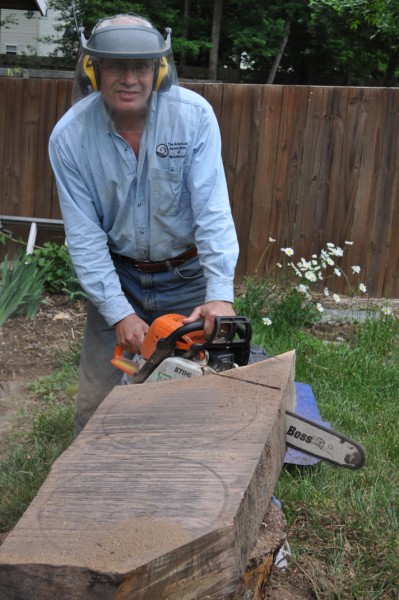
Came home to find a couple wood chunks on my doorstep. No idea who left it and no idea the type of wood. Both my wife and I smelled the wood and it's pretty bland without much odor.
Sure looks like elm to me. Both bark and grain. Not all elm will have that distinctive aroma until you turn it and even then it doesn't always smell real bad. Of course I turn a lot of it and may be getting used to it but my wife and kids will always ask me if I have been turning that smelly wood again.
Almost certainly elm. If the end grain photo were a bit more in focus/sharper and slightly higher in magnification, it could be confirmed definitely.
Black Locust (Robinia) is a dense, ring-porous wood with abundant tyloses... likely not present in this sample.
The wavy ray figure in the tangential section is a dead give-away for elm.
If fresh, the cut wood might have an "unusual' smell, sometimes likened to an aged, uncleaned urinal - or a well-used horse stable.
In my experience, elm is a very stable wood with minimal checking upon drying. I like the way it finishes, and for me it sells very well. A pretty wood.
BTW -I'm pretty sure most everyone has RECOGNIZED this wood, but not formally ID'ed it......a subtle, but important difference.
Rob, the wood waa very green and fresh cut. Even when i was cutting the blanks on my bandsaw the wood was extremely wet. But, not smell like urine. No odor at all.
I have turned quite a bit of both black locust and elm. Both are great turning woods, but his is elm. Black locust is great for natural edge bowls, since the bark stays on so well, and these bowls sell very well. Elm bark also stays on well, but I mostly turn regular bowls out of elm. As somebody else mentioned, the zig-zag pattern or elm grain is unmistakable. It looks as if the grain was laid down by sowing maching.
I vote for black locust -- I just cut and turned some black locust last week and this piece is a dead ringer. Deeply furrowed bark and that characteristic green tint.