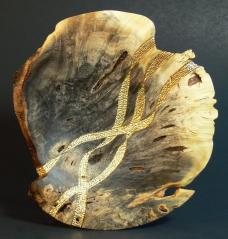
This is a maple hollow form turned from maple. It measures approximately 6 inches tall by 4.5 inches wide. I finished with aniline dyes and wipe-on poly. I don't know about the rest of you, but I am glad cooler weather is finally here! I have been wanting to try out my new Glaser Hitec bowl gouge for awhile and finally got the chance. Man is this thing an engineering marvel. I don't quite know how to explain it other than you have to get one and try it for yourselves. Anyway, all comments and critiques are welcomed and appreciated.
Are your dyes water or alcohol bases? Spent last weekend at a Jimmy Clewes demo and he uses alcohol. Reading some of the articles and posts here it seems water based are more light fast so I am confused as to which to use.
David Nittmann has done a huge amount of research on this topic. The difference in light-fastness is unrelated to the dilution compound, instead it relies on the dye itself. David found that metal-acid complex dyes are significantly more light-fast than aniline dyes.
(If memory serves, someone recently posted a photo of a project that had changed color within the space of a year. It was dyed with aniline dyes).
Anyway, the most light-fast dyes on the market are Trans-tint. You can dilute them with water or alcohol, your choice. (I have used them extensively in my work, often diluting with alcohol, since it evaporates faster than water). After using them for about 3 years, I've had no problems with fading or color change. The little bottles will go a LONG way.
David Nittmann and Cindy Drozda have used Trans-tint dyes for an even longer period of time. Ask David if you need more details. (Incidentally, he's also a guru on what types of marking pens to use, (for detailed dye work), etc.) You can imagine that with his high-end work, he wants the color to be as permanent as possible.