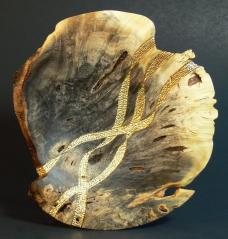
I sympathize completely, Charlie. I've been having some fun(?) with several large rounds of Black Locust a friend brought over. It has given me an opportunity to play with the DNA treatment though. I'm just going to have to try thicker rough outs next time. Lots of significant warping near any interesting grain.
If I was turning wet and thin, I might add a lamp nearby and use light transmission as my caliper. Just make sure to stop befor you get to the color white...
With a 25 percent hearing loss, in part thanks to a Blue Cheer concert in a small auditorium I worked at 40+ years ago, and 10+ years of using power tools without hearing protection, detecting small changes in sound is no longer possible for me. Hearing aids are also out of the question, given by ability to lose lit flashlights in dark rooms ; ).
Add to the mix that this is root burl, with grain running in unpredictable directions, some soft, some much harder, this may have just been The Perfect Storm phenomenon. The little vase I turned earlier from this same wood behaved better and didn't deform near as much as it dried (though it does have a noticable lean to it and did go oval a bit).
I guess I should just set aside a couple of days to play with this stuff and get to know it better.. Maybe the secret is to do small pieces ; )
It's very similar to what Hannes Michelsen does when he makes a hat. Light transmits through the wood, and it usually is pretty easy to get something uniform if you can see inside it. My hats are somewhere around 50/1000ths, which is less than a 1/16".
I've been kicking around an idea to have a bright light on the tip of a hollowing tool and hollowing by exterior color in the dark... real, blind turning!
Probably 80-90% of N. American hardwoods can be turned green without issues. A few woods are quite volatile, and roots, crotches etc. may move quite a bit, but its all quite predictable once you are familiar with that particular wood.
Implying that green wood is a problem because one piece moves some is faulty logic, Charlie. But you've heard that from me in person.
I've made a pretty good, and long career turning green wood without issues.
It may be merely a matter of experience with a particular wood - and the scale of the piece. For the tall narrow little vase I turned from this same green bay laurel, I used your 1/4" straight and goose neck pair in your 12" handle (should've got the 16" handle instead - look for a future order, along with another 1/4" sleeve, one's now permanently stuck on my 1/4" goose neck).
I think if I were hollowing a larger green piece, through a larger opening (the little christmas ornament was being hollowed through a half in hole) things might have gone better,
I tend to jump around a lot - different ideas, different woods, different tools, different methods - sort of a Liberal Arts approach rather thana BS in Chem Eng.. There are disappointments with this approach, but also interesting discoveries. Perhaps someday I may settle down and become a mature turner - but I doubt it.
Out of curiosity - how long had you been turning before you found the types of pieces you so obviiously enjoy doing - and evolving?
Not about to start a war or sprinkle salt on anyone's wounds, but I would MUCH rather play with green wood than dry, although for shiny items like ornaments I actually do both, roughing green, then saving finishing for the air-dried wood.
As John says, once you learn how much each wood moves, you plan ahead, and most of the wood is removed when its green, and easy, and cool, and dust-free, and infinitely more pleasant, tools stay sharp longer... and, well, you get it (or perhaps not, but that's how I see it). It is, after all, wood, so it does move, and that's part of what wood is. If we were looking for greater precision, then why turn wood at all? Other materials, like plastics, metals or ceramics will hold their shape better, and are easier to work with great precision.
I figure if someone likes turning dry wood, they'll absolutely love turning green wood. For those that say they don't like turning green wood, It's not the turning that bothers them, its the movement, the raised grain, or getting it to dry without cracks, etc...
Anyhow, that's some pretty cool looking wood Charlie has there, and I'd be happy to turn it if it's too disagreeable.
Lighting the end of the tool works wonders been using it sense Frank Sudal started it back in the early 2000 or late 1900 when he was doing the tall thin vases and piercing them ( 24" tall 1/16"walls ).
Well, I love turning green wood. For me it is the best wood to turn.
But your mention of Blue Cheer really took me back. It was one of my all time favorite bands. It even made me go to youtube to get me a dose of Summertime Blues.
I do relate to your hearing loss, I played in bands for 15 years, and always seemed to have the biggest and loudest amp right next to me.
... I LOVE turning green burls. I delight in the crinklies they make, the undulations on the surface. Wonderful stuff.
However, if you're looking to make bits and pieces that fit together, (like a box, or Christmas ornament w/ finial, et al.), dry out your wood first, then turn it.
One of the hollowing tool makers sells a light kit to mount at the end of its boring bar. It uses a 12 volt lamp driven from a battery charger - they recommend using a higher voltage to get more light at the expense of shorter bulb life.
http://www.onegoodturn.ca/pages/HollowingTools.html describes the tools and includes the light kit.
I have not used it and will probably have a go at making my own version.
It's not the amps that get you - it's the speakers. In Blue Cheers case, their Marshal (sp?) amps, FOUR per musician, amplified the signal. But it was the huge. two plus foot diameter Voice Of The Theater speaker cones and their large metal "horns" on top that moved the air a LOT of air.
At their benefit concert in a small high school theater in the Filmore, you had to keep your mouth open in order to equalize pressure on your ear drums. If you didn't things got PAINFUL.
Alas, Blue Cheer, and so many other bands, went for/go for sound VOLUME, ignoring sound QUALITY.
To really understand the difference you have to have listened to the Oveture of 1812, with 12 pound canons as the base percussion section, played through McIntosh ampS driving a high end, tuned speakers system that included Voice Of The Theaters and tweters that'd go up to 40Khz, in a sound room that has plush carpeting, heavy velvet floor to ceiling drapes and acoustic tiled ceiling.