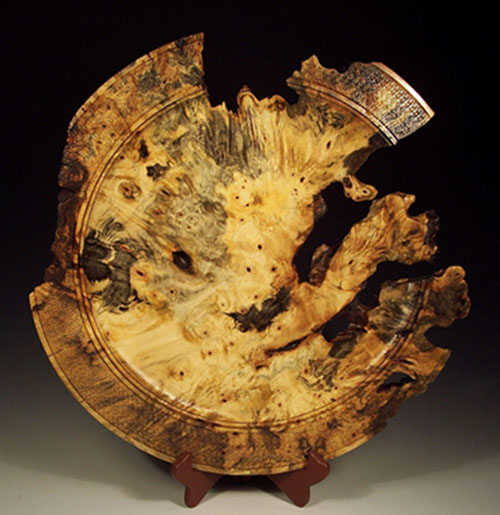
ALLAN BATTY- A LEGENDARY ARTIST and WOODTURNER
Paulo Marin
I started the week determined to turn a “SECRET BOX” which I had the privilege of learning from a woodturning legend: Mr. Allan Batty.
After I was done with it, I realized how lucky I was to have spent time with the only living woodturner to go through an apprenticeship in England. I am sure all of us when we finish turning a piece, we have that incredible sense of accomplishment. We might even catch ourselves saying: "Man... I'm awesome! Look what I've done. I must confess that I caught myself saying: "Man... I still got it".
When I came upstairs to show my wife, I had an encounter with reality. There sat in my bedroom, one of the most gorgeous pieces of woodturning I have ever seen in my life. Allan Batty's Spinning Wheel.
Perhaps this might have to be a DOUBLE POST, because of the gorgeous pictures I have. The Spinning Wheel given to us as a gift was made out of an English Yew Tree which according to Allan was approximately 300 years old. The tree was purchased in Scotland, planked and seasoned. The wheel is 18 inches in diameter. In those days (as you can see by the plaque) Allan signed his work as Allan McNair.
Humbled by this vision of perfection, I decided to postpone the results of my secret box. Instead, I would like to share with all of you some of my experiences and communications with this phenomenal woodturner.
I don’t know for sure when Allan was born, but I know that he lost his father at an early age. Most of his life he was raised by his mother, who according to Allan always told him at an early age that “his word was the most important thing in his life”. YOU MUST KEEP YOUR WORD ALWAYS AND NO EXCUSES she would constantly tell young Allan. He always tells me that he remembers his “MUM” with the greatest affection.
He also mentioned that one day he came home from school crying because he had a “good hiding” at school (please keep in mind that I am reading some of his expressions and accounts from our emails to each other). His mother then said: “Front room now boy!” According to Allan, if you were called to the front room that meant you were IN SERIOUS TROUBLE. She then threw at him a pair of boxing gloves and said: “Put those on boy” and she proceeded to knock him around the room and said: “You have no Dad to fight your battles for you… that’s the way you defend yourself. NEVER come home crying again.
“She had a heart of gold my mum, Allan wrote me. She was brought up as a tough “fisherwoman”. She was doing what she thought was right for a fatherless boy. She was a lady of integrity and that was important to her. When I served my apprenticeship 58 years ago says Allan, (I can’t believe I am that old), we were considered one step above a Laborer. In fact when I was younger and went to dances, I would invite a girl to dance, but I would never admit to her I was an apprentice woodworker. I discovered this never impressed them.
If my father were alive, he would have never believed I would finish traveling the world as a woodturner. I have this imaginary conversation with my father, writes Allan. If he had lived I would never have been allowed to go to the trade, but the company he worked for had a duty to start me as an apprentice because of his death.
When I left school at 15 as I had his tools I exercised that right and went to the trade as an apprentice. I never dreamed in my wildest dreams I would travel the world teaching my trade and the friends I would meet on the way, my dad would have been Gobstruck.
I also remember another thing we did. If the tradesman received “no pay” if they went sick, in the UK, I was given by my MUM a food parcel to take to their family. This way they had the basic essentials of life. How sad that too has disappeared. We were a community in those days.
As a working foreman, I knew a tradesman never parted with his tools…even in retirement. So, if I got word that one of the men was selling his tools in the workshop, I always tried to have a word with him in private, as I knew that he had a drink problem and he was selling tools to maintain his habit, so I needed to prove myself a friend to him, as he is no use to himself, me or the company. The most important thing was that I needed to establish TRUST with him, and find the root of the problem and together we could overcome it. And I never shared that with others, otherwise trust had just gone out the window.
Allan Batty is a great source of information of a period which most of us have NO IDEA on what woodturning was all about. So, instead of trying to relate his stories, I hope you can read this PDF document which I compiled. I am sure you will be fascinated by the depth of his knowledge as well as some of his personal life stories... not counting the incredible pictures of this fantastic piece.
Hope you enjoy!
Paulo Marin


---------------------------------------------------------------
[1] Turning A TRADITIONAL column.
This PRE-ASSEMBLED column arrived from the company charged with installation of the completed column, this column was replacing one OF FOUR on site This one had almost rotted away, it was important to copy the original exactly, as its nearest partner was only 14 inches away and any discrepancies would have been immediately obvious this is especially important when coping the entasis, this was a slight curve to the column, how to work OUT DETAILS ON the entasis, go to item on columns 3 and pages 6-7 of document entitled columns, this has become a historical document 16 pages long this document is especially useful to the modern turner who requires accurate information on columns, never before produced, this column was turned using traditional methods.
[1] Note the long wooden rest, these were common in the trade, as they got marked in use, we took a hand plane at the end of day and dressed it down. Note the parting tool cuts, these were taken down to the finished column diameter to ensure accuracy in the turning process it is so easy on big work to turn below finished diameter before you realize it, the parting tool cuts to the finished diameter ensure this does not happen
[2] Please note, wooden packers placed under the headstock and tailstock, these were used to increase the center height above the bed bar, this was a common practice on these lathes, I do not know of a modern lathe on which you can follow this most desirable of practical uses, any given diameter of the work piece never presented a problem in the past using this method, my own lathe was capable of turning 3 feet in Diameter between centers using this technique, increasing the length was a simple matter in the past, I have known of two lathes put together end to end, with one tailstock removed, this allowed work of 22 feet long to be carried out, many of the old trade lathes were made very long for this reason and the company bought two sets of lathe to fit the one bed and it was not uncommon for 2 turners to work side by side on the one bed, and if a long job came in, it was a simple task to remove one tailstock and complete the long work on the one bed.
In the past, you could buy headstock complete with faceplate and driving dog, tailstock, and 2 banjoes, or any lathe parts and you made the bed length to suit your needs.
One more normal practice was to turn the wooden pulleys that went above the lathe on the shaft, this way you could arrange speeds on the lathe to suit your needs,
[2]
[1] Note the long wooden rest.
[2] Traditionally the column was turned using 2 dead centres they only located the work between centres, using a faceplate with a driving dog, the driving dog was placed in the end of the column to one side this became the driving force for the column and guaranteed not to slip. The driving dog was about 2” long by 1/2” diameter, this screwed into one side of faceplate, and this became the driving force for the column, a 1/2” diameter hole was drilled in the end of the column to accommodate the driving dog
[3] A number of parting tool cuts were made using a calliper to arrive at a finished diameter in the waste section, the work was turned down to size using a standard roughing gouge to remove gouge marks a 1 1/4 “SKEW was used at a 45% angle along the length of column in a sheer scraping action AND THEY TELL ME, SHEER SCRAPING IS NEW, FROM THIS ACTION THE COLUMN REQUIRED LITTLE SANDING, TURNERS OFTEN USED THIS ACTION TO OVERCOME PROBLEMS.
[4] THE CAPITAL AND BASE WERE ALWAYS TURNED AND FITTED SEPARATELY this was due to change in overall diameter, as base and capital were much larger than column, this saved timber and turning time.
[5] THIS PARTICULAR COLUMN WAS NOT HISTORICALLY CORRECT, The base and capital were from another order, there are 2 possible reasons for this, [1] The wood turner did not understand the 5 orders of columns, although I suspect in this case, it was for the second reason as I estimate the columns had been turned in the 18th century and going off the quality of the existing columns the turner certainly knew his job well, as these columns were superb in every way, [2] more likely it was customer’s personal preference, customer may have said to the turner “I will leave the design to you”, the turner may have been familiar with this design, or the customer may have seen a design they liked, as this was not unusual, the turner would carry out his customers wishes, it is for this reason the need becomes more important, for the turner to check if there has been any customers personal preferences in the original design, he can only tell if he understands the 5, orders of columns himself.
[3]
Often my customer would say to me “ I will leave the design to you,” in which case if it was for a large staircase as an example, I would turn one Newel and one spindle from a cheap wood, to gain the customers approval, I would then get the customer to sign and date the samples on approval, the samples were put to one side in the workshop, this way when the work was complete the customer could not say “THIS IS NOT WHAT I ORDERED” the reason I followed this practice was I was caught by conman some years earlier for a lot of work I had put into a particular job.
There was a further advantage of these old trade lathes, by the headstock being able to move or float on the bed bars left or right, we could line up the headstock on an another pulley, and decrease or increase speed to suit own needs or in the case of turning column, I needed to decrease the speed even further than the lowest pulley allowed, so it was a simple matter to drop belt on to the shaft itself rather than a pulley. By this method with a 3 step pulley lathe it gave you a range of 8 speeds, more than the average modern pulley lathe, my speeds on my trade lathe went from 200 rpm to 2200 rpm, and yet the design was so simple it was class I now realize how much knowledge the older wood turners had about their trade and machines.
Note the wooden pulleys on my trade lathe, just a word on my lathe, it came from a company I did work for, it was built around 1860, and worked around the clock for 100 years, the older turners who worked the lathe, probably made every thing possible on a lathe, I know they produced at the turn of the century bull’s eyes or deadeyes, belaying pins for the old sailing ships, I only heard how good these guys were and the volume they turned was legendary.
* see foot note, at the end of the document page 4
A practice by the older wood turners as they ground their tools, to sharpen them, they would deburr the tool by burying into the wooden bed bar, you should not try that on a modern steel lathe.
[4]
As I rebuilt the lathe around 20 years ago, I retained the original part of the bed bar as a piece of history, which is on the wall above the refurbished lathe as I have looked at the marks left upon it following this long established practice I am able to identify the favorite tool used it was a 3/8th bowl gouge, this was the common tool of both the spindle and bowl turners, it is an interesting fact this practice was so common, the older turners had almost gone through a 4” thick wooden bed bar, the engineer who rebuilt the actual lathe metal parts, commented on the quality of the workmanship that had gone into machine and it still runs like a sewing machine after all that use.* footnote from page 3
A deadeye or sometime known as a bull’s eye is a round turning with one or three holes, one hole was the traditional method of guiding rigging ropes aloft and the three holes for increasing standing rigging tension in sailing ships. It is usually made of wood with rope or wire wound around the circumference. A groove was turned in the circumference to retain the rope or wire in position.
The two most common types of deadeyes are those with one hole, and those with three holes. Single hole deadeyes are usually used aloft, for changing the direction of running rigging, while those with three holes tend to be used in pairs for tensioning standing rigging at the gunwales many of these would be required for a sailing vessel plus spares.
A belaying pin was a turning approximately 14” long by approximately 1½”diameter, an old sailing ship would require many of these, plus spares as a few would be lost overboard at sea, these were used at sea to tie running rigging to, any wood turner who lived by the coast at the turn of the century, especially near a port, belaying pins and dead eyes, plus the other turnings on a ship would have provided the turner with more than enough work
Illustration of typical belaying pins and photo of three hole deadeyes
-----------------------------------------------------------------------
COLUMNS
[1]
The mystery of the entasis has been argued about for centuries, the main reason is lack of documented evidence. Entasis, swell or bulge, is one dictionary definition, I believe this does not conjure up an image; a coffin has a bulge, does that mean it has entasis, NO, a further dictionary definition is “to bow or bend;” now we have an image, in keeping with a gentle curve that represents a columns curvature, known as the Entasis.
Vitruvius A 1st century architect, is one of the most quoted of the ancient architects, he mentions in his book, “THE TEN BOOKS ON ARCHITECTURE” about how the entasis was established and refers the reader to drawings in his book, unfortunately no drawings or illustrations from his book survived the 1st century roman period.
In fact it was not until the fourteenth century, that his work was rediscovered, new woodcut illustrations were added in the fifteenth century, these were based on descriptions found in his original text.
This book along with the new added drawings became a major inspiration for renaissance, baroque and neoclassic architecture.
Trouble is the drawings are open to interpretation by the artist, probably not a tradesman; add to that the time difference, 15 centuries and translation difficulties. The translator must have faced many and numerous problems and possible errors were bound to take place, therefore assumptions are bound to occur when completing translation from someone else’s notes.
Examples: of wrong assumptions.
[1] Captain Cooke, on his expedition to find the North West passage north of Alaska came across, the BAIDARKA kayak [Russian for small boat.] , with a split bow; [or bifurcated bow,] he made an assumption as to reason for the split bow,[ believing it was to imitate a shark and to strike fear into a foe,] and In doing so, he made a gross error as to the true reason, the true reason was one of good design added to superlative sea going qualities of that particular kayak, that only the Aleutian islanders fully understood.
[2] Artist impressions of dinosaurs, from one tooth they can describe the animal in detail down to hair or scales, colour, shape, size, and probably what it had for breakfast in both cases they and Captain Cooke have made assumptions without knowing all the facts, because, in both cases the facts were never documented.
VITRUVIUS had much to say that we have discovered in this century to be accurate.
[1] That a structure must exhibit three qualities, it must be STRONG, USEFUL and BEAUTIFUL.
[2] We would say in the wood turning trade today “form follows function”.
It is worth noting that he advised against using lead for conducting drinking water, in the first century based on his observations of the labourers illnesses found in plumbum [LEAD] foundries of the time.
It is interesting fact it was not until about the1980s the USA and the UK banned the use of lead in plumbing due to lead poisoning.
By the fifteenth century arguments now raged freely amongst architects and tradesmen of the time as to the origins or how the entasis had been established in the first place.
Notably Vignola a 15th century architect, he suggests two ways, one we use today, [which he claims to have invented.]
[2]
His contemporises all suggest different ways; one notable architect of the time even says his method was to bend a batten between two points?
The second method shown by Vignola [not his method, apparently this was in common use at the time.] It has been copied by most 18th to 20th century authors, namely Chippendale, Architectural Graphics Standards [PAGE 519] and most modern text books on the subject.
What appears as a change in direction, in the 15th century architects were saying the Column was to be straight for one third of its length from base of column then that is the point the entasis was to start from, I am unable to find any examples from the Greek and Roman period that confirms this theory, in ALL CASES Both Greek and Roman without exception, the entasis started From BASE OF COLUMN. This is clearly shown by the surviving drawing from Apollo’s temple
The Parthenon, for example, shows dimensioning columns from the base WITHOUT entasis.
It is comforting to know, regardless if lower portion of column is straight for one third, or the entasis is marked out from base of column the setting out process remains the same.
Research has revealed 15th century architects could not agree on rules or even measurements, as seems to be the case in the Greek and Roman period. Seems to be personal preference, of the designer, within a given set of rules.
Research has revealed certain individuals have influenced our understanding of the past based on their own knowledge, not all had complete information to hand.
Example Christopher Wren the notable London based architect was influenced by Andrea Palladio a contemporary of Vignola. Both palladio and Vignola, acclaimed experts in Greek and Roman architecture, failed to agree on certain points, point is learn to read between the lines of gathered information, For example Palladio states in his writing his personal preference was for the attic base, as he says he “liked it better” he therefore shows most of his drawings of the Ionic, Corinthian and Composite columns with an attic base, even if this was not historically correct it was his personal choice because as he says he “liked it better”, and by making something your personal choice you influence, and lead future generations to possible error. READ BETWEEN THE LINES OF GATHERED INFORMATION. ??
Today we need to be sure our Mentors are exposed to and influenced by the correct understanding.
Question should Christopher Wren have been influenced by Palladio??
Many have tried to standardize the five orders of columns, Not least, Chippendale being one, TUSCAN, DORIC, IONIC, CORINTHIAN, COMPOSITE, all the 15th century architects seemed to be trying to say what base and what capital belonged a particular order. [The Doric
column in the 1st century was often made without any base what so ever]
15th century architects debated and argued as to what base was correct for the Doric column, even though there are enough surviving Doric columns of that period without bases. Even when evidence, was there to see, it seems it was ignored to suit the author. Much like today, not much has changed?
The Greeks and Romans had certain rules as to what base and capital were to be used with a particular column; research has shown these rules where no more applied than in any other century. Again personal preferences obviously applied in some cases.
Over a working lifetime I have seen various combinations, i.e. columns with bases and capitals from other orders, either it has been the craftsman who did not understand orders, or more likely, the customer has stipulated a particular column with a preference for a base and capital from another order
[3]
To summarize, today if I have a column to produce, if it is an existing column to be copied it is a straight forward reproduction of what already exists, if no column exists then careful and meaningful communication between customer, architect, and the wood turner, to arrive at historical accuracy as near as possible bearing in mind customers personal preferences and Vitruvius,s earlier statement “`MUST BE STRONG, USEFUL and BEAUTIFUL.
I digress, back to how to work entasis; one interesting drawing has survived from the TEMPLE OF APPOLLO in DIDYMA, TURKEY
Fortunately, this temple was never finished, the craftsman assigned to the making of the columns had followed the practice of the time, he had drawn in scale on the temple wall the columns he was to produce, there was to be 120 columns, each was to be 60 feet tall, the reason, the practice was for all working drawings to be drawn on the walls, was this, the project would have taken several life times to complete, the drawings would be there for successive generations. [Never had to work more than a couple of years in advance, myself]
Whilst this temple was destroyed by a great earthquake in the 15th century, only two columns survived the destruction, the drawing, fortunately, had been well documented, had the temple gone to completion the drawing would have been lost forever, because the final act of the builders would have been to plaster over all walls, hiding for ever this wonderful door to the past.
As with all tradesmen it was a working drawing, no mention is made, at how he arrived at his calculations, fortunately there is enough detail to allow another tradesman to be able to study and work out HOW the entasis was arrived at, IT NEVER CEASES TO AMAZE ME AT THE SKILLS IN THE PAST.
It proves the truth of the Japanese proverb, that says,” TO KNOW THE FUTURE YOU MUST VISIT THE PAST”.
My own working drawings lacked detail in the workshops, knowing another tradesman would understand and be able to take the project to completion, here in lies the problem, very little was documented for information outside the workshops, this in turn leaves people with a lack of understanding, and they tend therefore to make assumptions based on the absence of facts.
I firmly believe a good teacher should explain how and why he has arrived at a certain conclusion, without this information, the surrounding information is valueless to a student.
You might as well say to a student navigator looking at a chart for the first time, in the middle of an ocean “we are somewhere near here”, pointing to an area on the chart, accurate but useless information.
This information is for your future development, can be used in various projects, architectural spindle and faceplate work, individual artistic preferences apply.
Flutes and reeds are as complex as the entasis; much confusion surrounds these subjects as well, once explained the confusion disappears.
Attached are drawing on entasis, document columns 3 flutes, reeds and flats document columns 4, roman ogees. Document columns 2
[4]
Most modern scholars refer to the entasis as produced for ascetic reasons alone, my personal view right or wrongs are two reasons one [ascetic] two [structural strength.] Could I be making assumptions, I HOPE NOT?
Today, more than ever before we have made wonderful progress, but at what cost? The accumulative knowledge of centuries is being lost forever?
Vitruvius says STRONG, USEFUL, and BEAUTIFUL the ancient column from the past certainly fulfils all that. Hope you agree and find these notes helpful?
Study publications.
Author Vitruvius
Ten books on architecture. ISBN 0-521-00292-3. Excellent, some foreknowledge required
Translated by Hector D, espouy
Greek and Roman architecture in classic drawings ISBN 0-486-40491-9 many photo’s, little in way of explanation
Author Chippendale
The Gentleman & Cabinet Maker’s Director ISBN 0-486-21601-2
Thomas Chippendale has made an attempt to finally formalise the five orders, whilst he was a good craftsman, he was obviously influenced by the architects of the 15th century showing columns with first third straight, entasis is as Vignola, shows in his book, also his drawings of the five orders bear an uncanny resemblance to the five orders, engraving from Vignola,s regole delle cinqueordini d,architettura. common at time 17th century Europe, my personal impressions are it is not possible to formalise the five orders, due to too many anomalies, the student can, but, strive to be correct as to time frame of a particular column as shown historically by century.
Giacomo Barozzi da Vignola
Canon of the Five Orders of Architecture. Isbn 0- 926494-16-3 excellent book, I am given to understand this is one of the most quoted book on the subject.
Point of interest the reason apprenticeships were 6/7 years long was the extra knowledge required of a tradesman to have understanding of, this is why we were required to have a working relationship with all the trades surrounding our own area of expertise this was vital for successful communication between trades. I will be discussing in another session a wood turners need to understand joiners and staircases as this is another can of worms, including complex twisted work, little understood, how, when and why?, I recently came across a staircase turned early 19th century or late 18th century, that was so good I am returning to photograph it, the turning was perfection.
Writing these notes has made me realise how much I have forgotten over the years and the need for revision and more importantly documentation.
I have always encouraged apprentices of the importance of independent research, by researching independent of the tradesman he is learning from, and by taking notes of his/her research the subject becomes firmly imprinted in his mind, it is by basic revision he/she easily recalls the things learnt earlier.
[5]
I recall an apprentice who did not want to do this, [I had to point out the error of his ways.]At a very intensive point, in his training.
Fortunately I insisted that he took photographs during the teaching period, I also insisted he documented in writing [In his own time.] alongside the photographs, the complete write-up of how all was achieved, he now not has the only complete write up to ever exist on that particular subject, he also has invaluable documentation, which he can refer to for the rest of his life, and hopefully pass on to another generation
Whilst apprenticeships were 6/7 years, you were not considered a full tradesman until you had completed your journey time, the firm I served, [served being the operative word] my apprenticeship with always paid you off on reaching 21 years of age, this forced you to seek employment elsewhere, starting your journey time to gain experience away from your comfort zone, [Hence the expression, Journeyman, this was the term describing a man who had served a formal apprenticeship, but not completed his journey time, the journey time is what would finally recognize him as a tradesman on completion ] some five years later, your journey time up, you could call yourself a tradesman. I still do think this, was a superb way of building confidence in ones own ability. I personally worked across the UK and overseas in order to complete my journey time, in all this time you were gaining experience and picking up little informational gems on the way. I have never resented this time frame, because experience gained out weighed all inconvenience incurred.
All these years on I can still recall my trepidation on entering a new and strange workshop, for the first time I realized there was going to be no old Joe in the corner to help me out when I hit problems, IT WAS DOWN TO ME, to prove myself, what a learning curve, I learnt a most valuable lesson, in this workshop, as I was sent to start work by the foreman, an older man came across, he had recognized my nervousness and said to me “ if you need anything, just give me a shout,” I have never forgotten the act of kindness that man showed me, he is probably the reason I am still in the trade all these years on, and I have repeated this with any stranger to our workshops, it really does help a newcomer, to settle in quickly.
Another point of interest, when I had my own woodturning workshop, and I employed others I like my forefathers never asked for working references, I would say “Start Monday.” The man knew he had one week to impress me, otherwise he was out of work, written references were no use, as he knew and I knew any references could have been written by his best friend, therefore it was what he could produce on the shop floor, was his best reference
I digress again, often I would be asked to perform a trade test, to acquire work, again this was common practice in the trades in England, although this has now all but disappeared, again I see nothing wrong with been asked to prove your ability, although I personally never asked a employee to do a trade test, I would ask to see his tools, tools should be kept immaculate if they were not I would not employ him, tool condition says more about the owner than any paper references.
This is how I knew my Father was a good craftsman, he had died when I was a boy, and common practice those days, the Widow was offered one of two options.
[1] The craftsman’s widow was asked if she would like the tools to be auctioned off within the workshops, two reasons for this, the tools remained in the workshop, and the auction meant fellow tradesmen would offer more than the tools were worth, this way the Widow received maximum amount of money for the tools, I personally have bid at such actions, everything was sold down to the last item, many tools I use today have been acquired this way, again another practice that has long gone, HOW SAD
[2] My Mother choose for the tools to come home for me, again I digress, the workshops my Father had been employed in had a duty to start me as an apprentice at age 15 this is how I went to the trade on leaving school, because I exercised that right. I don’t believe you can do that today.
If you went beyond 16 years of age, you could not become an apprentice in England at that time, now they tell me school leavers stay until they 18 at least, my Dad started his apprenticeship at 14 years of age.
[6]
When my Fathers tools came home, I can recall opening the lid on this treasure chest, and finding all tools in pristine oiled condition, many tools had their own leather pouches to protect cutting edges, I still have many of the original tools from my Father’s toolbox, THAT IS HOW I KNEW HE WAS A GOOD CRAFTSMAN, this is obviously how he kept his tools, remember these were your only means of earning a living.
Again I digress, had my Father lived he had always said, I would not be allowed to enter the trade, as he felt he would like something better for me, unfortunately he would have been forcing a square peg into a round hole, because my choice of the trade was the right choice for me.
I have enjoyed writing these notes as they have taken me on a nice trip down memory lane, and recalled a good Father and craftsman. I have spent much time reflecting on the above, as I recalled my Father, and time spent as an apprentice.
Again I digress, the only difference between a wood turner and a prisoner, both involved time, only difference was we got to go home at night.
Attached are Vignola,s methods.
Again my personal opinions, seems Vignola assumes knowledge of the reader, or a lot has gone missing in the translation.
Something I have never ever seen before, according to Vignola’s drawing showing working out the entasis, the drawing clearly shows entasis carried down into lower third? Shown in Vignola’s book, plate 31 Canon of the Five Orders of Architecture. ISBN 0- 926494-16-3
Also there appears to be an error in the setting out process, unlikely it was Vignola, more likely the artist who reproduced the drawing, or in translation, the measurement shown at A-B top right corner of drawing, seems to show a starting point from bead above the column, this should be the column itself at the minimum diameter
Attached easy information on setting out
The easiest method I have come across, is Vignola’s of the fifteenth century, I am going to try to simplify the principles used even further. [SEE ATTACHED DRAWING COLUMN 3.]
We need, height of column, base diameter, top diameter, to arrive at all these correct measurements, yourself, see Vitruvius book or architect will provide [if he knows.]
Knowing height, base diameter, top diameter, we can use the following route to arrive at correct curvature, by doing a scale drawing, or by the trades preferred method, drawing full size on a lofting floor, this also reduces any chance of error.
[1] [[ SEE ATTACHED DRAWING COLUMN 3.] draw height, base diameter, top diameter, then using a pair of dividers or compasses, find radius of the base, this radius now becomes the key to all measurements, also extend the base line well out to the right, depending on the column order the base diameter varied, [ for example the Tuscan column’s base diameter was arrived at by, dividing the height of the column approx 8 or 9 times, one division of the height gave the base diameter, the base diameter was then divided into 6, top diameter was 5/6th of base diameter or approx 2/3rd of base.]
These are very rough rules, for the student wishing to be historically correct he needs to do an in-depth study of books listed.
Each order had its own rules on height to base diameter,[ These seemed to vary according the architect.] again an in depth study is required to arrive at historical correctness, for example the Ionic, Corinthian, composite columns were much more slender than Tuscan or Doric.
[2] Using dividers take one point to top left diameter and strike a line to the c/l of column, now draw a line through these two points to base extended line, where this line passes through the extended base line, this becomes the focal point.
[7]
[3] From focal point draw any number of lines, through column c/l and beyond, these can be any number and not necessary have to be in equal divisions.
[4] Using the same radius as before draw an arc from the c/l of column onto all the lines drawn from the focal point
[5] When the arcs are connected from end to end, through the column you have a natural curve or entasis, in the trade we used a flexible batten to join arcs together, by sighting down the batten it was possible to check how sweet the curve was, the batten was known as a fairing batten, in boat building it was known as a splining batten
The drawing on the wall at Apollo’s temple in Didyma seemed to use an even simpler principle that is if I have interpreted it correctly.
They drew a scale drawing which showed base Diameter, height, reduced divided into equal divisions. Top diameter, on this drawing they drew a straight line from base diameter diminishing to top diameter, this line was bi-sected and the line passing through the two bi-sectional points, was carried to extended base line where the two lines crossed this became focal point for compasses to strike a line between base and top, this in turn produces a sweet curved line or entasis, SO SIMPLE IT WAS CLASS, I have long learnt people try to find complicated answers, to questions, when the secret is to find the simplest possible route. This in turn allows the instructor to give the student clear informative information
The Entasis can be produced mathematically with a parabolic curve. Architectural Graphics Standards [PAGE 518] COPIES OF THIS BOOK AVAILABLE FROM GOOGLE SEACH
Drawings’ [Document Column 1] from Apollo’s temple DIDYMA .TURKEY
Please note all the above
These are my own observations, based on years in the trade woodturning, they are not meant to be a definitive work on the subject, no doubt a specialist on Greek and Roman history and architecture, may well disagree with my observations, and findings, much of the information has been .acquired through the workshops, I have worked in or been associated with from my apprenticeship on. I no doubt have been influenced by the craftsmen I worked with also the time frame I am locked into, that been said I have always tried to do independent research, and was encouraged to do so, to satisfy my own curiosity and to confirm the information I am given, IS ACCURATE, the only way to do this is to ask questions. I have long told my apprentices, there are no stupid questions, only stupid answers.
That is why the apprentice should be put with only the good teachers in the workshop, teachers showing patience, empathy and understanding, that way he learns quickly, if he is put with a harsh or aggressive mannered, demanding man, the apprentice rapidly regresses and ceases to learn, I am now wasting not only the apprentices time, but also my own and that of the companies, teaching is a good balancing act and if performed well the apprentice should reflect this, and be of benefit to himself and the company he works for. This was personal digression, as I feel very strongly on the point of good teaching. The bible sums this point up far better than I can, in the book of Luke chapter 6 verse 40, it goes like this,
“A pupil is not above his teacher, but the one perfectly instructed will become like his teacher.” Having reflected on those words the wisdom is clear, it is the teacher’s responsibility for good instruction, the above applies equally to good or bad instruction, apprentice will reflect his/her teacher
I would welcome any input that can be offered, to allow me to pass on to students the most up-to date and accurate information possible, if incorrect in any way I offer my apologies, and request the readers indulgence, as I am a VERY OLD GUY, that’s my excuse, I will stick with that?
[8]
A true story from my early days as an apprentice,
The qualities of a good teacher, a teacher, I have tried to imitate.
As a 15 year old apprentice, I was building my first boat at home, [This was a 2 masted ketch.] as the boat progressed an older tradesman I was working with kept asking me as to its progress.
Finally as the boat neared completion, he asked if I was going straight home from work, that evening, I replied I was “WHY”
He said “I want to see this boat you are building.”
It is only on reflection I realized the hardship this imposed on him, he rode a bicycle to work and he lived in the opposite direction to me, this would have added an hour or two on his journey home, I can recall and see it as yesterday, [55 years ago.] he entered the workshop where the boat was, he never spoke for a full five minutes as he examined the boat.
Finally he stood up and said “You know what Boy, I would be hard pushed to match that job,” then he said very gently “There are a couple of little points you need to be aware of.” He then kindly pointed out some obvious errors, when I look back the errors were probably more and worse than I care to remember or admit to.
He avoided saying such things “I have taught you better than that.” “You should know better.” “Have you not learnt anything.” the only comments were words of encouragement, when he left the workshop I felt seven foot tall, but I knew I had things to correct.
What a superb teacher and craftsman, over the years he never once made me feel uncomfortable regardless as to questions I asked, and even when assigned to work with other craftsmen, I would often return to him for advice knowing he would never make a fool of me, regardless how silly my questions.
This man is no longer alive, but his legacy, on good teaching survives, and hopefully I can only try to imitate such a good teacher.
I therefore dedicate all the above to a good craftsman and superlative teacher, a man I remember with the greatest affection as I relive that time of 55 years ago, his name, Mr. Jim Bradshaw. He would never have been recognised outside the workshops, nor would he have wanted to be.
He will always be Mr. Bradshaw to me, I owe him a debt of gratitude, and imitation of his qualities is the only way I know to repay that debt.
I have many pleasant memories of the older craftsmen I worked with, someday I should share these experiences with all, as many proved to be fine teachers, in the old workshops the only qualification for teaching was one common denominator, your indenture papers to prove you had served a formal apprenticeship,[without these you would not be employed.] all these years on this is my only official qualification, this would no longer qualify you as a teacher in the UK, but I claim “GRANDAD RIGHTS” and say there is NO substitute for experience and the proven ability of the old workshops to produce successive generations of tradesmen, is without question proof that through out history, regardless of trade, blacksmiths, joiners, coopers, boat builders, cabinet makers, wood turners, to name a few, each learnt their chosen trade within the workshops, from time served tradesmen
Now that apprenticeships have become a thing of the past we are losing centuries of accumulated knowledge, and this is loosely called PROGRESS
Now they tell me you can serve an apprenticeship in 6 weeks, all I can say I and many others must have been very slow learners, is this also called PROGRESS?