I am experimenting of making a bowl from a board and I am having a lot of problem in cutting the rings. The board is just poplar so the material is not very hard. I cannot image doing one with maple.
I am using a 1/16" parting tool. In my first trial, I used the tool as is with one long straight edge meeting the bevel edge. I made a tool rest with a slot to hold the parting tool at 55 degree. It takes a lot of effort even with frequent honing of the edge using a diamond file. The exit edges of the rings had bad tear out. I think the problem is caused by the tool exiting the cut at an angle.
On my second trial, I ground a short bevel at long edge of the parting tool. It does not help even with frequent sharpening of the short bevel edge on the grinder.
How can I cut these rings out easier with less tear-out?
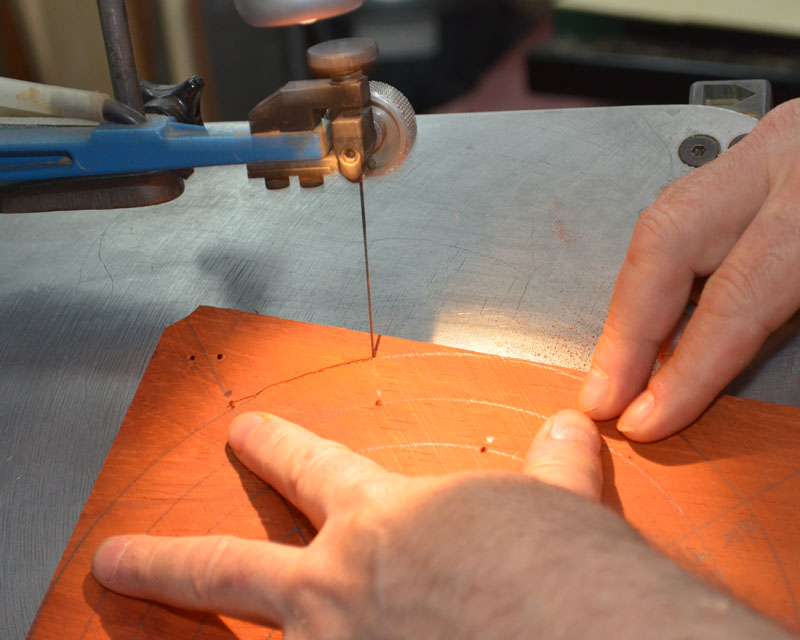
I've only done one so far, and I decided to cut the rings on a scrollsaw. Much less waste, allowing for wider rings.
Is this an option for you?
Others often cut a circle in half then cut the semi-circle rings on a band saw, then glue the halves together into full rings.
Cutting rings on the lathe is likely the least efficient way to do the process, unless you have a rig like the RingMaster (that cuts part way from the front and part way from the back)
I've got some photos of me drilling pilot holes and cutting rings on the scrollsaw if it's useful for you.
1.) Turn a grip on either side of the board for your chuck
2.) Draw concentric circles on either side of the board
3.) Part at an angle half way through
4.) Reverse in the chuck and part the other half way
By doing this, you should have 2 clean faces with a small possibility of some tearout in the middle of your segment. You have to recut it anyway, so it shouldn't be an issue.
In June 2010 I was Stephen Gleasner's demo assistant at the Hartford AAW Symposium where he showed how to make these, and saw all of his tools "up close and personal"... I got to see how he did these ring cuts, and even made a cut on one of his blanks to get the feel of how this works.
He uses a 1/8" diamond parting tool (he suggests that the smaller diamond-section parting tools in the old Sears tool sets are ideal for this purpose). Stephen modifies the grind on the parting tool, where he re-grinds the cutting edge to a skewed angle of about 30 degrees or so, forming a point on the "left" side of the tool (the cutting edge is still straight across from edge to edge, but is "pointy" on one side and "short" on the other. When he starts cutting the rings, he progresses slowly; the left (long) edge of the parting tool enters the wood first) - he then allows the "long edge" of the parting tool (on the left side of the cut going into the blank) to exit the wood first while moving through the back of the blank and releasing the ring, thereby resulting in a fairly clean cut.
I have also made several of these 'board bowls' using an unmodified 3/16" parting tool, and with controlled cuts (plus some quick sharpening in between each of the ring cuts), you can reduce or eliminate any tear-out.
I would think that reversing the blank back and forth as Steve suggests is WAY too much effort to go through for what really is a simple process. (Aligning each of the alternated cuts would probably be "interesting" too.) Good tools that are well-sharpened and some practice should have you doing this technique pretty quickly and efficiently. It isn't rocket science.
I'm working on an idea that I hope to try out real soon. It involves a metal cutting parting tool and a captured bar rig. Probably not the best way to go for everyone because I had to build the special adaptor to hold the metal cutting bit.
First of all I have tried all the parting tools I have it just not the best tool for doing this sort of thing. Scroll saws and bandsaws are much better. However when you use them you always have that half line in the middle.
What I suggest is using a backer board of MDF or something similar. then as you cut through the backside it prevents the tearout. If you cut from the center out the rings want to fly off and spin around your hand which isn't real pleasant. Cutting from the outside in keeps the rings trapped. I've thought about using double stick tape or hot glue to hold everything in place until I'm done but I haven't tried it yet.
Steve has a good idea but making those cuts meet would be difficult, especially if you change angles for each cut which is the best way to get the best shapes out of the BFB technique.
I've seen a really cool gadget that cuts from both sides on a push pull stroke but building it would be expensive and require some machining skills. It makes one cut halfway through and then you pull it and make the other cut. The cutters line up sort of like the Ring Tool.
Back to the parting tools. What has worked best is the metal cutting parting tools that are wider on the top and narrow at the bottom. The old wooden handle steak knives have a grind like this and will probably work as long as you put a longer handle on them. I have a couple but haven't had time to try it. The tool also has to be thin from top to bottom so it doesn't bind in the curved kerf.
Drill small holes through the board where you want your cuts and at the angle you want the cut at. Use the small holes to mark each side of the board. Make a shallow cut (1/16" to 1/8") on one side and a deep cut (deep enough to part through the board) on the other side.
Please know that the kerf must be wider than the parting tool. The parting tool can't be as wide as the kerf or the parting tool will bind in the slot of the cut.
1. Cutting from the back side will eliminate the tearout issue.
2. Drilling the small hole will eliminate matching up the two side of the cut.
3. A wide kerf (multiple cuts) and a small parting tool (top to bottom) will make the cutting go faster and easier.
After reading all of the replies and rethinking the process of cutting the rings, I can see that using a scroll saw to cut the rings is probably the best way. Using the scroll saw, the shape of the bowl can be controlled by varying the width of the ring and the cut angle. The cutting will be very clean with little waste and minimal tear-out. When a parting tool is used, the cutting angle and the width of the cut are hard to control even with a captive setup.
I am going to see whether I can pick up a used scroll saw from CL or borrow one from a fellow woodworker.
A good saw with good blades should be able to handle it.
I had a Dewalt 788 and upraded to a Hegner, but I don't think it is a matter of power at all. Just take it slow and let a sharp blade do the work, don't force it.
You have to make sure that your saw has the clearance between the table and the overhead arm when the table is tilted to 45 degrees.
My board was an 8 x 8 x 3/4" padauk, and the largest blade I had around was a #5. It would have gone much faster if I had #9 blades available.
I use Flying Dutchman blades... great blades at a great price from a good guy.
I watched a video this evening of making a BFB using a bandsaw to cut the rings. Since I have to join two boards to make one 8" or wider, There will always be a line in the middle anyway.
I will report back when I get this done in the next week or so.
There is a tool out there called Ringmaster that attaches to the lathes or there is a standalone version. The one pain is you had to drill a hole in the center of the board to mount the wood but now with chucks on a lathe you could use a chuck. I also saw a verion of these mounted on a toolpost using the banjo on your lathe.
She's a very nice lady, and autographed a copy for us.
Her book projects do not use a lathe, but instead use carefully cut rings and sanding to shape the bowls. This allows for some pretty creative shapes. This makes it easy to do an oval (or rectangular bowl).
She has a number of videos on YouTube... take a look at this for an example
I like his cutter. the Oneway drill guide is a little expensive. Mine would be hard for an individual to make. I do have some of the parting tool tool holders. I may see if there is an easier way for the average joe to rig one of these up.
I have not yet read all the responses, but as you continue to investigate the different "Bowl From A Board" methods, be sure to look more carefully at Stephen Gleasner's methods, and especially those of Michael Mode, widely considered the master of this genre.
Mike Mode mounts a square piece of wood to a round disk on a faceplate with screws through the corners of the board, which end up being waste. Then successive rings are cut from the smallest to the largest, so the original board only needs to be mounted once. The cut passes all the way through from one side, and the cuts are angled so that the pieces can be reconstructed to form a funnel-shaped bowl. The angle of the cut helps determine the final bowl profile and thickness. He has a special grind on the parting tool used, and in his case, the cutting tool is held in a cross-feed platform from a pattern maker's or machinist's lathe.
When I saw Stephen Gleasner use a similar method, he cut the largest rings first, and had to do more work to re-mount the remaining center piece for further cutting. While Stephen tends to use high-grade aircraft plywood, or dense Baltic Birch, Michael Mode tends to make up blanks from a number of very dense hardwoods to achieve colorful, striped bowls. These methods are limited to a fairly narrow range of shapes to insure that successive rings overlap with enough thickness available for turning.
In your own attempts, keep in mind that Poplar is very soft, and sometimes fairly abrasive. As a general rule, harder, finer grain woods cut much more cleanly than the softer varieties. You will probably find that the harder wood species with tighter grain will be much more satisfactory.