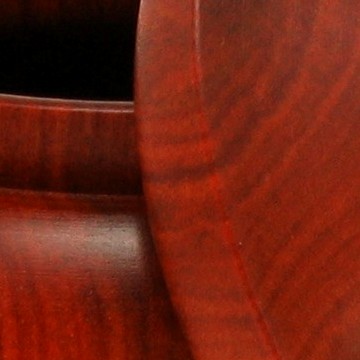
I was contacted and asked if I could/would turn a couple of porch column bases. I joked and told the customer that 30" diameter was my max. He said that is ok the largest dia is 29". Each base is made up of 3 sections. The wood is White Oak. Each assembled base weighs 104 lbs. The hardest part was all the glue ups.
The Oak was 5/4 random width, cupped, twisted and bowed. Each piece had to be face jointed, run through the thickness planer, edge jointed and sawn for width on the tablesaw. The first layer was biscuit jointed together. After the glue dried this layer was thickness sanded. The next layer was glued and screwed to the base layer. After the glue dried it was thickness sanded. So the dots you see are 1 1/4 deck screws. The layers were different thicknesses. 2.25, 1.75 and 2.75. There was also some resawing involved.
I'm not sure that is the best way to assemble a project like this.
With all the grain running the same way through the layers like this will only capture water and all the grunge that mother nature has to offer, which promote decay, causing them to self destruct fairly quickly.
While I normally don't like to recommend miter joints, I like to use finger joints on mitered sections, which gives a pretty good end to end glue-line. Then, you can make it hollow in the middle, which will hold up a lot better, especially if you can provide some air-flow up the inside, and preferably have the inside painted as well.
Very nice looking work but I'm going to concur with Keith on this as to construction.
I would suggest that you find the meanest preservative you can and use it generously, especially on end grain areas. My favorite is Super Di-All, which uses a tin-based preservative. This is wicked, wicked stuff so handle it with the utmost care. It comes in one-ounce bottles which can be mixed in a gallon of paint or, as we sometimes did in boat work, mixed in a lesser amount of mineral spirits or alcohol and applied to bare wood before primer. Be generous but HANDLE WITH CARE!
You might also consider boring a hole down through the middle, as Keith's comments hint at, to relieve stresses and allow some air through.