Home Articles Forums Gallery Marketplace Videos

WoodCentral Forums

Knowledge You Can Build On — Est. 1998

Combination Press Plough Plane

Applying a metal band to a turning

Posts

Applying a metal band to a turning

#1

Steven Antonucci

Applying a metal band to a turning

steven antonucci

So here I am with a technical problem...

I turned a large bit of wood this weekend, and it's a large spindle for lack of a better description. I cut some flat bottomed grooves in it with the intention of applying a metal band to them. The grooves are smaller than the largest diameter.

If I could somehow apply the metal to the wood without having a visible line in the band, that would be awesome. I have no idea how I would acomplish this.

Hence... my question: any ideas?

Steve
Re: Applying a metal band to a turning

#2

Re: Applying a metal band to a turning

Jim H

Probably too late now, but I would have suggested a joint under the band, using the band like a coupler.

Re: Applying a metal band to a turning

#3

Two options:

George Guadiane

Cut the wood in or near the center of the place you want to have the band, make the metal piece to fit and glue it back together

If there is not too much difference in diameter, using a soft metal (pewter, copper, brass, silver) make the band large enough to go over the wide part then hammer the metal down to fit.

I hope that makes sense and helps.

G

Re: Applying a metal band to a turning

#4

Richard Allen

Re: Applying a metal band to a turning

Richard Allen

Are you aware of something called a "reducing hammer"? This hammer has a textured face which ends up forming dimples on the surface of the metal. This dimpling will "shrink" the metal. The metal band will then be textured and captured in the recess of the wood. The band will not become tight.

You might try "metal spinning" into the metal into the slot. There are a variety of metals which you could use. Pewter, Copper, Brass. Metal spinning is not a trivial activity. You should likely practice a few times to get the process down.

A coupling can be an attractive feature, think belt buckle or broach.

Re: Applying a metal band to a turning

#5

Here's the easy way...

David Walser

There's an easy way to do what you want, but you'll need to start over:

Step one: Put the metal band over the branch of a tree.

Step two: Wait 20 years

Step three: You can take it from here.

Hope this helps!

Re: Applying a metal band to a turning

#6

Steven Antonucci

That would just strangle the limb, silly!

steven antonucci

I doubt I could get the diameter I need before the limb died, and then I'd have all of that staining to deal with...

:D

S

Re: Applying a metal band to a turning

#7

Re: Applying a metal band to a turning

woodspinner-Harry robinette

Try cutting a slot into the groove you have then bend the end of the band at 90* and insert it into the

slot, then wrap the band around and do the same with that end. You can solder or JB weld the ends.

Re: Applying a metal band to a turning

#8

Ken Vaughan

Cast Pewter into the groove

Ken Vaughan

Pewter works well this way -- most other metals will char the wood though.

Re: Applying a metal band to a turning

#9

Re: Applying a metal band to a turning

Cyril Griesbach

Steve,

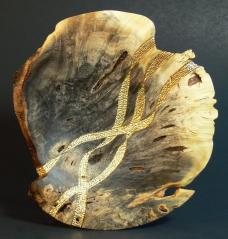
I believe that George and Ken are on the right track. Our mini turning group is presently exploring just what you may be trying to do using pewter sheet and liquid patinas. The texture in the photo was done with a small rounded and polished nail in a dremel engraver. The pewter sheet is applied with double sided carpet tape.


Re: Applying a metal band to a turning

#10

Steven Antonucci

That's the look!

steven antonucci

So, did you solder the ends together to get rid of the seam? Can I assume that it is a tight fitting band?

Interesting possibilities.

thanks

Steve

Re: Applying a metal band to a turning

#11

Katherine Kowalski

Re: Applying a metal band to a turning

Katherine Kowalski

I suspect your group may have already seen his demonstrations... but if not, look up John Wessels -- he does the most beautiful things with sheet and cast pewter. He's from South Africa, and has access to a treasure trove of wood! (Red Ivory, (what we call "Pink"), and so many others actually grow on trees down there...)

Anyway, he's made a specialty of using sheet pewter, textured, patinated, etc. to enhance his work. Beautiful.

Katherine

Re: Applying a metal band to a turning

#12

Ken Vaughan

soldering pewter

Ken Vaughan

I have found it to be a bit tricky if it is not to be easily visible as a soldered seam -- where heat application can make changes in the wood, double stick tape, etc.

Pewter work is very solderable - but the background is not as tolerant when working with wood unless you plan to burn the wood around the band.

Casting and inserting pewter into wood is an ancient technique -- and pewter (tin) is easy to turn with very sharp tools.

Re: Applying a metal band to a turning

#13

Re: Applying a metal band to a turning *LINK*

John Lucas

Steve I would go with the 2 part wood with tenons to hold it together and a metal band inserted on the tenon before assembly. However, you might look at this Lab metal. I have not used it but have seen it in use and it looks a lot like steel. I don't know if you can polish it like steel however.


http://www.alvinproducts.com/

Re: Applying a metal band to a turning

#14

Steven Antonucci

Thanks for all of the great ideas!

steven antonucci

More than one way to skin a cat, huh?

I have some pewter ingot, and I know that the melt temperature is pretty low. I wanted to do it in hammered copper, but I couldn't think of a way to do it without the seam.

Oh well, I suspect that I will make other pieces using one or more of these ideas. Thanks all...

Steve

Re: Applying a metal band to a turning

#15

Re: Thanks for all of the great ideas!

bill Crommett

Does anyone remember how to put a steel tire on a wood wagon wheel ?

Re: Applying a metal band to a turning

#16

Re: Thanks for all of the great ideas!

Stuart Johnson

Heat it and bang it on the wheel. Then pour water on to cool. It expands when heated and shrinks when cooled.

(Roy Underhill show many years ago)