Home Articles Forums Gallery Marketplace Videos

WoodCentral Forums

Knowledge You Can Build On — Est. 1998

Build it. Rock it. Rockler has your woodworking tools.

Advice requested: wings of natural edge bowls

Posts

Advice requested: wings of natural edge bowls

#1

Aage Rendalen

Advice requested: wings of natural edge bowls

Aage Rendalen

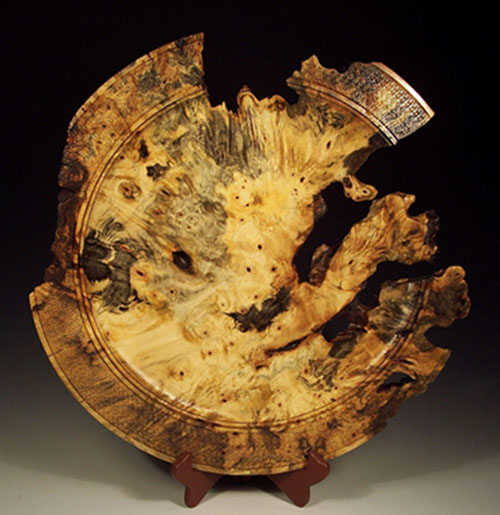
I'm giving a demonstration of natural edged bowls with multiple wings (scalloped look) for my club in a couple of weeks. Here's a problem I'd like you to help me with:

I end up with a fair amount of crushed fibers on the wings of some of my bowls. When I finish the outside, the surface generally looks very nice, but when it dries, ridges appear that require more sanding than I'm happy with. It obviously has something to do with the way the gouge negotiates the spaces between the wings.

What do you think?

Re: Advice requested: wings of natural edge bowls

#2

Re: Advice requested: wings of natural edge bowls

john lucas

I'm not an expert on this because I don't turn a lot of bowls. Here's my thoughts based on those I have turned.

One, the cambium layer is usually softer than the bark or the wood. This makes cutting it clean more diffiicult. Sometimes I'll apply thin CA to make it harder.

Second, the air spaces do cause a problem because the tool wants to move into them. This makes it take a bigger bite out of the leading edge of each chuck of wood. Learn to be as light on the bevel as you can. This and turning the speed of the lathe up helps control this. I find having the handle of the tool against my body and controlling the cut with your body helps stabilize the cutting edge so it's less likely to dip into the air space.

third. The cambium layer moves differently than the bark or the wood. I'ven noticed that the cambium layer either protrudes or sinks compared to the rest of the bowl as it dries. For this reason I try to wait for my final sanding until the bowl is dry.

Hope that helps. If nothing else it throws more questions up for the real experts at turning natural edge bowls to answer.

I had asked one time how long the bark will stay on with natural edge bowls. I don't personally have any laying around that are older than about 3 years. All the others have been either sold or gifted. I did however get some finish turned natural edge bowls from my friends wife for me to finish. These bowls were turned by Joe Looper more than 10 years ago and the bark is still on them. one is Walnut and the others are Ambrosia maple.

Re: Advice requested: wings of natural edge bowls

#3

Re: Advice requested: wings of natural edge bowls

Dick Wilson

AAge, I too am not an expert on winged bowls. You might want to check out a 5-6 part video by Jamie Donaldson on YouTube:

http://www.youtube.com/watch?v=BRgndozF4nQ&feature=mfu_in_order&list=UL

I watched the entire video set and picked up excellent ideas on process, etc. I plan on watching again a number of times and then try one myself.

Re: Advice requested: wings of natural edge bowls

#4

Walt Bennett

Re: Advice requested: wings of natural edge bowls

Walt Bennett

I really don't like turning natural edge bowls, since there's so much hand sanding required and I'm lazy, but I have made several. John's right about the cambrium layer being softer, and potentially causing tear out problems. I don't like sanding the wings while the lathe is running for the same reason John talked about being careful with your gouge in that area. That means a lot of work to get it 'right'.

Re: Advice requested: wings of natural edge bowls

#5

Don Leydens

Re: Advice requested: wings of natural edge bowls

Don Leydens

Hi Aage! I think John Lucus's advice was right on the money. Everything I would have said was explained very well by him. Hope the demo turns out great!!

Re: Advice requested: wings of natural edge bowls

#6

Oh - so many options!!!

jake Niedling

It has been my experience that the ridges generally occur as the bowl is drying. I believe it is just simply the amount of movement in the bowl vs the cambium & bark. Also, if the bark has a few loose spots, it will not follow the bowl as it warps. Getting a clean cut on the bark can be difficult, but try and experiment with several different options before you get to final diameter. First, try a freshly sharpen gouge and very light cuts ( keep the speed up ). If you have some different grinds on your bowl gouges, try them all. I have been playing with Staurt Batty 40 degree bevel with a push cut and it cuts very clean. Also, I suggest you might want to stop cutting the bowl from the bottom to the top edge just short of the bark. Then cut from the top edge down to where you stopped. This prevents knocking off the bark and gives something behind it for support to get a clean cut. The trick here is getting it starting on an interupted edge. Remember you can always make it a natural edge bowl without the bark. Have fun turning.

Re: Advice requested: wings of natural edge bowls

#7

Re: Advice requested: wings of natural edge bowls

Ron Bauer

I have turned a lot of natural edge bowls with and without bark. First of all the question on "how long does the bark stay on?". If the tree is cut in the fall after the sap has gone down the bark will usually stay on indefinitely. If it is cut in the spring or summer when the cambium is full of fluid you will probably not get the bark to stay on past drying. I do a lot of butternut and, yes, the cambium shrinks a lot more than the heart often leaving a significant dip just below the bark. This has to be sanded out while the bowl is not turning. As for the dips on the leading edge of the wings.....I also had a lot of trouble until I got a copy of David Ellsworths book. Most of the problem for me was eliminated when I started to apply his shear cutting and/or shear scraping techniques to the final exterior cuts. This even works on the interrupted cuts near the edge. You can take off shavings that are fine enough to be angels hair. Good turns. R.

Re: Advice requested: wings of natural edge bowls

#8

Aage Rendalen

Good advice

Aage Rendalen

I suspect the best advice is learning to use the Ellsworth gouge correctly on the wings to scrape them clean. It's the gouge I use anyhow. I'm surprised nobody has come up with a mechanical device to be attached to the tool rest into which you could insert your gouge and lock it down so that it could be fed into wood with gaps without getting dragged into the gaps--imitating a metal lathe, of sorts. I have not actually sat down and contemplated the problems you'd face, if it would be feasible or not, but I often wish I had such a device when my gouge begins to chatter against open spaces.