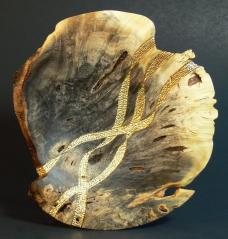
My tree trimmer gifted me with a pile of fresh Manitoba maple that is full of burls (gloat!). I am going to make a bunch of bowls and vessels and cut some pen blanks as well. How do I go about drying this? I usually Anchorseal endgrain and dry roughouts in my fridge-kiln. Do I just coat the whole piece in the case of burls?
Part of why burl looks so good is that the grain is not straight, so sealing the "ends" of pen blanks is really not sealing the end-grain.
I just (TODAY) finished with processing some Madrone Burl. Here is what I did.
I cut some of it into spindle stock (pen, bottle stoppers, pepper/salt mills), I cut the rest into bowl blanks. I then rough turned and cored the bowl blanks, setting the cores up for bowls, stopper blanks, etc.
I then boiled everything, boiling the spindle stock in the first batch and the bowls in the second.
I put my wax pot in the water, during the 2nd batch. When the was was melted, I coated every part of the spindle stock. I will either put these aside for a looongg time, or microwave the spindle blanks
Thanks Ralph. This is I figured and hoped for (seal the whole piece and dry normally). In my case, I only boil pasta and potatoes but I will throw a few pieces through the next cycle on my kiln.
I agree with every thing Katherine said. It does take a lot longer to dry but a piece totally covered with End grain sealer will dry. I have also covered pieces entirely with wax. They also dry but take many times longer. Still I've been able to save wood that would normally crack all to pieces in weeks by using these methods.
Steve, Katherine has given you some very good advice. I have successfully finished tons of Manitoba Maple this way. I do not boil Manitoba Maple burl as it does not distort or crack easily.
I'm going to try to differ slightly with everyone here without offending anyone.
I've turned a lot of Boxelder (a.k.a. Manitoba Maple) Burl, and I find it to be incredibly stable. The burls, that is, not the straight-grained wood of the tree. I don't usually seal rough-turned bowls at all. I do seal blocks for turning later, but they may degrade over time.
For really spectacular pieces with exceptional burl figure, you can paint it with Anchorseal or slather on paste wax (I've done both), but I don't find it to be necessary with Boxelder. I rough turn the pieces and just place them in a paper bag. As Katherine writes, if you turn these somewhat on the thin side, they will survive with no special treatment. I have chunks that were sealed with Anchorseal, and usually the colors and the bright sapwood are dulled. Sometimes the wood will stain grey in a very nice way (like Buckeye Burl), and of course, the bright red streaks will eventually fade away to a dull, light orange-brown, so at least rough turn them a soon as you can, and keep them away from sunlight for best results.
I have a friend who has made thousands of Boxelder Burl bowls, and he places his rough-outs on shelves near his hot wood stove -- with no treatment at all -- and rotates them after a few hours. He loses very few pieces. He usually turns them to completion when green, wet sands to about 320, then when they're dry, he finishes them with Scotch-Bright pads on a padded Velcro power sanding disk to retain the crinkled texture, and finishes with Watco or Urethane oil.
I don't usually take so many chances as that, and to be safe, you'll probably seal most of your burl pieces, but if you have some small pieces that are all burl, you might try turning a small piece and just setting it on a low shelf down near the floor to dry -- no bag or anything. You might just be amazed at how well it works. I would NOT suggest this for Black Cherry, Maple, or other burls -- just Boxelder.
With respect for the fine work and opinions of Katherine, Bill, John and others,
I agree with everything you've said. The most important reason I seal Boxelder burl is to keep it green! (I also wrap in plastic to retain the moisture until I can turn it). (My climate here is very dry).
Depending on the piece, I've turned hollow forms with wall thicknesses ranging from 2mm to about 3/4 inch, sanded wet, then put straight in my fridge kiln to dry, (without sealing). (I too like to retain the crinkled texture). My kiln works on a convection principle, and I keep it from 85-105 degrees F.
In general, I only seal solid blocks of wood -- not turned pieces.
Boxelder is extraordinarily forgiving in its ability to move without cracking.
One tip I learned from Jimmy Clewes -- to "retain" the red streaks, carefully dye them with red light-fast dye, (like Transtint, metal complex dye), and even when the natural streaking fades, the dye will last.