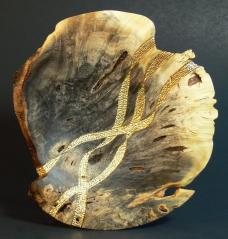
From "Symbols of Person, Series 1", this is "Passion." 5 1/2 in. diameter x 1 in. depth, ogee bowl, made from maple burl. Pyrographized, and gilded with 24k gold.
Though better seen in person then in the photo, the pyro- work is done in what I call "directional stippling," which adds character to the flames. Like other pieces in this series, the design folds over the edge to draw the eye to both sides of the piece.
Katherine very nice piece. I do like the flames. One tip on photography. Do away with the stand, it draws your eye right to it. Put something heavy behind the piece and then tape it to it. I use either paint cans or some bricks that I coated with rubber plasti-dip. If the can shows (and it probably will on round platters and bowls) then move the can back about 4 to 6" and tape a dowel to the top. Use the dowel to support the platter. Again you will probably have to tape the dowel to the platter. This makes the support completely invisible to the camera and focus's you eye on the piece. Other than the stand your photography is very good.
Thank you very much for your excellent suggestion! (I too dislike the look of the stand, and was trying to figure out a way to "fix" it.) I will be constructing one of these right away!
What I've been doing with smaller bowls is to use a medium-sized binder clip + sticky tack, (stuff used to hang posters on walls), and position them so that the binder clip supports the weight of the piece. (I photographed my "Squid" bowl this way).
YOur on the right track. Just use your imagination and you'll easily come up with a solution for supporting the pieces. In worse case scenarious where you could see through the bottom of the piece I have poked a hole in my seamless paper and run a 4 or 5 foot pipe through to hold the piece. It takes a lot of jury rigging to hold that pipe at the right angle.
Katherine, this is a striking piece. Maybe I have not been paying attention, but I do not recall seeing gold leaf over pyrography used on turnings before. Having done a bit of each myself, I am intrigued with the possibilities it raises. Congratulations.
I haven't seen it anywhere before either... :-) However, I'm not going to claim it is an original idea -- I'm sure that someone in the history of Earth has done it before!
This idea came to me after a conversation I had with a good friend who also does gilding -- Cindy Drozda. She said something to the effect that "gilding won't hide imperfections, instead, it reveals every one of them!"
This got me to thinking about creating "imperfections" and textures, so that the reflective nature of gold (and other metals), would enhance the surface quality, and make it stand out. (In fact, I've built a demonstration around this technique, "Gilding Natural Edges and Interesting Surfaces").
Anyway, you can create textures by all kinds of means -- pyrography, carving, chatterwork on the lathe, even build it up with sand, epoxy, etc. other materials, et al.
It's an interesting way to decorate wooden works, but make sure you have plenty of gold on hand -- it's a three-dimensional surface (even though tiny), so the gold doesn't go on flat... you have to press it into every crevice.