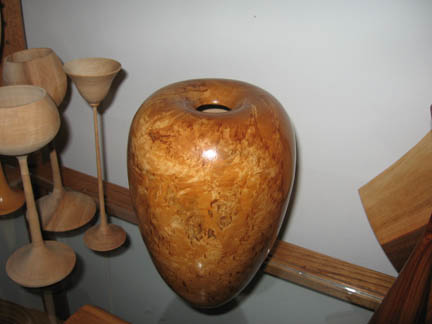
Re-turn the tenon. Open your chuck up as far as you can and place the bowl over the chuck applying pressure with the tail stock live center. Hopefully you will have left a small hole in the center of the tenon if not you might have to adjust it for a bit to get it running as centered as possible. With light cuts re-cut the tenon.
When I rough turn a bowl I make sure the center is marked on the inside with a little dimple. The center of the tenon is marked by the tailstock when it was turned.
When I get ready to finish the bowl I use the two center marks to align between centers using a spur chuck in the headstock and true up the tenon and sometimes the outside of the bowl. Once the tenon is trued up you can use the chuck. It is rare that a tenon is still round after drying.
First, measure the inside diameter, largest value and smallest at the same height, where the rim is lowest.
Then measure the outside diameter, largest value and smallest at the same height, again where the rim is lowest.
Compare the largest inside diameter = A and the smallest outside diameter = B. Consider B-A. If you want a bowl at least 3/8" in thickness, then B-A must exceed 3/8". If it doesn't, then consider chucking it, or make a shallower bowl.
In other words, make sure that you can get a bowl from the warped piece before trying to turn it. If A is larger than or equal to B, then you have problems.
I don't use the math. I simply put a rubber sink stopper over the chuck. Bring the tailstock up and center (I put a center mark as Barbara mentioned if for some reason my bowl doesn't have the center from when I first turned it) Then I rotate the bowl by hand and check to see that I can return it without losing the lip. Sometimes if the bowl warps funny you may have to slightly change the tailstock orientation to get the rim oriented so you can return it successfully. Once I get it correct I return the tenon to true it up for the chuck.
Whats-a-chuck-? Yes, put it back between centers and true up the chucking method of your choice. The old starting point may not work cause the drying will usually be asymmetrical. A little trick. I use the laser and shine it on the edge of the bowl. First on the outside of the rim and then on the inside of the rim. Spin the wood by hand and see if both high sides line up, and both low sides line up. Tilt the bowl between centers to get on the correct balanced axis.
Put your roughed, warped, and dryed, bowl into a tub of water and let it soak for a week. Some, if not all, the warp will come out of it. The best part of this is, that all the water in that wood will be 'free' water and so will not re-warp the same as when there was both free and bound water coming out at different rates.
That's one of those things that sounds like it wouldn't work but then I don't claim to be an expert on wood movement. I am studying it and trying to learn. Thanks for posting. I'm going to give it a try as soon as the weather gets warmer.
I've also wondered about putting a hose clamp around the rim to equalize the forces and keep it true. Haven't tried that but I did try it when I turned my Cardiac lamp. I turned the lamp from a green log and put the pith on centers. Then I completely hollowed it to about 1/8" thick which of course completely removed the pith. I put hose clamps on both end to hopefully keep it round since I planned to put solid wood base and tops on. It worked. It was out of round less than .020" . Now whether it was because I had centered it on the pith or the hose clamps I don't know. I plan to run a test one of these days.
My thoughts are that if the tree was growing straight up this would probably work but if you used a branch or a tree that was leaning it would probably warp unevenly due to the stresses in the wood. If I have the time I'm going to run 4 pieces. 2 from straight wood and 2 from limb stock. Then I will put hose clamps on 2 and not on 2. That may tell me something. It may just tell me I've wasted a days work but I still like to experiment and learn.
I suspect that your tube stayed round, because it was tangental wood all the way round, whereas if you had turned from something larger, off to one side of the pith, things would have been different. Certainly if you had some small arcing annual rings on one side, then radial wood on opposite sides, then on out to gentle arcs further out.
I cut down a pretty good size tree a few years ago, stripped the bark, then reassembled it inside a restaurant. I used a rod out near the balance point of each of the limbs, some of which were 20' long, and green when I put them up.
I expected them to sag of their own weight as they hung out there, but they did the opposite. The tension wood on top of the limbs contracted a lot more than the compression wood on the bottom, which caused the outer ends of the branches to rise up lifting the ceiling tiles.
I ended up having to go back about 4 times to cut the ends off, just to keep the ceiling in place. I am pretty sure that if I hung a green beam from a straight tree-trunk by its middle, it would have sagged on the ends.
John, I tried that many years ago before I knew much about the drying stresses. It did not work. The wood is not just warping it is shrinking as the water leaves the wood fibers. The shrinking causes the movement...Death, Taxes, and wood will shrink when it dryes. You can not stop it, I tried. An end grain hollow form will have less movement and more uniform movement then a bowl. The soaking the bowl in water method will swell the fibers, but when it dries, it will shrink again. This whole double turning process is such a pain I always turn green wood to finish, and live with the movement. If the walls are uniform it will not usually crack.
Ill see you at the Tenn. Symposium. And others at Fla. Symposium. And others soon at the Woodturning roundup in Arizona.
I always start my bowls between centers. Instead of the point on the live center I remove thit and use the cone. I also make the tenton larger than necessary so I have some extra wood when it comes time to return th bowl.
When I return the bowl I use one of my vacuum chucks as a jam chuck, bring up the tail stock and return the tenton . With the extra wood in the tenton I have room to true up the tneton. This works for me. I have been doing it for years.
It's enough that I can't get it in a four jaw chuck without beating it on. My concern is that I'm not going to get enough grip by doing this. I'd say I'm out about 1/4" - 3/16". Also, beating something so it fits just doesn't sound right to me. I don't want to screw up my chuck.
I start and finish every bowl between centers, except those rare ones that exceed the inboard capacity of the lathe which are turned outboard. I assume every tenon will be out of round when dry, so I plan for that when rough turning.
When you start a bowl between centers, you have an opportunity to change the positions of the drive and tail centers to get the most balanced profile or figure pattern. When you want to spend the $$$, a vacuum chuck is a might handy apparatus. Until then, here's another perfectly good way to proceed:
Rough turn the tenon at the tailstock end, turning the very bottom down to a small nub that will fit inside the chuck jaws when you grab the tenon with the chuck. Don't get rid of this until the very last step. After the rough-out is air-dried and warped, you can return the tailstock to the little nub left at the center of the tenon, and either place the open bowl over the extended chuck jaws, as Stuart and others suggest, or make up a few disks of scrap wood in different diameters for this purpose. The inside of the bowl will also be oval, but you will have at least 3 good points of contact (2 inside, plus the tailstock), so you can safely turn this as long as the original nub at the foot is strong enough.
If the bowl has warped too asymmetrically, you can always abandon the original center mark on the foot, but its a handy reference. To avoid this in the future, consider changing the orientation of the next bowl by tipping this way or that, back at the rough turning between centers step.
Now re-shape the outside of the bowl between centers, and true up the tenon for re-chucking. (If support seems lacking for finish turning the outside profile, true up the tenon, re-chuck the bowl, and true up a small part of the inside on which the chuck or your disk of wood will sit, then go back to turning between centers with the foot at the tail end. I find it more stable to shape and finish turn the outer profile while holding the bowl between centers.)
Then the inside of the bowl is turned and sanded. Lastly, reverse the bowl between centers again to remove chuck marks, and finish turn the foot, by supporting the open (top) side of the bowl with a cloth- or foam-covered disk, Cole jaws, or shop-made reversing chuck like a donut- or Longworth Chuck. If you are finish turning between centers (as I do), you sand and polish and cut the little tenon at the tailstock away to a tiny little nub that can be easily removed with a small chisel and a few swirls of sandpaper.
With practice, you can get the little nub down to about 1/8" with a balanced bowl and lower speed, and with more practice and great care, even cut right through it while keeping the bowl chucked with a hard-rub of the bevel pushing the bowl up against the headstock end. This is not for beginners, but you can turn the little nub down to a tiny stalk, switch the lathe off, and sever the little stem by raising the handle of a sharp shallow gouge as the lathe spins down to a stop -- remember that your tool is holding it in thin air, so be sure to catch the bowl! I'd recommend practicing this little trick on a small, light bowl of no particular value.
Here's a shot of a tiny nub on a hollow form demo piece about to be severed after sanding on the lathe.
Sounds (reads???) like your bowl is pretty small. You can grab a chunk of scrap wood, firewood, or a future box blank, and turn it between centers to make a small foot at one end to fit your chuck, and create a fat cylinder that will sit down inside the bowl to act as a temporary chuck. Put the bowl over this, bring up the tail center, and you're off to the races. For larger or wider bowl shapes, I make a slightly hollowed shape at the working end to make sure it sits on the outermost edge for the most stable support.
For larger bowls, I often use a small bowl or bowl blank as a drive chuck, with the top edge (rim) of the smaller bowl driving the larger one I'm working on. Richard Raffan's books show these methods very well.
I have a lot of good ideas and I guess I need to try one and see what I feel comfortable with. The general consensus seems to be going back to "between centers", truing the tenon / foot, and then into the chuck. This makes the most sense to me and the least dangerous for my capabilities.
Start by drawing a vertical and horizontal set of axes. Then put marks on the horizontal axes say 4 inches to the left and to the right. Then put marks on the vertical axes at say 3.5 inches above and below. Sketch the best ellipse that you can using these four points. Now repeat this process at 4.5 inches and at 4 inches and sketch the second ellipse. Now take a compass and put the center at the axes. Draw two circles, the first being the smallest circle that will fit between the ellipses and the second being the largest that will fit between them. What you have just done is determine the largest bowl that can be made from the elliptical warped bowl we started with.
Now, what would happen if we moved the horizontal points 1/2 inch further out along the axes and left the horizontal points fixed? How would this affect the two circles? At some point you can no longer put circles between the ellipses, so no bowl could be made from a blank that has warped to that shape.