Home Articles Forums Gallery Marketplace Videos

WoodCentral Forums

Knowledge You Can Build On — Est. 1998

Urban Salvaged Hardwood Slabs, Milled In-House from Rare Trees. Shop Unique Walnut Stock.

Burl #2, and some questions

Posts

Burl #2, and some questions

#1

Burl #2, and some questions

wilbur

Here's the second bowl I've made from a burl.
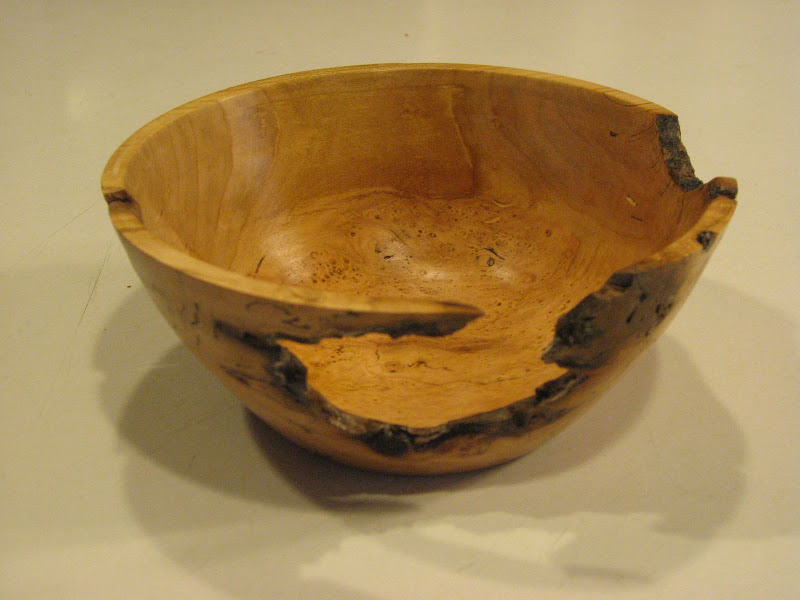

Dealing with the gap left by the inclusion was easier than I thought. I haven't attempted a natural edge bowl, either, so this was my first time dealing with a gap in a turned project.

I do have some questions for those with more experience. I'm used to sanding and finishing bowls on the lathe while the bowl is spinning. I sanded and finished this bowl with the lathe off. Is there a way to sand and finish a bowl like this while the lathe is on? It looks like it could be a recipe for disaster if I tried that.

Assuming you can't sand and finish a bowl like this with the lathe spinning, how do you like to go about doing that?

Finally, is there any way of predicting what the gap left by an inclusion will look like, or is this just going to be a matter of going with the flow?

Re: Burl #2, and some questions

#2

Power sanding

Doc Green

This refers to installing a sanding pad in a drill, placing a sanding disk on the pad, and then using the drill to rotate the sanding disk against the work. It's great! In fact, many turners use power sanding extensively for solid pieces because of its efficiency in removing scratches, tool marks, etc.

Power sanding can be done with the lathe off or turning slowly. For a piece with an open section or an incomplete rim, do it with the lathe off.

A variety of sanding pads are available. Check Packard Woodworks, Craft Supplies, Klingspore, and so forth. (Click on the icons in the WoodCentral Marketplace.) Extensions are available as well.

An angle drill is easier to use. Klingspore sells one that is angled at about 55 degrees (I think) that is ideal. Also, the drill needs to be reversible, as you will discover.

Good Luck, ~Doc

Re: Burl #2, and some questions

#3

As Doc has stated, power sanding...

JamieDonaldson

with the lathe stopped is the proper and safe method for irregular edges like this, regardless of the RPM. Some turners attempt to power sand at high speeds, but this rounds over the edges and it doesn't look great.

Re: Burl #2, and some questions

#4

Re: Power sanding

Barry

I've found that a plain old cordless, VSR drill works just fine for power sanding. I think you will find they are usually cheaper than angle drills. I have an old Panasonic 9.6 volt that I have used for about 10 years for power sanding. When it finally croaks, I'll buy another.

Re: Burl #2, and some questions

#5

Re: Burl #2, and some questions

Juergen

If you do decide to power sand:

1. Make sure to rotate this bowl in reverse, and keep the lathe at a VERY slow RPM.

2. Or, leave the lathe OFF and let the power sander create the rotation. With a variable speed drill one can keep the bowl rotation < 50 RPM easily.

3. With the drill (right angle is the best) in your right hand rotate the bowl with your left hand as required.

4. Do 2 and 3 above with a randon Orbital sander. I find the last to be the most effective for control and keeping the edges crisp.

Re: Burl #2, and some questions

#6

Re: As Doc has stated, power sanding...

Bill Neddow

I agree with Jamie.

Re: Burl #2, and some questions

#7

Re: Power sanding

mmann

A cheap RA drill can be had at Harbor Freight between $25 - $40 depends on whether they're on sale. Ebay always has them for $20. These are obviously cheapies but work just fine for sanding. Get one that reverses. Also get a variety of circular sanding attachments in different diameters and different firmness of the pad. I use hook and loop and buy it by the roll from Klingspor and cut out the discs, much cheaper than buying precut discs. Last thing but you probably know this, used 150 doesn't become 180, throw away used sandpaper....as someone once said, "Use sandpaper as though someone else paid for it". And don't skip grits. That piece you've shown, I sand it with the lathe off; if I did turn the lathe on it would be very slow speed with the sanding pad angled in such a way that the edge at the void doesn't catch the pad give you a much larger void as well as bashed knuckles and perhaps worse.