Hold Me Pieces
charlie belden
If you're turning a Gallery/Museum piece it's probably going to be a Look But DON'T Touch piece. And if it's a Craft Show piece, and you want people to pick it up it's got to be semi-indestructable - no little details that can be broken off, nothing that can be easily scratch - and definitely not some little piece - that can fit in a closed hand or in a pocket.
BUT - if it's something that will only be handled by you, or with your supervision (watch 'em like a hawk) - there's a LOT more options - for Look AND Touch - for tactile sensuality. A visible texture is one thing. If you can run your fingers over that same texture, maybe with your eye closed - that's a very different world. Imagine exploring a Hunter, Fennell, Tibbett, Drozda or Priddle piece - with just your hands, eyes closed - BEFORE you SEE what you're holding. Imagine where that'd take you.
The lathe is a component of a carving system. Turning is a constrained form of sculpting. (I know - sculpting sounds ARTSY - and most of us would NEVER think of ourselves as ARTISTIC or as sculptors). We can create wonderful shapes and forms, adding or removing color, and playing with the light reflected from it through the use of inscribe lines and/or textures, breaking up the piece in visual areas of potential interest. But it's all done by reflected light - and how our eye capture that light as well as how our brains interpret that information - a twice or thrice filtered perception of what's actually there.
Our sense of touch is a bit more direct - the experience less filtered. Sharp/dull, smooth/rough, round/flat, straight/curved, random/ordered, etc. AND - temperature - colder/warmer/HOT! And the resolution of our fingertips is pretty good - as anyone who has glued two flat boards together well knows. We can pick up a difference between adjacent flat surfaces that's in the hundredth and even thousands of an inch. And if you use your teeth as a touch device, the resolution is even higher. Take two "pearls", one a synthetic (plastic but not a "cultured pearl") and the other a natural or cultured pearl. Rub each on one of your front teeth - and you will immediately be able to distinguish real from fake - the natural or cultured pearl will feel "gritty" - because it in fact is. But the "grit" is below what we can detect visually, or with our finger tips.
So my question is:
Since DON'T TOUCH isn't necessary for pieces we turn for ourselves or others who won't misuse them
WHY aren't we doing more Hold Me, Touch Me pieces?
We've got wheel chair ramps and traffic signals with tones to let the visually impaired know when it's safe to cross the street. There's the American Disabilities Act (ADA) that requires that things be accessible to people with disabilities ( the word "disabled" bugs the crap out of me because I know and have met so many people that label has been slapped on - who are by no means "disabled", many far more "abled" than I am - in a bunch of ways). Why aren't organizations like the AAW and galleries and museums including areas of exhibits for the "visually impaired"? I CAN see - but I'd like to touch and feel many of the pieces I've seen - and I'm sure there are some that I wouldn't have to see to experience what the maker intended to convey.
Have YOU had an idea for a tactile piece - but never made it because of the Lood But Don't Touch barrier? If so, care to describe it?
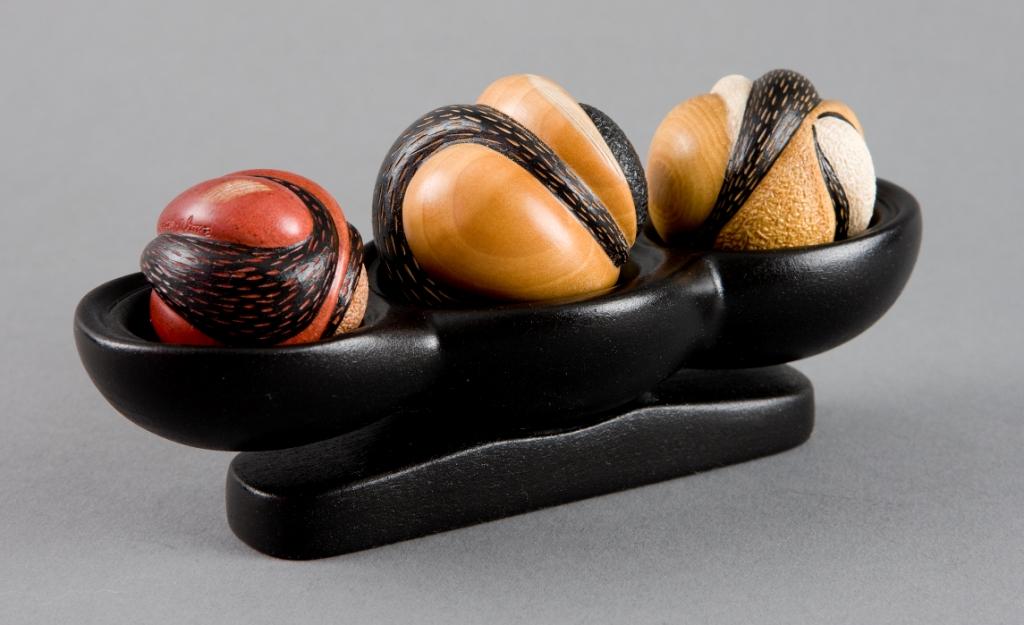
 If I see a sign that says "DON'T TOUCH" I walk right on by.


