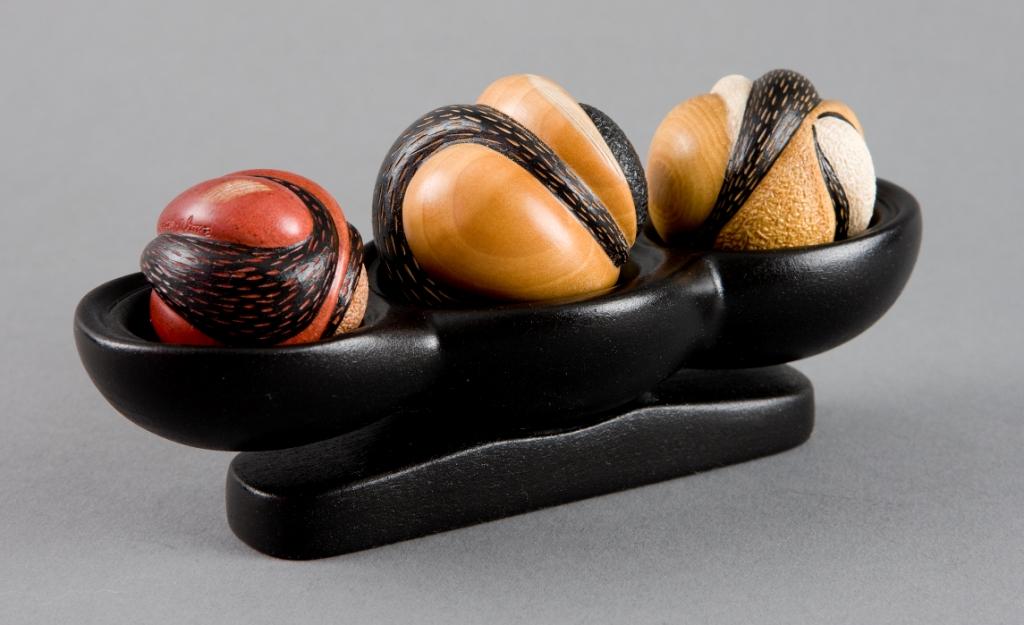
For the most part, woodturning DOES stop at brown and round. You can embellish the things that you turn, but you are no longer woodturning. When I carve a Santa Figure, I call it carving. If I paint a picture, I call it painting.
There is nothing wrong with producing highly ornamented work that has some basis in the lathe, but I am not sure that "woodturning" is the right word for it? I turned the Santa in this picture originaly because it was the fastest way that I could think of getting to the starting shape, but I doubt anyone would refer to it as a woodturning.
To answer your question, I started brown and round, and I have moved from it to something else- but still highly lathe centric. I identify my work as either a turning or something else depending upon how far it has departed from the lathe...
Where does segmented turning fall into a "turning" category? Those creative folks spend more time cutting little pieces and gluing them together than they do turning, yet the final product looks more "turned" than a carved piece.
I probably would not be associated with the turning community if the "rules" were that carving or embellishment were disallowed. I like that woodturning is so inclusive. It makes life much more interesting.
Any time a definition is developed, limits are imposed. What's the point of defining and limiting?
have started turning, because the thing that first attracted me were the visual things - curls flying through the air, the motions that the tools and turners made while I watched a bowl being created in as little as 30 minutes.
Then when I was the turner, it was the emotions - the satisfaction I felt when accomplishing my first completed bowl - crude though it was. The satisfaction of five years later, knowing that I could put that same first bowl on the lathe and turn two more from the same thickness. Satisfaction of being able to shear cut a surface that minimizes sanding time.
And yes, I now do things are NOT brown and round, because they, too, give me satisfaction. But like Steve pointed out, if it's a bowl that still looks like a bowl, it's a woodturned piece. If it originated on the lathe, but now barely resembles it's original shape because I've altered the appearance with carving or sculpting, then it's either a woodcarving or sculpted wood. That's my language.
There is more woodturning on a Windsor chair than most of the work being produced in the AAW today, but not many people would call a Windsor a turning.
If I paint my turning, it doesn't make it a painting? I am merely suggesting that the departure from something being lathe-centric is a departure from woodturning. If I don't need a lathe to make it, why would I want to call it a woodturning? I could have carved away all of the wood in my Santa with a knife, as the lathe was just a means to an end, but not an integral part of the making of the object.
Suppose I make a segmented piece, carefully gluing up my pieces and then use a rasp and sandpaper to get to my final form? Never touches a lathe. Would you have an issue with calling it a woodturning? I think that words become meaningless when we start to use them out of context, and as such, I choose mine carefully to describe what I do.
I have no issues with people producing these objects any way they see fit. I just wonder why a carver would call a carving a woodturning...
Turning is, in fact carving, merely a more dynamic form of carving since the piece of wood is moving, as is the carving tool AND the carver.
But let's start with just the word ROUND.
"Round" implies a circular cross section and the entire piece having a single axis of symetry.
Is therming turning? There's no round cross sections.
Are three intersecting arcs, each created on the lathe, turning?
Is what Escoulen or Steve Holt create turnings? Their pieces are created on the lathe, and are comprised of many round cross sections, as well as other partial circular cross sections.
By using a burning wire, or a piece of formica for that matter, on a turning, while it's turning - still result in a turning?
Is a knurled texture, or a chatter texture, created on the lathe, with the wood turning - result in something that is NOT a turning?
If you cut up one or more turned pieces, reorient the parts and glue them together in a different configuration, is the result still a turning or turnings?
As for BROWN.
"Brown" implies that the piece is all wood, perhaps a single piece of wood.
If a piece is not even wood, let's say it's ivory, bone or corian for that matter. If the object created is all done on the lathe, and is comprised of single axis round cross sections - it it still a turning?
Is combinging two turned piece - in the same or different woods a turning?
If the single axis symetrical, all circular cross section, solid single piece of wood - is then bleached - does that make it no longer a turning?
The implicaton of Round & Brown is single axis circular cross sections, all created on the lathe, using traditional turning tools - gouges and chisels - continuously round surfaces made with a single cut, the result created from a single piece of wood that comes off the lathe as one piece of wood.
I personally believe that if the basic form is created on the lathe, no mater what you do to it after the turning - it is still a turning. And because that opens up so many opportunities for further work - turning is and will likely continue to be so popular - and continue growing. Limit it JUST to Round & Brown and there will be some turners happy with just that. But many potential turners will probably not take up turning, seeing it as just to confined and too limited.
Wood- doesn't imply anything more than that the item on the lathe is made of wood. Pretty open beyond that- and inclusive of segmented, multi axis, etc. as long as the material is wood. If you have a hunk of brass, it's not WOODturning.
Is it still turning? Sure, unless it's a flat sheet and you happen to be metal spinning, which is also not woodturning.
turning- implies that the work is on a lathe and spinning. This means that you can burn a grove with a wire, and I suppose your still woodturning. If you take it off of the lathe, you aren't woodturning, but something else.
So, if I make pots on a potter's wheel, I am not woodturning. If I mount alabaster on a lathe and turn a bowl, I am not woodturning. If I decide to glue up a bunch of segments and use a rasp to knock off the points down to a perfect bowl form, I am not woodturning.
All of these things are valid forms of expression, and none should be contained, but when anything can be called a woodturning, woodturning becomes a meaningless word...
I'm with Steve. Even if you do all of the work on the lathe it's still not necessarily round or brown. I used to do a lot of inside out turning. Looks carved but it's all done on the lathe. Well at least after the glue ups.
Are you familiar with Stoney Lamar's work. It is, or at least used to be, totally turned. Sure didn't look that way. It was turned on multiple axis, more or less the same way Terry Scott does his burl bowls.
I started carving on turning out of necessity, sort of. I was turning the foot on a bowl and blew out the ring, so I carved away most of the rest of the ring and left 3 feet. That was probably my first introduction to adding more to the turned pieces.
I sure wouldn't be having as much fun in turning if wasn't for off the lathe playing. I think it allows people from more walks of life and with more ideas to call themselves turners. They can start of finish a work on the lathe but they can add whatever other skills they have to the project, be it carving, painting, working with epoxy, etc.
the late 70's. I hadn't seen any turned & carved period furniture at that point so turning held no interest for me. I know it disappointed my shop teacher as turning was his favorite aspect of wood working. It wasn't until a desire to make some special knobs for a chest of drawers in about '06, made me put my drill press into service as a "lathe". Cherry inserted into poplar to make a popping rosebud shape. So while "plain" turning can be quite impressive, it didn't do it for me the first time around, and I probably still wouldn't be doing it if that were the only expression allowed.
The Windsor Chair is a great example of getting around The Rules.
During the period of Guilds, there were very specific bounds set out by each guild. Near the top of the heap were the Joiners. If two pieces of wood in a piece of furniture were joined with anything but a round hole and a round "peg" - it was the exclusive domain of Joiners.
Turners exploited that little loophole to gain a footing in the furniture market. Initially their furniture pieces were tour de force of the turning craft - beads and coves and a host of other classic turning profiles. The fact that their pieces were clearly not tradional Joiner pieces let them slip under the radar. Over time, many turners were more furniture makers than turners, but vestages of turning remained - just in case - toned way down - but still "legally" turning.
Turners it seems, have a long tradition of going right up to the line - and often ignoring any lines - other than always going for Fair Curves. And had the masters of Fair Curves, boat builders, seen turners as competition - turning might have stayed out of furniture making.