Having searched the net and come up empty, I would like to ask the help of those here.
I am looking for an electric random orbital sander, similar in size and application to the small Grex air model. I have a 5", but I'm looking for something lighter and smaller for sanding pieces on the lathe. I also have a right angle drill that I use for 2" and 3" disks, but, of course, it is not random orbital.
... about what you're looking for that the Grex doesn't deliver. They make great tools, and that one is reasonably priced. In fact, I'm considering getting one myself, although I don't have a big compressor anymore. I'm not sure why, but, on Amazon, they recommend a 60 gallon tank, yet the sander only consumes 2.2SCFM @90psi, which is peanuts compared to a 5" Dynabrade or other conventional air sander.
One other thing I'm wondering about is the value of the random orbital action. On a stationary piece, it makes sense, to eliminate swirl marks, but if you're thinking of using it to sand spinning pieces on the lathe, my hunch is that the random orbital action will be cancelled by the rotation of the piece. I'd love to be wrong on this, but, with few exceptions, random orbital sanders don't have a power-driven eccentric action; only the orbital action is driven, and the eccentric action is induced. I imagine the resulting sanding action on a spinning piece would end up being unpredictable, partially dependent on the SFPM speed of the work and the amount of pressure of the sanding disk against the work, but I'd like to hear more about this from someone who has tried it.
Another related question is whether sanding a spinning piece would damage or destroy the pad brake that most ROS have. On air sanders, this is generally a plastic or rubberized shroud that exerts a little friction on the disk to keep it from spinning uncontrolled when you enter or exit the work.
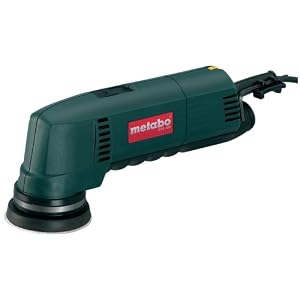
There is the Metabo SXE400 ROS. Lots of folks sell this and you should google it to find the price and service you are looking for.
I have used this sander for a few years and it works fine on the outside of bowls and hollow forms, not so good for the inside of bowls.
The result of using this sander is that regular power sanding works slightly better for me. I primarily use the Metabo for sanding platters and table tops.
The Fien multi-master or the clones provide ROS you can attach hook loop to business end of the Fien. I still prefer the regular power sanding.
Amazon, they recommend a 60 gallon tank, yet the sander only consumes 2.2SCFM @90psi
I have a Grex and it is a good sander. My compressor has a 30 gallon tank and I can only get 3 or 4 minutes if that before it kicks on. As a result I use it as a passive sander while the compressor cycles. It does loose the orbiting when sanding on a spinning piece. I just switched to power sanding using my Milwaukee right angle drill and find it does a better and faster job.
I love the Grex, but I have only a small Porter Cable pancake compressor and it won't keep up to the demands of the Grex. That's why I'm looking for an electric. I spoke to a Grex rep and he confirmed that my compressor and it's small storage are inadequate.
I found that when using a random orbital while the work was spinning the random went away, and it became a passive, to little benefit. The shroud Ellis mentioned caused more problems, when it touched the spinning wood, leaving plastic lines. To remedy a poor cut on the inside or wide bottom of a bowl, however, with the lathe stopped, it can really help smooth things out. Don't ask me how I know this...
I still occasionally use the Milwaukee angle drill and velcro disks and like it, but overall I get superior performance from the Vic Wood 90 degree passive sander, and a light touch. I can go through the grits in a couple of minutes, up to 2500, and polish the wood prior to applying finish. Most folks comment on my finishes, even years later.
The 2" passive from Sorby (I think) is a lesser option due to the use of a bushing instead of bearings, but with care and maintenance it will do the job, and in some instances, is a more utilitarian choice with it's increased reach.
I find that I can sand right up to details with the Vic Wood, without damaging the other areas. I stop the spinning with my finger, and use the edge of the disk to get right up to ridges and tenons, etc.
I see that Craft Supplies is no longer selling the Vic Wood in the latest catalog I saw at a club meeting this weekend. Shame, really.
I've had mine for many years, and it still works just like it did out of the box.
Random orbit sanding is best for off the lathe work. If you have large variations on a natural edge, sanding on the lathe with it spinning can round over edges. I use the Grex for off the lathe, or sanding around details on the lathe when it is not spinning. Then power sand to blend all the sanding together.
What I suggest in my demos and discussions is to use an angle drill for the lower grit such as 80-180. Random Orbital Sanding (ROS) is good for the higher grits say 220 and above and using a very slow speed if not having the piece stopped on the lathe. ROS IMO does not provide the support and torque need to remove deep scratches and tool marks. That comes from the torque and gearing of a drill. In addition, you will need, as someone mention, a tank of at least 60 gallons to run a ROS because of the amount of CFM that is required regularly. You may be able to get by running a 30 gallon for a while but you are denigrating the life of the compressor unit by doing so. I have my lathe at 50 RPM the slowest it will run when using ROS and using grits 220 and higher. All I am doing is just fogging or clouding the piece. It is a finesse action.
I only used a random orbital sander with a workpiece turning once and it ripped the hook/loop interface right off the sander. Never did replace it and haven't used the sander since. Ummm, it's over there somewhere under that pile of shavings......
Thanks Vince but it's ok. If I ever need my 5" random orbital sander again it will because I'm doing fl*t work and need to be shot anyway. I'll stick my blue disc and replaceable interface pads from your shop.
Thanks, Vince. I had gone to your site before I placed my first post. I saw the great looking little ROS air powered sanders you have, but I knew that my little compressor was not up to their draw.
It looks like it may well be the Metabo for me. All too typically, they are not handled by Metabo Canada and not available here. Amazon in the US has a good price, though.
Ellis, I will jump in here, since I am pretty sure I know where Grant got his hankering for a random orbit similar to the Grex. I have had the RA Grex for a number of years, and use it just like Vince describes in this thread. I do the main sanding on a piece with an electric drill or the Grex air drill - whichever is better suited to the piece at hand. Once I get to my final grit, I switch over to the RA sander and run the lathe as slowly as I can, and then finish up with the lathe stopped, and just moving the piece by hand. This works great for the natural edged pieces I do.
I've been running the Grex RA sander for about five years now. I started out with a 27 gal Coleman, but it eventually wore out. It was always playing catch up. Now I run it with an 80 gal Ingersoll Rand with a 5 HP motor rated for continuous duty. It is amazing how much air that tiny little sander can use! Oh, and if you don't remember seeing the compressor when you were here a little while ago, it was in the big chipboard box behind the lathe.




 I have had the RA Grex for a number of years, and use it just like Vince describes in this thread. I do the main sanding on a piece with an electric drill or the Grex air drill - whichever is better suited to the piece at hand. Once I get to my final grit, I switch over to the RA sander and run the lathe as slowly as I can, and then finish up with the lathe stopped, and just moving the piece by hand. This works great for the natural edged pieces I do.


