Today's question:
steven antonucci
What's the most difficult thing you have ever turned and what made it difficult for you?
I'm looking to see how everyone defines "difficult"...
Steven
Knowledge You Can Build On — Est. 1998

Today's question:
steven antonucci
What's the most difficult thing you have ever turned and what made it difficult for you?
I'm looking to see how everyone defines "difficult"...
Steven
Re: Today's question:
Ken Oakley-Sunny St. Cloud, Fla
Back in the 1960's while working as a modelmaker I turned the original prototype for the container that Comet cleanser comes in. I turned the body in wood and then had to apply the little petals around the rim which I made of Plexiglas, Afer applying them I had to rechuck the model and turned the petals to .030" in thickness. After it was delivered to the designers and they did an immersion test to calculate the amount of cleanser powder the container would hold they wanted to reduce the size so I had to cut the model in half and remove about 1/2", reglue it and refinish it so no seam lines showed. Comet still is sold in containers based on that prototype. Wish I had gotten a royality on it. Who knew?
Re: Today's question:
John Lucas
I don't know if it was all that difficult just really time consuming. I turned a hand mirror that looked like a sunflower with actual leaves all around the edges. The leaves were turned using the ring turning method where you cut them apart afterwords. Of course the tenons turned on the bottom where square. It took a million years to sand all those leaves and hand carve the tenons round. I also had to throw away at least 1/4 of them because of side grain in the tenons.
I kept it for quite a while and finally decided that it was too fragile to sell and tossed it. Obviously I need Cindy Drozda's clientele because some of her pieces appear more fragile than this was. 
Re: Today's question:
JL
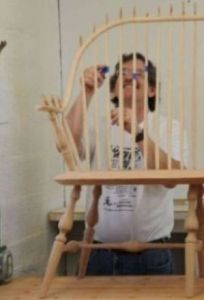
Some very long stiles for a set of end chairs. Even when I used my spindle steady they had a lot of flex. I had to keep sharpening the tools or I would get too much deflection.
Re: Today's question:
John Lucas
JL I had to turn some 54" spindles that were about 2" in diameter if my memory is good. I fought those things for a whole day. I ended up making some V shaped steady's to go along with my wheel steady.
Re: Today's question:
robo hippy
Some one gave me a piece of coconut palm to make a bowl out of. I never forgave him.
robo hippy
Re: Today's question:
Bill Turpin in WNC mountains
I am currently making a walking cane for myself out of 1 1/2" square quilted maple that is 42" long at this point. Wobble is so bad that I had to build a steady rest for my 3520 w/extension. I am now ready to proceed. I hope to have it finished for Bill G's seminar on 9-11.
Re: Today's question:
Peter Charles Fagg (UK)
My dificulties were brought home by my accepting the commission to make 5 stacking bowls that had to fit a locker on a sailing boat so that they didn't crash about in heavy seas!
Making one wasn't so bad but the third, fourth and fifth were a nightmare. They did fit the locker but only after I had left them out in the sun for a few hours!
Regards, Peter.
The first thing I turned
Terry Scott
Steve interesting question
Apart from the first thing I made which was done without any knowledge on the subject on a lathe if you could call it that
A motor with a pulley which I drilled through to bolt on a piece of ply .Then with the aid of old files I scraped a piece of snarly pine.
Scraping my way with 3 files Id sharpened I had dig in after dig in until Id broken all three files .The wood as it was screwed to the face plate didn't come off but because it was so out of balance the motor threw its self across the bench with wood attached as I had only screwed it down .Luckily the lead was only a foot long and pulled out of the socket .Not geared down it was probably doing 1200rpm
For a 9 year old I was very proud to eventually take in a platter to my mother who used the beaten up piece of pine for a pot plant stand in the conservatory for years until it rotted away .
It wasn't until 16 at high school that I had the opportunity to do a little turning as I took woodwork .
Then nothing for 25 years or so
Since then nothing has been difficult just a big challenge
Re: Today's question:
Mike Foster
Not the most difficult turning, although that wasn't easy, but the most problematic in figuring out how to carry it off. This piece looks like it is traditional staved construction, but is not. I wanted the piece to stay together with changes in humidity, and decided that it needed to be constructed consistently, not segmented and staved together, which could lead to problems with the wood moving differently. I was also constrained by the 8/4 thickness of bubinga I had for the construction. I wound up cutting the "Staved" portion of the turning cut as compound miters with the grain running horizontally through the staves as one would with segmented pieces. Getting the angle set on a jig for the compound miters was a real test. I then wound up with a cone, but the top and the bottom of the cone were not flat, but had sharp corners that stuck up from the 8/4 bubinga from the way they were cut on the sled. It took me quite a while before I finally came up with a way to flatten them out. I couldn't figure a way to mount it and turn it, since I didn't have a flat surface on either the top or bottom, and it would have taken forever to do with a 6" belt sander. I finally found a surface planer that is pretty safe that installs in a drill press (can't remember the name of it, but it still kicking around in the shop). This allowed me to get one surface pretty flat, and I could finish it on the belt sander. Then it was just a matter of mounting that surface, turning the other end flat and sanding it. The whole piece then, was a very thick (tall) segmented layer that was glued to the rest in the traditional segmented constriction manner. That was probably clear as mud, in description, but unfortunately I don't have a picture of the piece during construction. Anyway, I have never attempted another of these.
Mike
Re: Today's question:
Russ Fairfield
I made the white piece for the front porch stairs of a house in Seattle in 1956, and it was the 1st commercial project I did. I was just a green kid competing against Denver Ullery and a couple other good woodturners in town, and it was a scarry one for me because woodturning was a new way to earn money. There were 4 of them and they were turned from old-growth cedar.
The 2 new ones in the photo were made 2 years ago for the new owners of the house. I have no idea who made them or what they charged, but I bet they cost a lot more than the originals. I remember getting $50 for the 4 of them. It took less than a day to make them and the wood was free, so it was really good money for the time.

Re: Today's question:
Walt Bennett
A friend needed a dry oak burl roughed as it was too large to go onto his lathe. I can't remember what species it was, but I had to sharpen my two 5/8" gouges three times - couldn't believe how hard the wood was!

Re: Today's question:
Jim Barbour
The turning was not too bad -- The assembly was a pain!! A couple of years back I was asked to make three heraldic staves for the faculty marshals to carry in formal academic procession. My university, Elon, has a great fondness for oak -- Elon is Oak in Hebrew -- so, of course they had to be turned from oak that grew on the campus - enough of a problem right there. Each of two are roughly seven feet tall with appropriate decoration full length and a turned acorn with bronze leaves on top. The third is only 4 1/2 feet tall so it was not as much of a problem. The difficult part arose from the fact that I could not turn them in one piece on a Nova DVR and had no access to a lathe with a seven food bed! Thus I had to turn them in four sections and connect them with 3/8X8 steel threaded dowels (these are walking staffs so they must have a great deal of structural integrity). So far, not too bad. However, the joints had to match EXACTLY with respect to the grain. Thus the threaded dowels had to attain maximum strength just as the pieces' grain aligned. I must have put them together twenty times before I finally got everything aligned and epoxied the dowels. Of course each assembly involved a great deal of tension in the final twist -- strap wrenches came in handy! Here's a shot of the top of one of the three.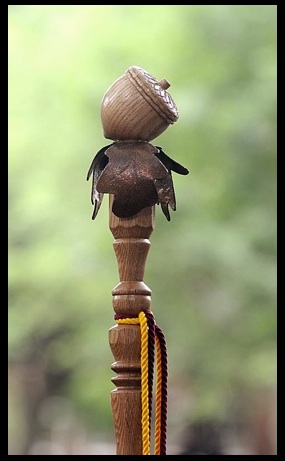
Re: This is the most challenging .....
JamieDonaldson
...square or winged form I've ever made, and forgot that I had to get my hand with sandpaper in the underside/neck area of the vessel to sand while it was spinning on the lathe! 

Twelve!
Steve Kubien
Oops, guess I should've read the actual question before giving an answer.
Two most difficult things I ever turned were a cremation for a baby boy and a keepsake urn to hold some ashes of my swordsman (for his wife).
Re: Today's question:
Ken Oakley-Sunny St. Cloud, Fla
Phenominal
what, no desert ironwood turners? :-)
steven antonucci
glad that folks haven't leaned on the wood for answers.
For me, the hardest thing I have ever done was is tall work. I'm talking about work in the 16" and taller category, where you are so far over the rest that everything is magnified. forces, motions, errors- all magnified.
beat myself to a pulp...
S
Re: what, no desert ironwood turners? :-)
bill crommett from Seneca
I can feel for Steve. I turned one after having attended a demo by (the man from Alberta) . It was 18 in. tall and sits on the Kitchen cabinet now as part of the "Series of One". alone and still not forgiven >
Re: Today's question:
Matt Birchfield
I accepted a commission to replicate a 4-5/8" x 4-5/8" x 11 Ft. long porch column. Turning the profiles was very easy on a strategically glued up and mill-squared blank. I don't have an lathe with that distance between centers, and getting it to join properly near the center joint was the problem. I used a mortise and tenon that was ~9 inches long... REALLY curious how others would have done this, or if anybody would have accepted the commission ($500)? Light-weight shingled porch roof... no deck above.
Re: what, no desert ironwood turners? :-)
Jason Clark
I turn a fair amount of Desert Ironwood but think that some of the Eucalyptus we get around here can be just as hard, particularly when bone dry.
As far as difficulty goes I have a hard time judging the bottom of bowls when coring. I tend to go either too deep or too shallow. Shallow is better, I'll end up with fewer bowls than I might have otherwise but I also don't end up with a funnel.
Jason
Re: Today's question:
Matt Birchfield
In my opinion, John, a "V" steady that's waxed is far more versitile and "smooth-turning' than a wheel steady on long spindles!
Re: what, no desert ironwood turners? :-)
bill crommett from Seneca
Matt's dilemma reminds me of the time I accepted a commission to build a hand railing for a yacht that was to be over four feet long (the railing, not the yacht).
I resurrected the old Shopsmith and bolted the tailstock to the shop wall about five feet away. The whipping of the turned blank was so bad that after the initial rounding I had to use the belt sander to do the final "turning".
.

Re: Today's question:
Joe Fleming
I'm sure my response will be "duh", but what is a V-steady? Can you describe it a bit? I'm turning some canes right now, and the whip is annoying. Joe
Re: Today's question:
charlie belden
This Bot Bowl is the most challenging turning I've done - so far for two reasons.
An overhanging rim bowl can be challenging when turning up under the rim. But since there's basically an upside down bowl - INSIDE the overhanging rim bowl - making cuts where they join was tricky - and a bit nerve racking.
The REAL challenge was getting the 5 1/2" Diameter by 2 3/4" tall bowl's weight down to 62 grams or less - the maximum weight that the little battery powered micro-robot under it could carry. THAT involved a lot of delicate cuts - in tight places - removal from the chuck - weighing - rechucking - returning - removal and weighing - reverse chucking - more light cuts in tight spaces - removal - weighing . . .
To give you an idea of what 62 grams weighs - pick up a dozen sheets of normal printer paper. In order to get down to 62 grams, the walls had to be pretty thin - in some places almost paper thin. Did a LOT of checking by putting an LED on a gooseneck inside to see where I had some thickness I could remove, versus areas that I HAD to avoid even chucking. And inside and outside chucking was tense - just enough pressure to hold - but not crush - or split open.
This was the most nerve racking and time consuming piece I'd done. and getting the grain of the lid to line up with the grain of the bowl was a One Shot deal. Screw up the lid and I was done for,
The end result doesn't look special or that difficult - by intent. The concept was to take something ordinary and familiar - and have it do something completely unexpected - walk away when the lid was removed. Making it - so it'd work - was an eight hour turning ordeal - spread out over three or four days.
Wild Hare Ideas can be hairy to do. This one was the hairiest - so far.


