A question from a rookie about turning speed. A smallish bowl blank, about 8 x 3 spalted maple, a little off balance, starts to vibrate a 1642 at approximately 700-750 rpm. It is not trying to walk but is noticeable, run speed up to 1050-1100 and it becomes as smooth as can be. I have observed this scenario on perhaps three different pieces now, not all the same speeds but the same reaction. Is this an anomaly and if not, any explanations?
Nope. No anomaly. When things are just a little off balance you can often bring them up to a speed where the vibration stops. Just be careful, if the vibration gets a lot worse as the speed increases, back off to a lower speed and trim a little.
Ted, this is caused by a common phenomenon in mechanics called "resonance" and appears in many forms. Your lathe, because of a particular combination of springiness of it's structure and the mass of components that are attached to this structure, tends to vibrate easily at a certain frequency. If a periodic force at that frequency is applied, the movement of the system will tend to build up -- sometimes with catastrophic results. Dennis
You have 2 choices. You can slow down, or you can speed up and hope that you get past the vibration. Should you choose the later, there is always the possibility that it will get worse.
Some people like to live dangerously and speed up. Experience and turning disasters have taught me that I should slow down when there is vibration.
Trued-up does not necessarily mean balanced. Lot of factors can affect balance in a piece of wood....different areas of density, different areas of moisture content...
Some wood will still not be balanced when perfectly round around the turning axis. If you have heartwood on one side and sapwood on the other, the piece might still be off-balance when you are finished turning it....been there, done that!
A friend of mine made a staved birdhouse out of african mahogany and poplar. Needless to say, all of the mahogany was on one side and poplar on the other (instead of the woods alternating). He couldn't turn it on his Jet 1442 because he couldn't slow it down enough (min 450 rpms?). Thankfully my modified Delta 1440 is able to turn slow enough to turn it (about 200 rpms). This is exactly like having a piece of wood that has a big difference in densities between the heartwood and sapwood.
I play a mechanical engineer by day, but it has been a long time since I was involved in any "real" engineering (long story). Anyway, everything has a natural frequency (remember the Tacoma narows Bridge?). When an object is exposed to it's natural frequency or any integer multiple of that frequency, bad things happen. Could be the case here. So, by increasing or decreasing the rpm, you are exiting the integer multiple of the natural frequency of said object. Or somethign like that! I used to design valve train components for race cars and that was something we tried to avoid - designing the natural frequency of the valve train within the rpm range of the engine while racing. Ok to run past it, but just don't linger there. We watched what happened with a high speed camera - it was pretty cool. I bet the same could be done with your turning. Anyway, just a thought.
Thanks to all for your comments, very interesting. I use to know a little about harmonics in micro-wave radio but never associated it with the lathe. Big deal, I'm old.
Re: Natural Frequency, your lathe position & Elvis
Michael Mocho
Resonance Trivia:
In working with both stringed instruments and lathes, I have learned there is a similar phenomenon that is manifest as a particular dissonance at certain frequencies. In the world of instruments, it is referred to as a �wolf note�- a specific spot in the range of frequencies that creates a sympathetic vibration of the particular instrument that has to do with it�s unique characteristic resonance and fundamental series of overtones. Sometimes subtle changes to the soundboard bracing, mass and/or volume of air in the body of the instrument can move the wolf note up or down, so the dissonance doesn�t occur at a spot where it will be disruptive.
To translate this to a lathe (keeping in mind I have absolutely no scientific background and should really keep my mouth shut), there is a similar RPM for a given mass of spinning wood on a particular lathe that will create what I will refer to as the �Elvis node� �. (a �whole lotta shakin� goin� on�). Spinning the piece a bit slower or faster seems to smooth out the vibration, and as stated in an earlier post by Tony in Memphis, it seems to be a multiple of the particular resonant frequency of your lathe.
In (somewhat) practical terms, this phenomenon has been useful in determining the position and optimal adjustment of the contact points of a particular lathe on any floor. I put a piece of wood between centers- deliberately a bit off center- then spin it through a range of RPM speeds until the lathe starts to shake. I then try to determine which leg or corner of the lathe is not fully contacting the floor, and adjust it or drive a thin wedge under until the vibration seems to calm down a bit. I increase the RPM until the shaking increases, and try and fine-tune the lathe footing again to smooth it out. Optimal adjustment is when you can spin a slightly off center piece through the RPM range with minimal (Elvis) shaking, indicating that the machine is a stable as it is going to get in that position. Shaky lathe bases that have a lot of flex may never calm down, but it�s amazing what less than a 1/64� wedge or shim will do to smooth out a machine. Once you get the lathe sitting as solid as you can DON�T MOVE IT. You may want to outline the feet with a marker or tape on the floor so you can see if it has moved.
I still think that if you are going to attempt to spin big or unbalanced pieces you need the mass of a big lathe, but if your machine had one leg even slightly off the floor, then the �Elvis node� will appear and you won�t get your smoothest cut.
Sorry this took so long to explain �. Now the engineers who have the patience to read this are welcome to correct me.
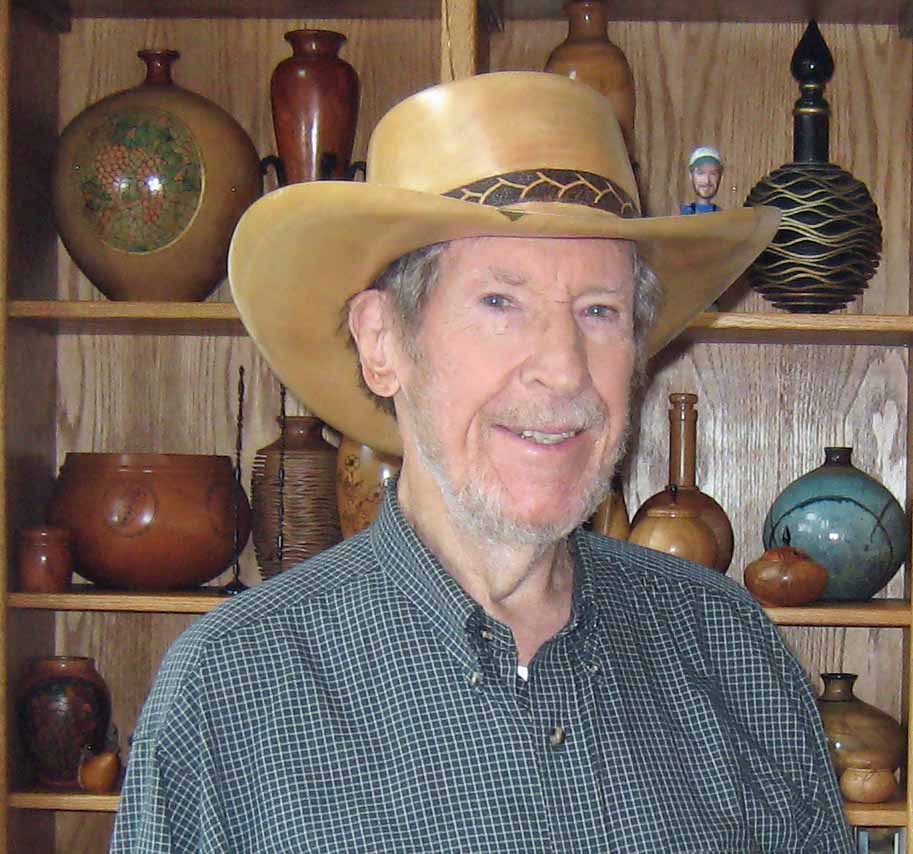
 Dennis


