For someone stepping to the lathe for the first time, I know what they need to know, and I have a pretty good idea of how to get the point across... but my question is: what "object" do you teach them to make first?
What projects do you teach as stealth "skill building" projects to reinforce proper technique without just "cutting wood"? Or would you focus on "just cutting wood?"
I know it sounds daft but I always get any students to turn a flat disc just so that they can familiarise themselves with a gouge and the eye to hand co-ordination.
Then, if they have a good grasp of both the safety angle and the technique we progress to a simple platter or bowl that at the end of the session they can take home.
In my experience that is usually enough to kindle the flame of the obsession!
Steve I constantly battle this. My last class was gift you can turn. I decided to have then turn a Rude Osolnik candlestick first. It could ( and was) easily modified when they had trouble controlling the tool. It could be turned with just 2 tools, a spindle roughing gouge and a parting tool. I did introduce them to the spindle gouge during this session.
Then I went to a wine stopper for the same reason. It's still a simple project and can be made into just about any shape. It gave me a chance to introduce the spindle or detail gouge, teach them about coves and beads and show them how to use the skew on it's side to fine tune the shapes.
It worked pretty well. Some still had trouble understanding how the bevel controls the cut but started coming around about Thursday or Friday.
I've taught a bowl turning class and sometimes think that it is a better way to begin. The are only using 2 tools, bowl gouge and parting tool. When you hollow a bowl you are doing the same thing over and over which I think helps them learn to use the bevel. Turning the outside is still a challenge for them.
The AAW has a great downloadable book of teaching methods and projects:
Teaching Woodturning Basics Go to the Members Area and look in the downloadable articles section. If you sort by date it is 7/6/2009. Really a very nice job. I give kids one of the projects as a handout to study for the next session. And this link has some good project tutorials:
I teach Junior Hi kids, 2 or 3 at a time once a week or so with some fellow turners. I have them start out most days with a bead and cove stick. They don't mind, now do it quickly, it is a good warmup, and they save them so they can see their progress. Recently they have gotten creative and spontaneously converted them into unique candle sticks, twig pots, back-scratchers and what-nots. A first step in creativity.
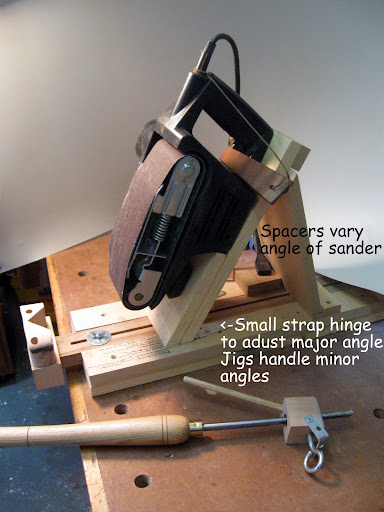
The biggest challenge for me as they get better is to make them independent to make turning blanks and especially sharpen tools. I was just uncomfortable with the grinder, as were there parents. So I built a beltsander system (shown) and now I plan to have them do all their own sharpening. The full slide show on it is here:
Hi Steve, whenever I teach there are invariably new turners in the group. I like a combination class of bowl/spindle turning as an itroduction. I stress three things to new turners: 1. learning to sharpen, always with a jig/fixture. There is nothing more frustrating to a new turner than struggling at the grinder, yet it's an absolute necessity. Freehand grinding is not shown or advocated in my newbie classes. 2. Good technique. I always have a project, it gives the student something to strive towards. I have an upcoming finial class; first I'll show my techniques using a piece of fir. Then I'll hand out a detailed drawing of a finial for them to duplicate, again in fir, looking for clean cuts. Then, the real thing. 3. Design: After they complete a few successful finials, I'll discuss the WHY aspect of design, and give each student a clean sheet to design their own finials. Before turning, we'll discuss the strong and weak points of their design. This aspect is often overlooked, especially with new turners.
I think the most frustrating part of teaching newbies is some just will not follow directions...a common problem is the turner who, despite being told and shown many times, reverts to cutting uphill on spindle work...just like he did before the class. I'll give that student a series of v-cuts to turn until it begins to sink in, while the rest of the class moves forward. I let students know they cannot take a class then neglect to turn for weeks at a time...they must practice on a regular basis in order to retain and improve.
I have always taught sharpening first. If they can't have sharp tools then they are not going to learn wood turning. If they can't learn sharpening then I tell them that they will need to take up another hobby. This may be a bit hard nosed, but dull tools will cause accidents and will make poor cuts. I am willing to spend many hours teaching sharpening with a student who wants to learn. I see too many turners using dull tools and they wonder why they have problems. In most cases I will offer to show them an easier way to get a sharper edge on their tools, but sometimes its difficult to teach an old dog new tricks or those who don't care to learn. Next I show them how to use one tool at a time starting with the Spindle Roughing Gouge.
Each tool is sharpened first and then they are taught how to use that tool. Normally I encourage a beginner to start off with spindle turning before venturing into facceplate turning.
If you start off with the ABC's of wood turning, Anchor the tool to the tool rest, Bevel rubbing and then Cutting they will have no problems in the future. What you teach a new turner in the beginning is very important as it sets their woodturning foundation. Teaching poor techniques will make woodturning very difficult for the future turner. Bad habits are hard to break...
I have been very happy and satisfied with my teaching ways as I have taught several students who have gone on to become very good turners.
I'm debating running my class at the end of the summer with "no projects".
Teaching new turners the basics over two very full days, I don't know if I'd actually want people to be focused on "finishing something" vs. mastering some skills. In my head, I think this is going to be the syllabus (assuming we can move through things quickly)
1.) Overview of trees and wood. From field to lathe.
2.) Sharpening- a spindle gouge, a scraper, and a bowl gouge
3.) Mounting between centers vs. face grain orientation
4.) Safety and the physics of turning
5.) Basic tool skills with tools in #2
I suspect that participants will feel cheated if they don't get to bring something home to show the results of their efforts, so I am trying to figure out what I can do at the end of the class to assuage that need...
Steve, everyone wants a project to bring home. At the end of all my classes, the students all hold their work and take group photos. A great feeling of accomplishment!
I agree with Keith. Most students want to take something home. Most classes I teach have people who have never turned. They don't own a lathe and may not buy one. In this case I think it's really important to finish a project.
I have had one student who was an experienced turner and he just wasn't having a good weekend. I told him, don't worry about finishing a piece. Just work on the cuts and experiment with the tool. I helped him along during the remainder of the class. At the end of the weekend he told me he had learned more from that than any other class he took.
Also, FWIW, it will be more difficult to "sell" the class without a project. I have taught woodworking for 20 years. To get people to part with their money, they have to feel they are getting a good deal. Just learning is not considered a good deal. As teachers, we have to compromise between what they think they want and what we know they need to know. It is not always easy, and as John pointed out, sometimes you have to go with the flow. He had a student who wanted to learn. He was astute enough to simply encourage the guy and not hold him to an agenda the guy was not enjoying.
As an instructor, I always found that I learned more and had a better time when we went off the agenda a bit and then had to come back. I don't teach because I have a need to show what I know. I teach because I like learning from other folks. It shows me there are all kinds of ways to get the same thing done. Have a good time, sez I, and everyone will learn something.
As a beginner's project, I recommend mushrooms. Fungi exist in all shapes and sizes so there is not one correct mushroom as may be the case with bowling pins and even some candlesticks.
is a good idea you have, Steve, that has been successful for me. I set out out a some green logs casually at my wood pile that have been sawed in half, then have the new turner select one, bring it into the shop and take them to the bandsaw and let them see it be cut into 4x4x14 blanks. Then they turn a mallet.
The mallet is great for teaching basic tool control (roughing gouge and a spinclle or bowl gouge.) Sometimes I have them bring their own log if the have one that is not badly split. It is always an amazement for a new turner to see firewood end up with something useful that they take home, whether they continue with turning or not.
They use my mallet to set the drive center so they know that it is a useful turners tool, and also as a helper to the knockout bar. I have them oil it and teach them to bag it to slow down drying, and how to fill the cracks with epoxy should they appear.
Not a refined project but it does the job for a first session. I haven't found anything better that can cover the ground you want to cover and end up with something in 2-3 hours.
I find it also helps in learning tool control and the ABC's (anchor, bevel, cut) to hand turn the lathe for them so they can see those three actions as they hold the tool, maybe with my guidance. It just takes a minute but there is usually an "ah hah!"
I might be an anomaly, and I've never done any real teaching of woodturning techniques, but I might start off a beginner with a skew chisel. The skew was one of the first things I tried using on a lathe after watching the Alan Lacer video, and apparently I was such a newbie that I didn't know that it was hard to use a skew. I still like using a skew chisel over a spindle gouge whenever possible.
Once I learned how to use a skew chisel, it was trivial for me to pick up and use a spindle gouge. I'm not sure the same is true the other way around.
In my opinion, I think it is beneficial to start between centers and then, when students have a grasp on tool control and bevels and such, move on to face grain turning. As with JL, I like to start with a mallet. This gives an opportunity to work on several essential cuts and ends up with something useful. Students always want to finish something to take home. In my bowl classes I start the class by telling them that I do not guarantee that they will leave with a finished product, that the class is about process and technique, but that everyone will leave with something generally "bowl-like". I explain that I am going to throw a lot of information at them in a short time and that this is just a start-they need to go home and practice. They can't be experienced turners without the actual experience. I do not even allow sanding and explain that I don't want my or their lungs to be the dust collectors. (I teach in our club shop.) However, people still expect a finished product and will sand anyway and I have even had students bring a finishing product and apply it to their bowl.
My advice, such as it is, keep it simple, have fun, and don't get too frustrated if they don't quite get it right away.
...redwood for me to turn into a garden 'shroom during Big Bill's recent Folk School class, but Bill informed us that he is very allergic and we left the wood there.I did notice that most of the others are aging very gracefully, especially the redwood.