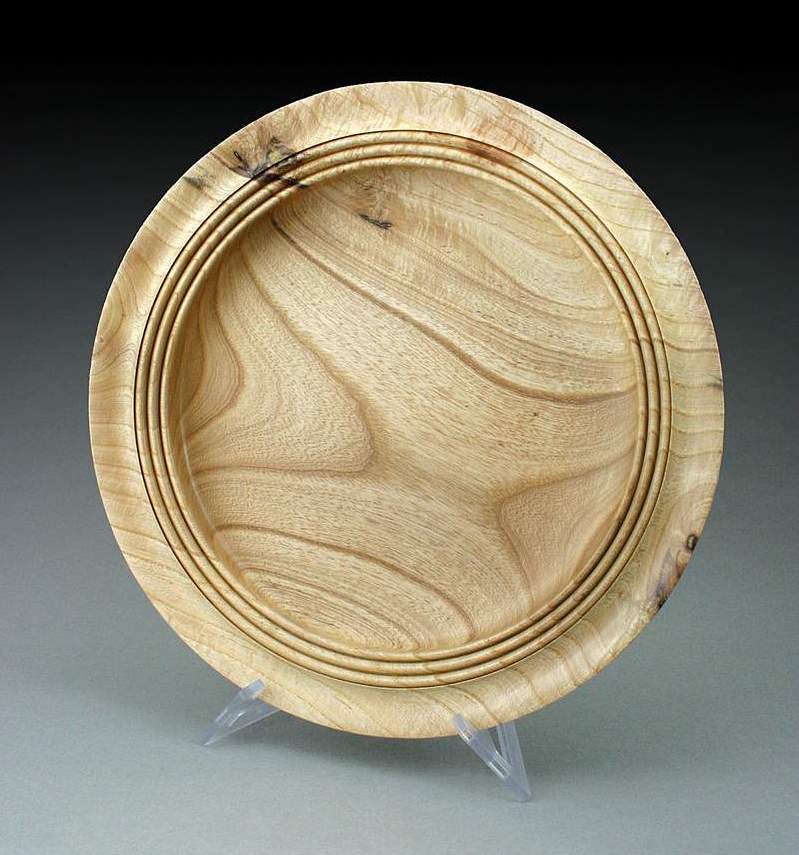
I looked in the Archive and found very, very little about the use of
Clear Acrylic Matte Spray (CAMS) as a finishing product. Mike Schwing liked it in 2005.
We have hundreds, no thousands of posts that talk about using
lacquer, oils, varnishes, blends, polys (water and solvent based), etc.
What about CAMS?
I have used it on several projects involving lighter woods that I don't want yellowed or darkened (maple, birch...), and I am pretty happy with it. Yes, it doesn't pop the grain as much as an oil, but if the popped grain has to be yellow, it's not always a plus.
It "may" (or not?) have just a subtle bluing cast, but I don't think it's as bad as some of the water-based polys. As far as the "matte" business is concerned, don't be fooled -- a couple of good coats will take on a very nice, silky, satiny sheen if rubbed down to 1000 or more with Abralon. It dries very quickly -- another big plus -- and doesn't finger print -- also good.
So my question is: Why don't more people use this product for finishing light woods? Are there drawbacks? I have yet to find any.
I use an acrylic spray on my Mandala projects. There is no figure to highlight. I use a very thin water base poly on any light wood on which I don't want a color change. Since these woods usually have little figure it isn't an issue. I know that Ellis has on occasion used the water base poly to keep the natural color of light wood.
Similar to what Barbara said, I am currently using some thin water based poly (satin finish) on some red malee burl. It really pops the grain of the burl without making the red really dark, and it keeps the creme colored sap wood really light. I like it.
I remember a pic that Ellis posted a long time ago of a buckeye burl hollow form that had beautiful colors with that finish.
Does "thin" mean diluted water-based poly, or just a coat or two or both or ....?
I have been looking at some of my older turnings and there are a lot of them with such a yellow color that I really dislike them. I would do more lacquer but the odor is so strong and it doesn't like cool air which is an issue here in the winter.
Am I confused in my reading here? It seems like water-based polys are being equated with acrylic sprays. Are they the same thing? If so, I wasn't aware of it -- but that would be interesting info. ...Gary
There seems to be some confusion here. Maybe I can straighten it out, or make it more confusing.
Acrylics and Polyurethanes are both man-made plastic resins. They are different in that polyurethanes are harder, add some amber color to the wood, and turn an amber color with age and exposure to air and UV radiation. How much harder? Some of the waterborne Poly finishes are among the hardest finishes we can use. Enduro is an example of this and it is the hardest finish I have used, and is right up there between Plexiglass and CA glue when it is used as a finish.
Waterborne Polyurethanes add less color to the wood than the oil/solvent based finishes that use the same resins. How much less depends on the product. Some add more color than others. Enduro adds a lot of color and does an excellent job of accenting the grain, it is more of a reddish/brown coloring when compared to the yellow/amber of the other Polyurethane finishes, and it doesn't get darker with age and exposure. A gloss High Performance by General Finishes doesn't add much more color than wetting the wood with water, and the matte adds less color than plain water; but it is too new to know what happens to it over time and exposure.
We think that the Acrylics should be just as hard because it has the same name as Plexiglass, which is also an Acrylic plastic material. That is just what the manufacturers want us to think. The truth is that the Acrylic finishes I have tested are somewhere in hardness that was between Shellac and a good quality and Nitrocellulose Lacquer such as Deft or the Watco product.
Acrylic finishes in general add very little if any color to the new wood. The new Deft Acrylic adds less color than their lacquer. Sometimes this is a good thing, but the absence of color doesn't do much for accenting the grain.
It may be a matter of opinion or how close we look, but all of the Acrylics still have some degree of a bluish-haze in a high gloss, but that bluish color is masked by a matte surface. Quite often that blue haze will disappear under an incandescent light but be quite visible when viewed at a low angle with flurorescent lighting
Color is a fleeting thing, because there are 2 color changes taking place - the finish and the wood. We can remove the color from the finish, and wood will have a natural color when it is new. However, the the wood itself will still change color and become darker with age, and we don't yet have a finish that will prevent that.
My thoughts on spray cans is they are useful for specific products, such as the Krylon Workable Fixitif, but they are the most expensive way to put a finish on a piece of wood.
There are lot of people who do use the CAMS because they are available and convenient, and there is nothing wrong with that. As described in my other post, there are better finishes that have more desireable characteristics, but that is only my opinion.
They do have an advantage in a matte finish because there is no gloss or color added to the wood, and they photograph well with no surface glare or bright spots to hide the wood. A dirty little secret is that this no glare photo can then be Photo-Shopped to achieve a spectacular picture by adding a little color and contrast with the software.
Your encyclopedic knowledge never ceases to amaze me, and your ability to communicate it is legendary. You have done it again -- from the background chemistry, through application and characteristics, and into long-term result.
I think we all understand this situation a lot better now.
....Russ's comment about General Finish's "High Performance" H2O based poly as my favorite among the new generation of non-blue finishes. It doesn't yellow the many spalted maple pieces I turn, and dries to a very hard and so far very durable finish.