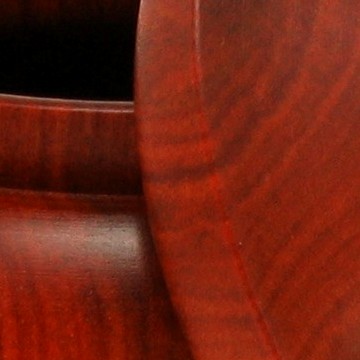
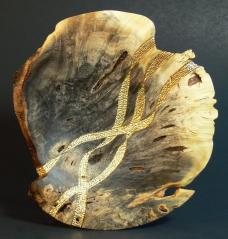
>I've had this blank about 2 years. It had a huge tearout, probably from an industrial planer right in the middle. If filled just about all of the bowl area and went all the way through. I looked at it for years and finally decided what to do.
I took careful measurements so that I could put a glue block on the back. This enabled me to turn the bowl depression exactly where the torn out area was. When I got that area turned away there was still a void from what I guess was a crotch area in the bottom. I filled it with epoxy.
It was very difficult to turn the outer edges. The grain ran in 2 different directions so you turned from outside to middle and it tore the grain really bad on one end. turn from the middle out and it tore the grain on the other end. This was with a sharp 55 degree bowl gouge. I ended up using my 40 degree bowl gouge freshly sharpened and took very small bites. It took about 8 passes to get past the tearout.
I had to completely hand sand everything but the bowl because the details were too sharp. The sides and ends were trimmed on the bandsaw and then flattened on a disc sander. I wanted sort of a boat shape.
It was sanded to 400 grit and minwax wipe on Poly applied.
>I had a WYsteria vine that I've been drying for about 4 years. I sliced it up into wafers and then glued 4 of them up to make the front of the mirror.
I glued 2 segments together so they overlapped slightly and then cut through this overlap with my scroll saw. then butted them together and glued those 2 up. then I glued these 2 to the other 2 and did the same thing to make 4.
I cut 3 more up into wedges and trued them up on my new bandsaw segment jig. the glued this ring to the back so I would have the proper thickness for the mirror.
I carved then handle completely and made a joint to fit into the mirror head.
I don't use hand mirrors, but I really like the natural edge one one. Woodworkers would, but I agree with Brad, the round one would probably sell better.
Nice mirrors indeed! What a great idea of how to use this thinner diameter material! I'll have to give this a try with some old, very dry yew branches I have.
Personally, I like the natural edge version, but from a marketing perspective, I would think that the turned (round) mirror (with the NE removed) will sell better. I'm just thinking of one of these mirrors sitting at home on a makeup stand, dresser, etc. - the piece would be most likely to be purchased by a person of the female persuasion. The NE may be a bit too 'wild' for this situation.... I'd be interested to hear what others think...??
BTW - the botany professor in me would like to correct your use of 'WYsteria' to Wisteria.... (with an "i" used instead of the "y")... in case you're writing the name of the wood on the pieces you make.
>I think the natural edge would sell in a heart beat! Goes with the natural shaped handle and I can see it on the dresser of a rustic cabin. Would match the decor better than the round.
>I made this out of one piece. It's pretty scary having that one bladed propeller spinning around. I carved finger grooves in the backside but you can't see that from this side. I need to work on the design of the handle more but this piece had defects that had to be cut away and sort of decided the shape for me.
>I'm not allergic to poison ivy but my customers might be. My Ex could read the word poison ivy in a dictionary anc come down with a case. I did get a pretty good rash from climbing a tree with Poison Sumac on it while rescuing a cat. Maybe that's why I don't like cats :)
Your Wisteria mirrors are lovely! I personally prefer the one with the natural edge -- it looks "scallopy" almost lacy looking! Very decorative and feminine.