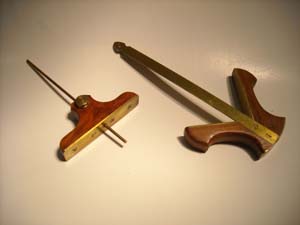
>I've been wanting to build one of these for quite a while. I rally haven't noticed a problem that I can trace back to leaving the tension on the blade. However it just seems right and other people who I respect say it should be de-tensioned between use. I had wanted to add a new tension knob anyway because the original one hurts my hand. Today was the day to solve both problems.
This was an article I cut out of Woodsmith magazine quite a while ago. If anyone needs a copy of the article I scanned it and can send it to you by e-mail.
>I've thought about this also, it's supposed to save on the bearings over time.But it's a hassel to release the pressure all the time and I never do. Thanks for sharing I would appreciate a copy. Thank You Doug
>Well I'm one of those that have had a problem that caused a failure. Bought a used bandsaw that was never de-tensioned. Never thought anything about it. One day the saw started drifting, I tensioned it a little more, it kept getting worse. Did some checking, and the mechanism was cracking that applies tension. So after the bill for a new one of $29 plus $25 shipping, I was then installing a Carter. I did see that article John refers, but long after my install.
>Bandsaw experts have always recommend releasing the tension because of concerns about blade fatigue, flat spots on the rubber tires, and bearing damage.
I have seen that among woodturners, there is more likely to be fatigue failure of the aluminum top wheel assembly casting, and fatigue of the tension spring. The reason for this is that woodturners are more likely to be making deep cuts and running the saw with higher tension than other users. They are also more likely to be using 1/2" wide blades.
>Why release? Because all the manufacturers I know of say to. A quick tensioner makes this so quick and easy.
According to Iturra Design, the larger blades and extra tension is the reason for the most common failure on the 14" Delta bandsaws: the tracking arm. This will eventually bend causing the tracking arm to hang up in the upper wheel guard cutout hole. (mine was bent) Iturra sells a vastly improved replacement arm that looks impossible to bend.
The things I did which greatly improved my 14" Delta:
- replaced the tracking arm with Iturra's
- replaced stock tensioning spring with high-tension spring
- added the Carter quick-tension arm
- purchased a blade tension meter (Starrett)
- installed 6" riser block
- replaced stock guides with cool blocks
- added internal brushes to keep blade clean
- did the coplaner alignment
- learned how to sharpen the blade
This allowed accurate higher tensioning and instant tension release after use. The saw tracks and cuts better and will easily section 12" green blocks using 1/2" or 5/8" 3tpi blades. I once resawed 10' 2x12 doug fir into 1/2" boards with no problem on this saw. (I've since added an 18" Rikon so I don't use the Delta as much now.)
For those who don't know, call Iturra and get their free catalog which contains a lot of very useful bandsaw information: 866-883-8064
>I dont bother releasing the tension as I have had more mishaps coming back to the band saw turning it on to find I haven't put the tension back on.I do find though that on some occasions the set has been taken off in a section of the blade
>Problems from not de-tensioning may vary and depend on factors such as the radius of the wheels and type of blade.
For example, people on the sawmill forums relate repeatedly breaking woodmizer blades when they start the saw after leaving the blade tensioned for a time.
I always de-tension both my woodmizer and shop bandsaws. So far I've never forgotten to re-tension before use (knock on bubinga). Does it damage something or just get noisy?
>Just a data point for the record: I've been a woodworker for over 30 years, in my own shop and as an employee, using bandsaws: old 14" Delta, 16" Walker Turner, 20" Powermatic, and 20" Davis & Wells. 12 of those years the shop was entirely full-time woodturning (though not high-production bowls).
Have never de-tensioned the blade (except when changing it of course!). Have never had to replace bearings because of our current use (only when the saw was bought as a basket case to be rebuilt).
About 90% of the time the blade becomes useless through too many sharpening cycles before ever breaking. Anytime the blade broke from fatigue, I was glad because it was ready to be thrown away anyway.
De-tensioning has never seemed to be worth the time and hassle to me.
>Ditto what Cindy said. I had a 20" delta bandsaw at school for 30+ years. we never released the tension and I never had any problems with blade breakage. If we broke a blade if was usually because of something a student did wrong. I've had my 14" Delta in my shop and I've never released the tension on it either and report no problems. In the 15+ years that I've had it, I think I've broken one blade and that was my fault.
>Don't remember, John. That was way back when I first got my bandsaw. I think it was the noise that caused me to immediately hit the switch. Don't remember any damage, but I imagine if you pushed a piece of wood into an untensioned blade it would get your attention in a hurry.
Bill Neddow------WebKitFormBoundary+w+uCg3oRve3I+f
Bill Neddow------WebKitFormBoundary+w+uCg3oRve3I+f
Guest
Re: Why release blade tension
Bill Neddow------WebKitFormBoundary+w+uCg3oRve3I+f
>I agree with Cindy and Joe. I have never had a problem with a bandsaw caused by tensioning. I have three bandsaws, the newest, a General 18" is about 15 years old. I also have an Inca (European model-- 220v 50 cycle) that I have been using for 30 years. The other saw is a giant 36" built sometime before 1900 that I restored, converted to a 7 hp electric motor, and have been using since 1968. They all see a lot of use.
I would be concerned about the safety of de-tensioning, if you have visitors in your shop. People have a tendency to simply flip the starter on a bandsaw without checking blade tension. There seems to be a mile of blade around the wheels of old Nessie.
>The bearings can handle that kind of tension for ever, almost, so that's not an issue.
On some older units with rubber tires, parking the machine under tension for prolonged periods would compress a flat spot onto the tire, which makes for vibration when running. In cold conditions this could be quite pronounced. The resulting oscillations in blade tension from those flat spots when running will degrade the blade steel more readily. You can hear, and feel, a very slight throbbing sometimes from this.
Also the blade itself can develop a "memory" from being held under tension and motionless. This can be really subtle in its effects when sawing, and can give symptoms similar to a blade either dull or with an improper set; often there's a slight bow in the board when resawing for example. Changing to a "sharp" blade fixes it, but dullness was not the problem to begin with.
This too can be heard by listening very carefully to the sound of the blade in the wood, the pitch of the sound will be very slightly inconsistent, as if the density of the wood itself was varying.
Really.
The newer neoprene tires are less prone to this problem, but blade memory is still an issue for blades "parked" for extended periods.
None of this matters worth a darn for cutting turning blanks with a 3 or 4 tpi aggressive blade though. Those rascals will cut rapidly even with all kinds of things not quite up to snuff. But I detension mine anyway, then take the bright red spring clamp off the tension wheel and clamp it over the "on" switch, so it has to be removed to turn the saw on. Reminds me every time.
>Every time I've seen this subject come up, some say they always or usually de-tension and some say they never de-tension.
What do the bandsaw blade makers say? I looked at the Suffolk Machinery web site, makers of Timberwolf blades (www.suffolkmachinery.com). I found this and more:
- ALWAYS DETENSION YOUR BAND SAW BLADES.
- VERY IMPORTANT: If your machine is over 5 years old, DON'T overlook the shafts and wheel bearings, especially if you leave your bands on the saw UNDER TENSION, when not in use. Just because they TURN, does not mean they are good. Bad bearings can turn easier than NEW bearings.
- Age, over tensioning and not detensioning the blade after use, compress and flatten the crown out of the tire. This compression will also make the tires hard and brittle.
What do the bandsaw makers say? The the instruction manuals of all of my bandsaws say to release tension when not in use. Perhaps I could ignore this and get by, but having not done the engineering design, QA testing, or dealt with years of warranty and repair issues on the saws myself, I decided to follow these instructions rather than second-guess the makers. Unless I have multiple identical saws side-by-side with identical blades and run them equally and de-tension some and not the others, how will I ever know if not de-tensioning is detrimental to the a saw or blade over time?
My 18" Rikon bandsaw has an integral quick-release lever. My Woodmizer sawmill does not, but even then de-tensioning only takes about 20 seconds (although it does take two hands and an effort - that blade is under a LOT of tension!). A quick-release lever was easy to add to my older 14" Delta and makes de-tensioning a 2 second process.
Sir Google tells me at least some of the new bandsaws sold today (all that I checked) come with quick tension release levers - Delta, Jet, Powermatic, Laguna. I'm guessing they do this for more than just marketing reasons. Powermatic states: CARTER� quick tension lever speeds blade changes, and the de-tension setting extends blade life during non-use.
I use Timberwolf blades myself, on the mill and the upright. Art, the big cheese at Suffolk machine knows more about bandsaw dynamics than anyone I've ever spoken to, and by following his advice (commands really, he's very forthright) totally transformed the performance of both units.