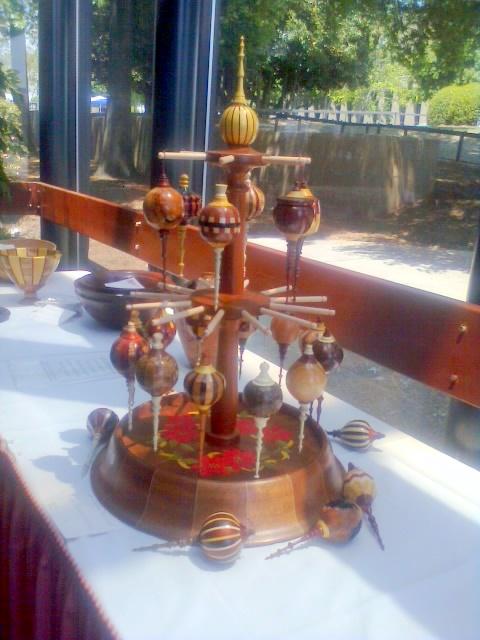
>Wood turning has undergone, relative to other forms of woodworking, a pretty dramatic change over the last 20+ years and the rate of change seems to keep accelerating.
As I understand it, when Dale Nish started turning wood that everyone else saw as not suitable for turning anything "decent", the turning community response was at best luke warm and more like semi-outrage.
And I suspect that when David Ellsworth started turning his signature hollow forms, the turning community didn't take to it right away either.
And when applied color started showing up on turned pieces, it apparently caused quite a stir and elicited some outrage.
And when Hunter and J. Paul Fennel began carving and piercing their turnings the intial response probably wasn't very positive either.
On the other hand, Francois Escoulen came to the party with a radically new - at least to most US wood turners - turning technique and style - and became a relatively instant celebrity.
My question to the turners who were in the turning community at the time these folks came along is:
How long after these significant departures of the accepted norms of turning, did it take for them to become accepted norms - at least for one "accepted" branch of wood turning?
>Contact Albert Lecoff at the Wood Turning Center in Phil. PA. He had the vision. When AAW was formed it was believed that Albert's vision was different from that of the organisers of AAW and that he shoud go his own way, With the backing of some recognized US turners, a few collectors, a museum curator and a few folks interested in the craft/art of turning the WTC began to promote woodturning as an art form. In 1986 I believe, the WTC staged the first major museum exhibit of woodturning. Albert and the WTC brought foreign turners to the US. AAW and the WTC are largely responsible for the promotion,fostering and cultivation of the field.
I don't feel the need to create a market that doesn't exist. I've worked in sales for too long to know that most will fail in trying to do that. It is far easier to service a need that is already there than to convince someone that they need something they've never even considered.
If you worry about new ideas becoming mainstream more than loving the work you are doing, and pushing YOURSELF instead of the medium, you'll find that there is a market for what you are doing, even if it is only in your livingroom...
>Steve My question if no one trys to create a market ,where would we be today? Maybe still in the stone age or riding horses instead of driving cars? I think being creative is a good thing for ony market ,some make it and some fail. But we all have our new ideas and it's nice to share.
>Yes there has been a dramatic change in woodturning, but it wasn't just 20 years ago, it started in the 60's and 70's when people like Rude Osolnik, Bob Stocksdale, Ed Moultrup, Dale Nish, David Ellsworth and a few others started selling their work as something other than functional pieces. I don't know about the affect on the turning community because there really were very few organized groups of woodturners, so there really wasn't a "turning community". The AAW was formed in 1986 with a few hundred members.
I'd been turning for a lot of years when I read an article in Fine Woodworking magazine in 1978 or '79 on David Ellsworth and his thin walled hollow forms. There were quite a few photos. My reaction was "Wow, I have to learn how to do that".
At the first AAW symposium in 1987 in Lexington, Ky, there were lots of open bowls and very few hollowforms. I think that there were very few if any, pieces that had been colored, pierced, burned or otherwise enhanced. If you visit the instant gallery at current symposiums the difference is dramatic.
It may be a coincident, but the advent of the first bowl gouge on the market in about 1980 seems to be when the popularity of woodturning started to increase in a big way.
>I started woodturning after a class with Russ Zimmerman in 1979. He had bowl gouges then, was a Peter Childs graduate. Got my Myford lathe from him and haven't stopped since, though I'm on my third lathe now. So 1980 is well after the beginning.
>You're right, Peter Child designed the modern bowl gouge and talked Henry Taylor into manufacturing them in the late 70's. They reached this country around 1979 or 1980. Russ probably brought his from the UK if he studied with Peter Child.
Dale Nish's first book, published in 1975 has no mention of a bowl gouge. Photos show him hollowing a bowl with scrapers. His second book, published in 1980 has a lot of info about using the bowl gouge.
I saw my first bowl gouge in around 1983 and promptly bought one. No one I knew had one at the time.
Bowl gouges all came ground square across and that's the way just about everyone used them until someone came up with the fingernail grind. The side grind came later.
Maybe because I came of age in what was about to become Silicon Valley I was influenced by the imagination and innovation of the likes of Hewlett-Packard and, of course, Apple. Both are known for creating very successful products that were marketed rightfully as "Solutions Looking For Problems To Solve" and "Computers For The Rest of Us" and creating markets that had never existed before.
I also came of age during a very tumultuous period when youth were really questioning, and challenging, everything about the Status Quo and developing what The Media labeled the Counter Culture. So questioning assumed "truths" and "rules" became a part of my approach to life.
Perhaps it's that I worked as what is now called a Futurist that I'm curious about how we got HERE in order to have some idea of where we are GOING. I look for trends.
But I'm not interested in "marketing a product" in terms of selling something I make.
I AM interested in how the pioneers "stuff" became "main stream" - how the pioneers found others exploring their area of interest/bordeline obsesssion. How were networks established between kindred spirits which made the exchange of ideas and techniques possible - and encouraged? What were the obstacles which had to be overcome to reach a "critical mass" where hurdles were lept over by one - who then shared how with others (think in terms of the high jumper Dick Fossberry and the Fossberry Flop)?
Were there "centers of gravity" where Wild Hare Ideas and Off The Wall pieces were, if not accepted, at least tolerated and where some of the Old Guard mentored and maybe even encouraged young upstarts exploring territories well beyond the existing frontiers of turning at the time. There apparently were schools and "centers", primarily in the eastern, older, parts of the country were people working in various mediums gathered and exchanged ideas and techniques and maybe collaborated on pieces - the Cross Pollination thing - now referred to as Inter Disciplinery.
How did new technology, or the use of a technology developed and refined for another purpose, get into the hands of a few turners, and then made available specifically for turners as interest levels increased to make these products viable - and profitable?
I'm interested in exploring two large areas of turning which don't seem to have been explored much - actual movement and internal lighting - and the application of new technologies to do both. There are early wiffs of smoke from these new fires in the wood turning camp and I'm looking for both the sparks - and the kindling - ideas and the tools and techniques to make those ideas a reality.
If you remember much of the '60s, you didn't really get into it much ; ).
So it appears, at least to me, that signicant changes in woodturning are linked to when many of the current "icons of turning" came of age (the 60s, a period of rapid societal changes) AND when the bowl gouge became somewhat readily available (new technology).
Hmmm - we're in another period of significant societal changes and an explosion of technology, some of which is becoming afforable and available. Are there already hints of some of the changes in the turning world that might be coming in the next 5 to 10 years? Does the proliferation of captured hollowing systems indicate one possible trend? What about the availability of smaller, more affordable CNC machines, micro-controllers, miniature motors and stepper motors?
Will solar electrical generation - at small scale - play a role? What about new battery technologies?
We're living in very interesting times and I forsee some very interesting turnings on the horizon, the likes of which we may have never seen before - again.
>I almost didn't read to this, because of the title, but I have to say that is is well written, well considered and an excellent declarative of what you want to know and do, and why you want it.
You clearly stated (to me - in my mind) what your search (and mine) is about...
I think that anyone who is looking first for aggrandizement, then for knowledge will fall short with both.
Malcolm Tibbetts has just posted a lighted piece somewhere, and, as usual, it is cutting edge... Does he do it because he WANTS to be famous or is he famous (and admired and coppied) because he found something that he wants to do?
>just don't expect anyone to follow you! We all have to find our own way. Once we get there, we may look around and find that some folks have followed us and are interested in what we do, but don't make your goal to be first. Do what interests you.
I think that the Silicon Valley lifestyle is very different than what most people know. I spent 7 years at a SV hypergrowth company, and I alway laughed when I heard some of the ideas people had over lunch. However, someone was always crazy enough to VC the idea, so maybe I'm the fool?
We are seeing a transformation in the world of turning, but I challenge the idea that it's in tooling. Rather, I think the availability of information and shrinking the learning cycles is the biggest "new thing". The Internet has connected people to share knowledge and techniques like ever before. What used to take a lifetime to learn can now be developed in 6-12 months, which means that woodturners can get very good in an short amount of time.
By not struggling with the basics, people now have the time to chase their wild hares. Imagine if you could only get one out of three projects off the lathe in one piece? Would you consider cutting a hole for a robot in it? Would you risk it walking off the table to it's doom?
>In the seventies few could sell their work. Most artist barely made a living. Bob Stocksdale and Jerry Glaser did a great deal to advance the field to say nothig about James Prestini
>I think Steve A is onto something here. New turners today have so much more available to them. When I started turning in the 70's I did not know another person that turned, there was maybe 1 or 2 books ( mostly spindle work ) no clubs, no videos, I used a homemade lathe and mostly homemade tools, there was certainly no opportunity to sell work. I was pretty much self taught ( and picked up lots of bad habits) still turn with a square grind bowl gouge because that is the way I learned.
The information avail to turners today is phenomanal, the variey of tools and equipment, the help & support of clubs shortens the learning curve significantly. I see people in my club that have been turning 2 - 5 years that have skills it took me 20 years to learn.
I think most turners start out by emulating the work of others.
Most of us start out making the "basic bowl" and then start looking for more. There is more info avail now on "cutting edge" or pushing the envelop turning so more people are apt to try something different.
If you think about it most all of the "name turners" have a specialty. This I think also is something I see new turners trying to develop much sooner.