Home Articles Forums Gallery Marketplace Videos

WoodCentral Forums

Knowledge You Can Build On — Est. 1998

If you sell to woodworkers, your customers are already here

On a roll: pens #4-10, and a finishing question

Posts

On a roll: pens #4-10, and a finishing question

#1

On a roll: pens #4-10, and a finishing question

wilbur

>I managed to get all these done tonight. I was really surprised as to how fast it went. I even managed to salvage a blank that I thought I had really screwed up. I also learned that for these spalted maple blanks, it pays to figure out the best way to orient the clip in relation to the spalting.
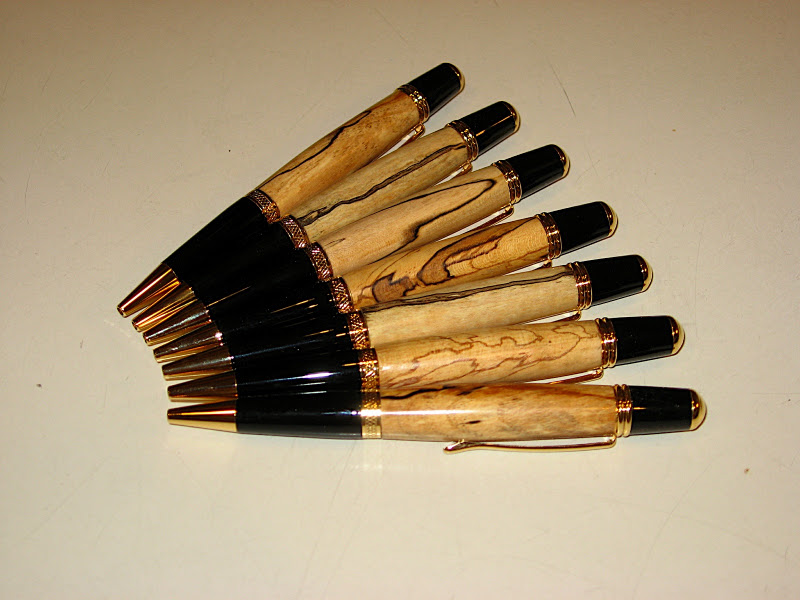

This time instead of using the Liberon Woodturner's polish and wax stick, I used the Mylands sanding sealer and high friction polish, and Mylands wax. I think I like the extra gloss that this finishing routine gave me. It's shiny but not too shiny. I'll have to try it on a bowl, next time I make one.

One question I had on the sanding sealer: there seem to be no instructions as to the recommended way to use it. I sanded my turned pen blanks up to 400 grit, applied the sanding sealer with a paper towel, then sanded it with 400, and then did another application with a paper towel. That was followed by three quick coats of the high friction polish.

Are you supposed to sand with the sanding sealer? Is there a recommended way to use this product?

Re: On a roll: pens #4-10, and a finishing question

#2

Re: On a roll: pens #4-10, and a finishing questio

Bob Entwisle in NJ

>Nice pens, wilbur,

Are you doing them on the Conover?

Bob (in NJ)

Re: On a roll: pens #4-10, and a finishing question

#3

Re: On a roll: pens #4-10, and a finishing questio

Dick Coers

>Those are nice pens, but I am not a fan of friction polish on items that can be heavily used. Lacquer and shellac are not water resistant. I also had trouble early on with these type of finishes if the owner used certain hand lotions. My doctor showed me her pen that was so sticky, it was almost unuseable. I stripped the finish, and used CA to refinish. No problems after that, unless she was too embarrassed to tell me!

To answer your question though; Sanding sealer is lacquer that has an agent added to make sanding easier. It used to be some sort of sterate (soap)that powders easily and won't clog the sanding paper. I don't know what is used today. That sterate doesn't help with hardness, or water resistance one bit, but is there for easy sanding. I wouldn't use anything courser than 400 between coats. By cutting the finish between coats, you might get more of a "grain fill" to the finish, but probably not any smoother.

Re: On a roll: pens #4-10, and a finishing question

#4

Re: On a roll: pens #4-10, and a finishing questio

wilbur

>Hi Bob,

Yup -- they were all made on my Conover lathe. There was a very high lathe to workpiece mass ratio going on last night.

Re: On a roll: pens #4-10, and a finishing question

#5

Re: On a roll: pens #4-10, and a finishing questio

wilbur

>That's interesting about the sanding sealer having stearate or something added to keep the sandpaper from clogging, since I thought that it was clogging my 400 grit sandpaper quite a bit. The finish was still pretty nice, though.