>I've been interested in trying segmented turning for a while now and I have a couple of books by Ray Allen and Malcolm Tibbetts. Both books recommend a disc sander - Malcolm goes so far as to recommend a 12" benchtop disc sander.
I have looked at the options available and they seem a bit more pricey than I had expected - ranging from $200 for a Delta which seems rather cheap to $400 for a Jet which seems very nice. Of course there are other more expensive models available as well, but those are beyond my interest at this point.
My question for all of you segmented turners (or those who know segmented turners, or just the tool nuts) is which disc sander would you recommend?
>I've had the Delta for several years and it works just fine. The only problem I've had is the switch getting too much dust in it and not working until I take it apart and blow the dust out of the contact points. I now blow it out about once a year and don't have any problem.
>Sounds like folks are plenty happy with the Delta - are we talking about Delta 31-120, or do you have a older/heavier duty model? There's quite a difference between the Delta and Jet ($200), so I'd be happy to go with the Delta if it has decent quality.
I've also been looking at the Grizzly G7297, which is cheaper than the Delta. The most interesting difference is that the Delta has 1/2 HP motor whereas the Grizzly has 1 HP motor. Anyone had any experience with the Grizzly?
>Brian Look at the new Rikon. That's what I'm saving for. It has a better table than any of the other 12" sanders in this price range. I obviously don't own one yet so I can't speak on the overall quality of the machine but Rikon does have a decent reputation on their other tools. I looked at all the sander in the under $400 price range when I went to the IWF in Atlanta. I thought the Rikon was the best buy.
I did segmented turning for years without any good tools. I simply made my rings in sections that could be evenly divided so that when I glued them up I ended up with 45, 90 and 180 glue ups This allowed me to adjust the segements using a homemade sanding jig. I would glue up some segments using the rub joint method. Then I would check them against my 45 degree square. If they were off I would sand them until they were perfect. then I would glue these together to make a 90, check sand and then 180 etc. The only down side to this method was that it is slow.
I now use a table saw for the completed rings but I'm going to switch to the bandsaw and sander for some rings because you can get better grain alignment. I don't do many segmented pieces anymore because it's difficult to get the money out of them in my area. Still I love doing them and I hope that setting up jigs on the sander will speed up the process and let me have more fun. I'll just have to keep them until I can find a better market.
In about a 1/2 hour you can make a perfectly good disk sander that is driven by your lathe. It won't cost a thing if you have a spare faceplate. This should be perfect for getting started.
Cut a circle of good quality 3/4" plywood or even mdf, fasten to the face plate with screws, mount on the lathe then true as necessary. Fasten sanding disks to this with the normal adhesive, perhaps after a few coats of shellac or poly.
Make a flat table that either fits into your banjo, or better and sturdier, sits right on the lathe bed, taking care that the surface is 90 degrees to the disk.
I've seen these recommended and in operation for years. A quick question put to Google found some links - the first one I looked at below. I haven't built one but I'm about to - I have a good disk/belt sander in my storage building, new in the box, waiting for me to build my workshop. I don't even have room for it in the little garage I use now for turning and wood storage. I don't even remember the brand but I think I bought a stand for it as well.
Hey, do you happen to live in or near East TN? If so, maybe you'd like to borrow my sander until I get my shop built and see if you really like segmented turning. I can't imagine how using it could hurt it, just break it in! It will probably be a year before I need it, especially since my barn construction is on hold for a few months while my ribs heal.
I'm very interested in hearing all about your segmented adventures. I bought the same books you mentioned and have been reading up.
>I took a class for segmented turning at the John Cambell Folk School. We were shown a technique on how to cut the pieces using a miter saw, with an expensive blade, I think it was a Forest blade. There was no need to do any sanding before gluing the pieces as they fit perfectly. The technique involved cutting four or five scrap segments, and putting them together. Then making fine adjustments to the angle of the blade, until they fit perfect, no sanding. Seeing was beleiving.
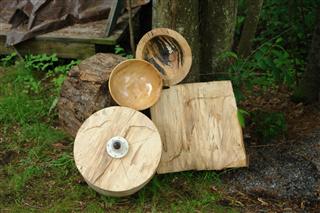
>I made the disc sander in the photo about 10 years ago as a temporary tool until I could buy a commercial model. I am still using this one because it has 3 advantages over the commercial tool.
The variable speed of the lathe mounted disc give me control of how fast the wood is removed. The commercial sanders run at 1800 RPM and remove a lot of wood very fast from a small piecd of wood. Sneeking up on a perfect fit is a lot easier when the sander is spinning at 180 RPM.
A slower sanding speed prevents burning the ends of the segments. It is impossible to sand some species without burning the end grain, and end-grain joints are already weak enough without burning the surfaces.
The fixed angle rests are always in adjustment, and they can be changed without having to reset the angles. Good joints require accurate angles, and it takes a lot of tweaking and fiddling with a machine table to get there.
>Another option that will do a good job but is not too expensive is to buy a lathe arbor from Shopsmith: http://www.shopsmith.com/ownersite/catalog/l_lathearbors.htm and get a shopsmith 12" steel sanding disc: http://www.shopsmith.com/ownersite/catalog/sn_sandingdisc.htm
They also have the sandpaper discs which I didn't take the time to look up.
Because the Shopsmith uses a 5/8" drive spindle for their tools, the sanding disc will have a 5/8" hole in it with a set screw. The lathe arbor mentioned above will fit into your headstock #2 morse taper and provide the male 5/8" end that you need to mount the sanding disc.
The sanding disc is #555143 and currently lists for $55.60. The lathe arbor is #505603 and is on sale for $14.55. Looks like for well under $100 you could put together an outfit that will do a fine job.
I don't work for Shopsmith but did own one for a number of years and am still using some of their accessories in my shop.
>I agree with Russ,I do have a 12" aftermarket , that I got two yrs ago and it is a great mach,no problems with it at all ,EXCEPT for the burning part,as you cannot sand certain wood endgrain without burning it.So I am going to make one this winter.I never thought about the benifit of slowing the speed down on the lathe.Thanks Russ
>John, now you and Russ have got me thinking. I guess that I'm on the fence now between buying versus making one to fit my Oneway.
By the way, that's a very generous offer John to let me borrow your sander - thanks, but I'm not in a great rush at the moment. Just thinking ahead for the holidays. I don't live near TN (actually, I live in NH), but I did go to school in TN for a couple of years (UT). Goes to show you that there's lots of great folks on this forum for sure!!!
>Sears and Rubbish sells a 10" sanding disk (steel plate with permanent abrasive) meant to mount on a table saw. It was less than $20 and could easily be adapted to a Morse taper adapter for your lathe.
On the table saw you would have the advantage of the miter gauge and very little effort to get started. The speed is a bit high.
On the lathe you would have to improvise a miter gauge but speed could be made more reasonable.
The steel plate will flex if you push too hard on it, but you shouldn't be pushing on an abrasive anyway, let the motion of the abrasive do the work.
>As all miter saws are NOT created equal, I wonder what saw was being used at Campbell?
My only point is I wonder how much that would have to do with the success of this procedure. I'm in NO way questioning your comment.
I'm thinking more about my miter saw, a crapsman. Any possibility of getting a small tutorial on the procedure?
For the original poster, have you considered a sanding disk for your table saw? That would be very inexpensive to get started and see if you like doing segmented.
>I haven't done any segmenting work in several years, because I don't like the tedious work of cutting the segments and fitting them. I did considerable amounts of segmenting 8 or 10 years ago when I mostly had flat boards to work with. I never did get fancy with the exotic rings that many of the segmented turners are doing today; however, I found that if I went ahead and glued up the rings trying to get any misfits opposite one another that I could take the glued up ring and make a bandsaw cut through two opposite joints and then reglue them immediately that I eliminated most of the misfit problems. Sometimes, I had to make two saw cuts on a single ring, but I always glued after each saw cut.
A friend of mine who did some excellent segmented work, said my technique really helped him solve the occasional misfit problem. This is quite a bit cheaper than purchasing a $200 or $400 disk sander. Especially, if you already have a bandsaw.
>I have an old Model B Shopsmith that is now, for all intents and purposes, a dedicated disk sander. The disk is aluminum, but has stayed true for many years.
>Brian: until you start doing really intricate design segmented work you don't really need a disc sander. Use the technique mentioned in one post : align the gap 180 degree across from each other, clamp to a sled and run the table saw blade through both gaps. The problem with most segmented books & videos is the reader get the impression that segmented work is complicated, takes lots of math and jigs. Get some scrap wood, make some rings, glue them up and make something. It might not be perfect, but with a few you will learn how to use your head to solve the problem instead of a new tool. Good luck!
>My father does segmented turning, and cuts his pieces using a ryobi table saw with a sled attached to the sliding table. A trick he learned from his woodworkers club to help with the accuracy of the cut is to use a smaller diameter blade to eliminate potential blade wobble. So instead of using the 10" blade, he uses an 8" Forrest 2. Similar to what others have mentioned, I think he assembles his rings in quarter sections, trues them up using an off-brand 12" disk sander, assembles in half sections, trues them up using the table saw, then completes the rings.
As a side note, he uses one of my mother's quilting programs (Electric Quilt ?), in addition to the segmented software available, to help design his feature rings.