Home Articles Forums Gallery Marketplace Videos

WoodCentral Forums

Knowledge You Can Build On — Est. 1998

Price drop on over 1300 Rockler items

Question about cracks appearing in work

Posts

Question about cracks appearing in work

#1

Question about cracks appearing in work

GolfSteve in Calgary

>I'm really new to turning, so this is probably something well known and avoidable if you have a brain larger than a peanut, but I'll ask anyway.

First of all, thanks for your help with my grain orientation question:

(http://www.woodcentral.com/cgi-bin/turning.pl?read=171617&v1=e2vrt43&v2=pneumatic+nailer&v4=belt+sander&v5=e2vrt43).

I ended up laminating a blank in a spindle turning orientation. The wood is maple, was kiln dried when I bought it, and has been in my shop for at least two years. It's not particularly great wood and has a lot of discoloration.

For a first "real" project, other than some pens, I turned a goblet with my daughter's face profile on the stem (there's a guy on the Internet calling these "pirolette's", but that does not seem to be a recognized word). He sells them for $149, and more power to him...this has taken me about 12 hours so far. Basically a patternmaking exercise was a challenging choice for my first project. The bowl started out at 8" diameter, but after a particularly spectacular fragmentation when I was doing a final clean-up on the rim, I was lucky to be left with a 7" diameter bowl. Here's a shot of the goblet as of a couple of days ago:


After turning the stem, I started hearing some "cracking" noises. The base had developed some cracks - my theory being that differential expansion was occuring due to the exposure of the goblet bottom to the atmosphere on only one side. Here's a picture of the cracks:


My question is - how could I have avoided this? Should I have parted away most of the waste on the underside of the stem bottom to allow for equal air circulation on both sides? Was it just bad luck or bad wood? I was leaving the material on the underside to keep the assembly strong...I'd had enough catches that I didn't want to inadvertently break the goblet away as I was finishing it up.

Santa Claus doesn't have enough time to start over, so he's ploughing ahead cracks and all. I turned away most of the waste under the base and soaked the underside with cyanoacrylate. Last night I sprayed the vase a dark cherry colour (dyed quite dark to even out the poor grain appearance), and was having great luck until my final topcoat of shellac when I sprayed a bit heavy and got a run....back to the sandpaper.

Thanks for your advice about the cracking,

Steven

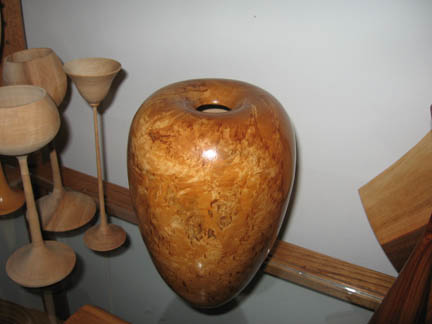
The lathe sure makes a mess:

Re: Question about cracks appearing in work

#2

Re: Question about cracks appearing in work

Doug Turner

>The cracks appear to be heat stress cracks. Did you overheat the wood while sanding? Try sanding with a coarser grit to start and work your way tru the grits. End grain is very sensitive to heat stress cracking.

Re: Question about cracks appearing in work

#3

Re: Question about cracks appearing in work

Norm Smith

>Steven, Doug is right on. You also should slow down the lathe while sanding, especially if you are power sanding.

Norm

Re: Question about cracks appearing in work

#4

Re: Question about cracks appearing in work

john lucas

>I agree it almost has to be heat cracks since you said the wood was so dry. On the plus side us woodturners and serious collectors are the only ones who really worry about those. Your daughter won't see them. Put some finish on that area. Then put some thin CA and sand with something like 150 or so. The sand dust will fill the cracks. When the CA has hardened you can go ahead and finish sanding and then apply your finish.

You've done a great job matching the profile. She's going to love this.

Re: Question about cracks appearing in work

#5

Heat stress cracks

GolfSteve in Calgary

>Hmm...never thought of that. The cracks did appear while I was sanding. I don't think I got the wood too hot (I didn't burn my fingers), but I'll take it easier next time.

Norm says that I should turn the speed down when sanding....I read the opposite somewhere, so had turned the speed up.

Thanks for the help.

Steven

Re: Question about cracks appearing in work

#6

Re: Heat stress cracks

ET

>I have read about reducing speed to sand and tried it. I noticed that the coarser grits ( 150 & 180) cut better at a lower speed. I will speed up for 220 and 320, but not at full speed. I guess the granules of abrasive have more time to cut the wood at a lower speed. I am looking for a better explanation here. ET

Re: Question about cracks appearing in work

#7

Re: Question about cracks appearing in work

Bill Hale / The Wood Spinner

>I agree with John. One thing he forgot to say is do the sanding while the CA is still wet.

I sand at 700 to 900 RPM for all grits.

Good turning and be safe. Merry Christmas

Bill in CG, AZ.

Re: Question about cracks appearing in work

#8

Re: ET, I think you'll get...

Allen Neighbors

>much better results if you slow down a little bit as you progress through the grits. I may be sanding 150-180 grit at 1,000rpm, and when I go to 220, I slow it down a little, to around 900rpm. Then 280 and 320 at about 800rpm. 400-600 even a little slower. I also sand for a little bit longer time, at the finer grits, in order to remove the previous grit's scratches.

The finer the grit, the easier it is to get too hot, and the slower it needs to turn, in order for the grits to clear as the wood comes past.

Re: Question about cracks appearing in work

#9

Re: Heat stress cracks

JohnKJordan in East TN

>GolfSteve,

I've also had checks like this from agressively hot sanding. It can also happen if the wood is not completely dry. Note that even kiln dry wood can pick up a lot of moisture quickly if stored in a humid area, such as a garage or shop that is not heated/air conditioned.

I do most of my on-lathe sanding with the lathe speed turned down nearly as low as it will go, and much of the sanding with the lathe off. This eliminates overheating. I started doing this when I first started turning and saw heat checks forming before my eyes in dry e.r.cedar as I sanded at a high speed.

I sand with a particular grit, then with the lathe off I sand with the grain, with the figure, and/or in a radial direction until the circular sanding scratches are gone. This lets me be CERTAIN that no deeper scratches remain from the previous or earlier grit. If you continue through the grits with the lathe always turning, it is difficult or impossible to see a deeper scratch until you get to a much finer grit, then you have to start over again with a coarser grit.

I also tend to turn up the speed as the as I get to the finest grits, such as 600, but again, I stop the lathe and sand by hand as well.

One other thing I find helps a lot on some types of wood is to apply a coat of celulose sander sealer after the coarsest grits. I use Mylands

JKJ

Re: Question about cracks appearing in work

#10

Re: Question about cracks appearing in work

Lan Brady

>No expert here, but the quality of my work improved 100% when i slowed down sanding. Usuall about half of where I was turning.

It appears that the sand paper begins to cut better. At higher speeds it looks better but when the finsih is applied, all the missed opertunites show up. My theory is that I clog the paper and it begins polishing instead of actually sanding.

Good luck, Lan

Re: Question about cracks appearing in work

#11

Re: Question about cracks appearing in work

Ed Heuslein

>Howdy GolfSteve: When in doubt, go to the Godfather of finishing, "Don" Russ Fairfield and his DVD set on finishing (Finishing Secrets). The best bang for buck you'll ever spend for finishing information. He says "slower is better." Try it. You'll like it. Ed

Re: Question about cracks appearing in work

#12

Re: Question about cracks appearing in work

Juergen

>A random Orbital sander like the Grex, or the cheaper model sold by Harbor Freight will make this problem go away. It's still possible to over head the wood but it's less likely

Re: Question about cracks appearing in work

#13

Lyle Jamieson

Re: Question about cracks appearing in work

Lyle Jamieson

>Hi All,

Good thread, I agree with most of your suggestions. The problem is most likely sanding checks. Another possibility is the cracks might have been in the wood before you started. They are very hard to see and only "open" up when sanding.

In my opinion there are two things to help. Slow the lathe down...way down to its lowest speed. If needed, only with your first course grit, to get bad tool marks off you can use a little faster speed. With power sanding you have more speed than you want already from the drill/sander so keep the lathe speed down to prevent heating the wood at all. The second tip, that was not stated, is to use SHARP SANDPAPER!!! Very important that you are not brusing and burnishing the fibers over but cutting them cleanly. Dont grind away on dull sandpaper. It will cause the heat cracks and leave you with a cloudy finish. I never use power sanding with fine sandpaper, it becomes dull in a heartbeat and is not cutting clean. I hand sand with averything over 220 grit. By hand I mean hand held sandpaper with the lathe running as slow as I can, 100 rpm or so. I know many lathes wont go that slow but the slower the better to get through the grits without heat checks. Happy Holidays!!

Re: Question about cracks appearing in work

#14

Re: Question about cracks appearing in work

georgetroy

>Work on your tool work. Use a spindle tool to do your details. The bowl or cup of a goblet is done first and then the stem next to the headstock. After the cup part of the goblet is done the stem is turned with support. If you power sand in a tight area you will lose details. When you seal and finish the wood you will see a big difference in worked that has been over sanded and work that has not. I very seldom power sand and I use an inertia sander.

Suggest you practice on small limbs for your goblet. Wood laminated together shows it. Use a solid block.

Re: Question about cracks appearing in work

#15

Re: Question about cracks appearing in work

GolfSteve in Calgary

>Thanks everyone.

I'll certainly work on my tool work; the less sanding required the better.

I've taken a single two-day turning course and turned a spindle (beads and covers), a small goblet, and a bowl. Having an instructor nearby demonstrating the techniques was great - but a month later, at home by myself, remembering the techniques was difficult.

I would have loved to use a single piece blank, but did not have time to source that material before Christmas. I need to find some reasonably priced blank sources around here.

This place is great.

Re: Question about cracks appearing in work

#16

Re: Question about cracks appearing in work

john lucas

>It's very difficult to find dry wood that thick anyway. I had to turn a piece that had to be dry last year and I searched 80 miles in 4 directions before I found it.

Re: Question about cracks appearing in work

#17

Re: Question about cracks appearing in work

Wally Dickerman

>Steve, since you apparently didn't experience cracking in the bowl portion of the goblet, I'd guess that your problem lies in the fact that you're sanding heavy wood on the base. If you'd cut away wood on the bottom of the goblet to about the same thickness as the bowl, the cracking may not have happened. Even though you may think that a piece of wood that thick is dry to the center, it probably isn't, and moisture combined with heat is the problem.

Except when I'm turning some of the exotics, I sand at about the same speed as I turn, which is faster than most. I do keep the paper moving quite fast so that I don't generate much heat. If I think that there is much moisture present, I do slow it down a bit.

Wally