Home Articles Forums Gallery Marketplace Videos

WoodCentral Forums

Knowledge You Can Build On — Est. 1998

Personalized Wooden Watches, Engraved Free

Rcent large project

Posts

Rcent large project

#1

Rcent large project

Chuck Engstrom

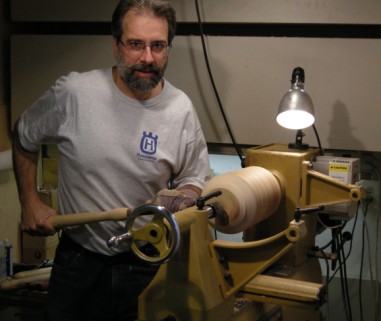
>Hi all -- Myself and John Ramsey, left, with a seven-foot-tall chandelier designed and completed by John's shop, Deep Landing Workshop (www.deeplandingworkshop.com), a manufacturer of custom lighting fixtures here in Chestertown, MD. We have done about eight chandeliers of around six-foot height in the past, but this is now the record holder.

I turned the center spindle parts from 8/4 slabs of kiln-dried poplar glued up to create blocks of adequate size; the bottom piece started out as 12" x 12" x 18" and 49 lbs. but was reduced to only 11 lbs. as you see it here, still with a diameter of 11-1/2". Finish was water-based Lockwood Dark Walnut stain (almost a pint!), walnut paste filler, MinWax Wipe-on Poly, and wax -- the client specified "dark wood" and we made it real dark to mask the variations of the underlying poplar.

The 28 arms are bent from 3/8" brass tubing and blackened chemically. Total weight is 75 lbs. This will go into a large private home in the Eastern Shore of Maryland for about the price of a couple of big Oneways with all the trimmings.

img

Re: Rcent large project

#2

Re:How did you manage to hide all of the wiring ?

Jamie Donaldson

>

Re: Rcent large project

#3

Re:How did you manage to hide all of the wiring ?

Chuck Engstrom

>Hi Jamie -- Wiring comes down the chain and through the top hanger, which is attached to all-thread tubing. Each section has the all-thread tubing running through it to carry the wiring into a cavity under each armplate where it meets the wires coming in through the tubular arms. The all-thread also carries the weight from section to section. To meet UL specs, wiring in a wooden-body "lumiere" (UL's word for any lighting fixture) must be enclosed in metal, so each cavity has a metal bottom and wall as well as the armplate at the top.

On most smaller chandeliers we use a shop-made "wireless hook" attachment (see photo) which runs supply wire down from ceiling box through tubing instead of chain and on through a hook and loop, fabricated from copper tubing, that we can hide the wires in as they pass into the top of the chandelier. Very slick -- I think John's dad got a patent on it but it's a pesky rascal to assemble.

Best--

Chuck


img

Re: Rcent large project

#4

Andy DiPietro

Re: Rcent large project

Andy DiPietro

>Chuck,

That is just a beautiful chandelier. I really like the shape and proportions. I would love to see a picture of it hanging in the house.

The small town of Chestertown MD. Any chance you went to the Artworks show that opened tonight in downtown Chestertown? Joe Weinbrecht was displaying four of my hollow forms their tonight. I am curious if they had a good turn out.

Thanks

Andy DiPietro

Re: Rcent large project

#5

Brian McKearney

Re: Recent large project

Brian McKearney

>That's awesome! Great to see pieces that folks do "commercially" - looks like a really professional job!

Thanks for posting.

Brian

Re: Rcent large project

#6

WOW!

Eddie Pacheco, San Jose, Ca.

>So like, how big is the house? Does each sphere have a metal lined cavity where the wires are connected? I believe that is what you alluded to in a post above.

Very nice and interesting work.

Re: Rcent large project

#7

Re: Rcent large project

Mike Brazeau

>Just showed it to my wife who is the chandelier choser in our house and she gave it a two thumbs up! Beautiful colloboration.

Re: Rcent large project

#8

Re: WOW!

Chuck Engstrom

>Hi Eddie -- We don't kow how big the house is, but there are some biggies down there in Talbot County -- I heard of one over a year ago that was going to be 45,000 sq feet, which is more than an acre, but I don't think that's where this is going. Once in a while we get a set of floor plans, if we are doing a whole bunch of lights for a house, but not this time. Rumsfeld and Cheney have homes down there, and Michael Jackson, God help us, is rumored to be looking around. One of my friends has a business suit from the local Goodwill with a label "Custom made for Donald Rumsfeld."

Yes, each tier of arms feeds into a metal-lined cavity hollowed out in the top of the wood "ball." The two middle sections, by the way, are done in two pieces, the upper ball and lower slimmer section, then joined with glue as well as the all-thread tubing.

Best--

Chuck

Re: Rcent large project

#9

How you gonna deliver it?

Gerry Meekins in Maryland

>Very nice job Chuck!

So are you going to put it on the deck of the Sultana and float her down to Talbot County?

Gerry

Re: Rcent large project

#10

Steven Antonucci

Stunning, and some more questions...

steve antonucci

>I'm always trying to figure out how things are done, and based upon your description, I'm guessing that the center column was turned with some of the wiring already imbedded (prewired)?

It is a stunning piece, and I can only imagine the space it will hang in. I'm always amazed at the level of talent we have around WC.

Steve

Re: Rcent large project

#11

Re: How you gonna deliver it?

Chuck Engstrom

>Not a bad idea!! We can hoist it aboard on the end of the boom etc...

We will have to disassemble it and load it carefully in John's pickup, and probably make several trips. We have shipped the six-footers motor-freight fully assembled in individually built frames on pallets; we made four of them plus a bunch of smaller stuff for a church in Lancaster PA area and just got an empty freight trailer parked in the yard while we packed everything up.

Best--

Chuck

Re: Rcent large project

#12

Re: Stunning, and some more questions...

Chuck Engstrom

>Hi Steve -- no, nothing is prewired. I round off the big hunks, turn a tenon on one end, and grip that while I hollow out the wiring cavity (about 7" x 2" deep). Then I drill 1/2" all the way through but this bore rarely comes out dead straight with respect to the original rounding and tenon.

Because I didn't then have deep jaws, I had to bolt a waste-block disc into the cavity and turn a tenon on that. Without this my chuck would have gone so far into the cavity that its wrench hole would be covered. (I have since gotten a set of Oneway's Tower jaws so I can just cut a groove into the bottom of the cavity and grip on that, a much simpler matter.)

The slimmer pieces -- top section and lower part of two middle sections -- are drilled through then gripped using a homemade brass plug that goes into the 1/2" hole but allows a 1-1/4" Steb center to fit its teeth around it and drive the piece. This way I am sure to turn exterior shape concentric to the bore, which may have wandered up to 1/2" in the longer pieces, in this case was almost 19".

The bores eventually have to be drilled out to 17/32" to accommodate the all-tread tubing, which is a shade more than 1/2" diameter. Wiring doesn't start till all the arm plates have been dry-fit to the spindles for consistent orientation of arms, etc. Next the arms are fitted with lamp sockets and prewired before they are attached to the armplates. Then the whole thing goes together, working from the top down, to attached all the wiring from the arms to the supply wiring running down through the middle.

So building one of these comes to involve as much knowledge of the "process" as of the actual turning itself. I've done enough of them now to know what comes first, etc., but the first few times through it involved an awful lot of head-scratching and not a few missteps.