We value your privacy.
We use cookies to enhance your browsing experience, analyse site traffic, and personalise content.
By clicking “Accept all”, you consent to our use of cookies. You can also choose
“Essential only” or learn more.
>Well, actually I turned a few balls this weekend and had a great time doing it! On Friday evening, I happened to check out the Woodworking Channel online and I caught a 15-minute video by Dick Sing on turning balls. It looked pretty easy and fun so I gave it a try yesterday morning and now I'm hooked.
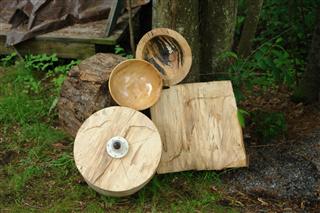
Seems like a fun idea to turn balls of as many different types of wood that I can get my hands on, so I started with what I had in my shop. Here's what I've got so far!
>In case anyone is interested in the process, here's how I made the balls in my previous post. Since I made my first ball yesterday, I am by no means an expert, and this process is that taught by Dick Sing, so all the credit goes to him!
Anyway, I start out with a scrap piece of wood that is slightly longer than it is square (e.g. 2" x 2" x 2.5"). I turn between centers and rough out a ball shape. Before removing from the lathe, I turn the ends down to the smallest cylinder as possible (essentially ending up with a roughed out ball shape with some small points on the two ends where it was turned between centers).
Then I mount the roughed out ball into my "ball chuck" that I made per Dick Sing's instruction. This "chuck" is essentially two cones that have cups hollowed out in the ends where the ball will sit. One thing that I found helpful is to hollow the cups deep enough so that the bottom of your roughed out ball doesn't bottom out - by this I mean that I want the cups to grip the ball around the edge and not at the bottom of the cup. This entire assembly is mounted between centers (one cup on each side of the ball). For a better explanation, see the pic.
With the ball mounted between centers in the cup "chucks", I carefully round out the shape. Then stop the lathe and rotate the ball slightly and repeat the process. I simply keep repeating this process until I have a perfect ball shape. At a certain point, I call it quits with the gouge and switch to sandpaper - I found that power sanding produces a perfect spherical shape. Just sand, stop the lathe and rotate the ball and repeat as many times as is necessary working through the grits of sandpaper until you have a finished ball.
Once the ball is finished, I followed Dick Sing's finishing procedure as well. He brushes on a coat of Deft (your fingers will get dirty here!!!). I found that I take time to clean my brush and when I return, the finish is ready to be wiped dry with a paper towel. Then I take the ball back to the lathe to be buffed with the Beall buffing system.
I had a lot of fun with this project and plan to do more in the future. One nice thing about turning balls is that I found that I can make one start to finish in less than an hour.
>I've never seen Osage that color. Are you sure. I'd sure like to get some with red in it. Mine has always been bright yellow turning to a rich tan as it ages. Good job on the balls. They are fun.
I could be wrong on the Osage - I picked up a small chunk from Rockler and it wasn't labelled. I gathered that it was Osage from other pieces in the pile and the signs seemed to indicate that it was all Osage Orange - I may have gotten it wrong? I haven't ever truned Osage Orange, but whatever that piece was, I'd like to get more of it as it turned beautifully! The shavings smelled pretty good - they had a hint of citrus.
>That makes sense. When I was at Rockler, I picked up several small pieces of wood and two happened to be Osage Orange and Tulipwood. The stacks of wood weren't well labelled, and never having worked with either, I assumed that the reddish piece was Osage Orange and the lighter piece was Tulipwood - from your comments, sounds like I might have gotten them mixed up.
Here's the other piece that I thought was Tulipwood, but sounds like it may be Osage Orange?
>I just recently finished making the perfect egg chuck from a 1 1/2" PVC Dresser Coupling filled with Bois d'Arc, and have been turning eggs like crazy. Now I'm going to try turning some balls. :o)
>Thanks for the clarification guys - I'm glad to know especially since the Tulipwood turned so nicely. I'd like to get a bigger piece of Tulipwood sometime!
I guess that the OO will have to wait til next weekend!
>Brian That wood looks more like lemonwood than osage but it's hard to tell without them side by side. Usually Osage has a more pronounced summer winter grainvariation that is quite noticeable. Lemonwood and yellow heart are very smooth with no apparent grain or figure.
>That looks about the same color and texture as what I've seen called Argentine Osage - really a misnomer if our only reference is the usual Osage we see here in the States. This has a lot tighter grain and cuts very clean, not as coarse as the usual stuff. Plus, the color actually changes to orange over time instead of the tan brown color. Polishes well, too. I think a lot of people are hesitant to try it because it's called Osage.
I received your e-mail and replied last night. If you don't get my reply, post a message directed to me on the forum and I'll see that we get in touch.