We value your privacy.
We use cookies to enhance your browsing experience, analyse site traffic, and personalise content.
By clicking “Accept all”, you consent to our use of cookies. You can also choose
“Essential only” or learn more.
>It's not as easy as it sounds this time of the year for woodturners to follow the old admonition about poison ivy, oak and sumac: "leaves of three, let them be". Oh sure!
I started to post a long itchy 'dissertation' re these allergenic leaves, but in an abundance of mercy, I'll just suggest a timely site for general info that some of you might want to review. You can thank me now or flame me later as we laugh & scratch together. :)
I going after an Ambosia maple later this week. My turning buddy didn't want to get near it because it's covered with poisen Ivy. Fortunately I can handle it quite safely so I get the tree. John
>Depends upon how long since exposure, but every time I went into the bush, so to speak, I made it a point to head for the shower as soon as I returned and using a good detergent I scrubbed good all over. Can't begin to count the number of times that kept me from breaking out with the itchy stuff. Try it sometime and you will be a convert.
>Remember there are plants with three leaves that are not poison ivy. The harmless Virgina Creeper vine sometimes has three leaflets although most have 5 leaflets - it is often confused with poison ivy. Many people around here think Virginia Creeper is posion oak and stay away but that's unnecessary. A number of harmless plants have three leaflets on the end of a stem which make them look like poison ivy, but also have two more leaflets further down the stem. Some brambles have 3 leaves (but spikes). Young box elder even looks a lot like poison ivy until you look closely at how the lower leaves grow on the stem.
The real poison ivy is so thick in spots here that the woods look carpeted. It can be a small plant, ground cover, shrub, or vine. I cut down hundreds of vines from the trees here, some as thick as 4" in diameter or so. My goats help - they love the stuff. Once I was hacking at a big vine with a machette when I got squirted in the eye with a stream of liquid. Turned out to be no problem - I suspect the sap from inside the large vine was mostly water without the urushiol. I understand the problem compound is mostly on the outside of the leaves and stems.
Sometimes the vines have taken over a tree which may be dead but looks alive from the ivy leaves! The big vine will send out long stick-like branches all over the tree.
If trying to identify poison ivy, note that the leaves can look very different on different plants or perhaps in different areas. For example, most references say the leaves are shiny, but around here many of the leaves are a non-shiny green. Some are more narrow, some are very broad and quite large. In some varities the outer two leaves have a sort of "mitten" shape. (Most of those around here have this shape.) Some leaves are far more "toothed" than others. Some have lobes, some do not. The middle leaf of the three will always have a long leaf stock while the other two grow very close to the stem. The bigger vines are "hairy" with fine roots clinging to the tree.
One thing about exposure - if I touch the plants I just wash with water which is supposed to neutralize the stuff. I've read some advice to wash with soap and water and then with alcohol, but plain water seems to work as well.
>I have washed with thinner, such as paint thinner or lacquer thinner and it seems to help. Soap and warm watter seem to help reduce the amount of the oil and maybe the severity of the reaction if you wash it off soon enough. The thinner seems to help even after you are itching.
>The back yard of my first house was a small section of overgrown field that was half poison ivy. And I'm rather allergic to the stuff.
During the process of cleaning out the poison ivy, I developed a procedure that worked for me. First, minimum exposed skin, i.e. long sleeves, pants and latex gloves inside my work gloves. Then, as soon as I was done, all the the clothes went into the washer and I showered with Fels-Naptha.
But usually the contact is accidental when you're not expecting it. In those cases (and I've had more than a few), I'll still do the laundry and shower routine if the exposure was extensive. If it was just a spot or two, I've found that washing the area with household ammonia works very well. Supposedly the ammonia de-activates the toxic compounds (as does the Fels-Naptha). Another thing that I've found useful is to take an antihistamine (allergy tablet). For me it stops the development of the allergic reaction and the symptoms aren't nearly as bad.
Then there's the time that I was pulling up some dead poison ivy one summer and got it all over my arms and legs (shorts and a T-shirt). It came from the dirt that was around the roots. That case required a trip to the doctor and stronger medicine!
>I have been very lucky over the years and only got it a couple of times. I have found that if you do get it, washing the blister area with bleach helps to dry it up and keep it from spreading too much.
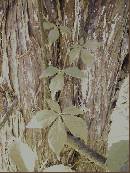
>I have to agree - this one looks like Virginia Creeper, especially that group of five leaves at the bottom of the picture.
Tomorrow morning I will be taking a group of scouts out for my 17th foray at summer camp as an adult leader. One of my first orders of business is to locate a patch of PI and identify it for the scouts. In 17 years of doing this, we have yet to have a serious outbreak of PI rash in the troop. Of course, it helps that the scout camp we are going to is 40 years old and several eradication programs have been conducted, although none have been 100% effective.
In Missouri, PI (Toxicodendron radicans) is common throughout the state, with Poison Oak (T. toxicarium) reported in only three counties, one of which is where we are going. I've only seen it once at the Ranch, and then only in a remote part. Poison Sumac (T. vernix) has never been recorded in Missouri. My nextdoor neighbor had a dandy example growing up the side of his house, until I identified it for him. With care, we can remove it come winter.
I couldn't find that picture at the link you posted, but (the good news) it is definitely not poison ivy. I agree with the virginia creeper id. Poison ivy never has 5 leaves. Virginia creeper mostly has 5 but can have some 3-leaflet leaves. (The entire set of 5 is really one leaf, called a "palmate" arrangement.
Another thing obvious from that photo: the stem lengths are wrong for poison ivy. Look at some pictures of poison ivy - the middle leaf always has a longer stock than the other two. The other two have almost no stock at all, appearing to be growing right off the main stem. In the photo, the stocks of all 5 leaflets appear to be equal.
But here is the bad news: Some people report being sensitive to virgina creeper. I've been tearing the vines down with my bare hands and certainly rub it all over my arms but have never had the slightest irritation. I think it is relatively rare, but some people claim a reaction very similar to poison ivy. This is understandable, since some people are also alergic to tomatoes, peanuts, etc. But I wonder if some of those reporting a reaction to virginia creeper came in contact with some poison ivy at the same time without realizing it. I very often see both growing intertwined on the same tree. I look VERY carefully before pulling down any creeper.
>Just curious. The fellow who sells pens made out of poison ivy, does he claim that they are designed for writers of "poison pen letters?" Pun intended.
It seems LOML is one of those folks who is sensitive to virgina creeper. She got it pretty bad a few years ago clearing the area that I need to do again this year.
Stuff is hard to kill, any ideas? We tried a few of the well known brands of Ivy Killer, but it seems to return each year.
>Before you get too comfortable with Poison Ivy and Poison Oak, etc., please remember that it usually takes an initial sensitizing exposure to "set up" the immune system for the real thing. Often a person can be exposed to Poison Ivy or some other toxic substance with no noticeable reaction. But, the NEXT exposure is the biggie! Be careful!